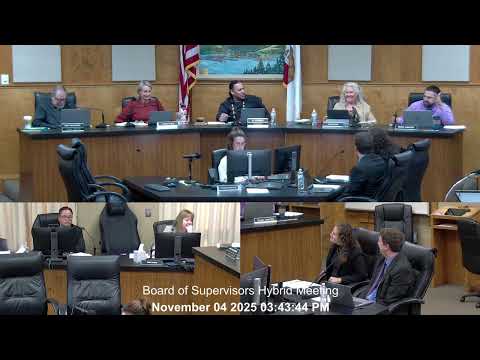
Lake County staff outlines broad cannabis ordinance changes; board favors tiered setbacks and continued drafting
Loading...
Summary
Lake County staff previewed a package of proposed cannabis ordinance amendments that would increase setbacks from residences, refine how canopy is measured, standardize permit expiration and opt-out rules, and add enforcement and restoration-bond provisions.
Community Development Director Maria Turner presented a multi-topic update to Lake County's cannabis regulatory framework on Oct. 1, proposing changes to Article 27 that would increase setbacks, refine canopy measurement, tighten application and background procedures, standardize permit expiration rules, and add a restoration bond and compliance processes.
Turner said staff prioritized items they believed would qualify for a CEQA common-sense exemption and could be advanced sooner: "Increasing the setbacks from off-site residences from 200 to 500 feet," a proposed cap on commercial canopy at 20 acres, measures to clean up incomplete or abandoned applications, synchronization of ownership/background checks with state processes, and clarifications about hemp versus commercial cannabis canopy. She also presented an option to fund a programmatic EIR focused on odor thresholds and mitigations; the consultant estimate provided to the county was about $250,000 and roughly eight months of work.
The presentation covered additional items the department will continue to evaluate: scenic corridor setbacks, synchronization of watercourse setbacks with the State Water Resources Control Board (staff cited 150 feet for perennial and intermittent water bodies, 50 feet for ephemeral), a June 1 deadline for opt-out notifications, restricting consecutive-year opt-outs, removal of the 10-year permit term so cannabis conditional use permits align with other permits, and a proposed $5,000 restoration bond to guarantee site restoration after permit termination.
Public commenters and industry representatives were split on several points. Margot Kambara of Lake County Community Action Project warned proposed changes to Measure C—s tax base (opt-out and canopy changes) may raise legal issues: "Measure C established a square footage based tax on cultivation area," she said, arguing cumulative administrative changes could alter the voter-approved tax base. Growers and processors urged caution on EIR timing and costs and urged the board not to "tax the industry out of the county," saying local competitiveness with neighboring counties is a concern.
Board members asked staff to pursue a tiered approach to residential setbacks so setback distances scale with project size and zoning; multiple supervisors supported prioritizing items that could move quickly through the planning commission process. Supervisors also asked staff to explore making retail dispensaries in some commercial zones subject to use permits rather than by-right development, align restoration-bond amounts with existing hemp-bond thresholds, and to return with a draft ordinance for planning commission review (planning commission review dates were discussed for mid-November). Director Turner noted coordination with the sheriff—s office regarding active-warrant notifications is limited by state rules but staff will add language to allow tabling of applications if staff becomes aware of active warrants.
Turner offered the programmatic EIR as an option to produce science-based odor thresholds and mitigation measures: the planning-contractor estimate supplied to staff was about $250,000 and an approximately eight-month schedule, "something to think about because it helps us when we're doing our CEQA evaluations to have established thresholds that are based in science."
No board vote was required; supervisors gave direction to continue drafting, pursue planning commission review, return with clarifying language and schedules, and to "pin" the EIR funding decision while continuing to evaluate water-impact processes with priority.
The board emphasized water resources and odor as the two highest community concerns and directed staff to pursue technical coordination with state agencies on water setbacks and to examine options to make cannabis permit rules more consistent with other land uses when feasible.