ADEQ: Circle K contamination confined to soil; remediation underway, agency disputes 86,000-gallon estimate
Loading...
Summary
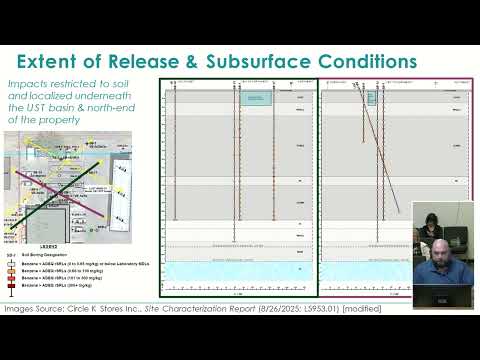
Chris Marks of the Arizona Department of Environmental Quality told the Chino Valley Town Council that soil contamination from a fuel release at the Circle K store has been characterized and remains above a clay aquitard, with no evidence to date of impact to the regional aquifer.
Chris Marks of the Arizona Department of Environmental Quality told the Chino Valley Town Council on Nov. 5 that investigators have completed site characterization for the fuel release at the Circle K convenience store and that contamination is confined to soil above a clay aquitard, with no evidence of impact to the regional aquifer.
"We have crossed the site characterization phase," Marks said. "The extent of the release, at this point, the impacts are restricted to soil." He added, "Thus, there is no current threat to a drinking water resource by any members of the community from this release."
The department summarized the investigative work: 18 soil borings (some converted to monitoring wells), four regional-aquifer monitoring wells sited between the property and nearby private wells, sampling of seven private drinking-water wells, and two soil-gas surveys to check for vapor hazards. ADEQ said the lithology under the tank basin is interbedded sands, silts and clays and that a sharp increase in clay content near 150 feet forms an aquitard that limits downward migration.
Circle K reported a suspected release in early January 2024 after a technician observed fuel spraying into the containment sump for a submersible turbine pump. The company repaired the pump and sump in February and began remediation in March. ADEQ said Circle K completed testing of system components in April and performed initial abatement in May 2024.
Circle K used soil vapor extraction (SVE) as the remedial approach. ADEQ described the remedy : extraction wells around the tank basin pull vapor-phase contamination to a treatment compound, where vapors are oxidized. "The remedial performance has been promising," Marks said, noting Circle K estimated roughly 118,000 pounds of hydrocarbons removed (a rough volatile-equivalent estimate of about 20,000 gallons) and identifying downhole confirmation borings that show reduced concentrations after about a year of SVE operation.
ADEQ also said it reviewed Circle K—s site characterization report and administratively approved the report in September, but took the extra, nonstandard step of formally documenting that it does not concur with Circle K—s operational explanation for the source and magnitude of contamination. Circle K initially provided an inventory-based estimate of about 79,000—6,000 gallons lost and later presented an environmental estimate in a 50,000—9,000-gallon range. ADEQ said multiple lines of evidence do not support a single catastrophic 86,000-gallon release from one failed pump component.
"If that volume of fuel had been released in just 18 days, that would make it essentially the most catastrophic release from a UST system in the history of this country in terms of volume over time," Marks said, summarizing ADEQ—s review of operational and environmental data. He described comparing hourly automatic tank gauge (ATG) records, delivery bills of lading (manual gauging by drivers), technician site-visit logs, monitoring-well and soil data, and the condition of the tank basin monitoring well.
ADEQ told the council that the ATG and delivery records confirm that fuel entered the tank and later left the tank at an elevated rate in the December 2023—January 2024 period, but that environmental sampling did not show the free-phase gasoline or shallow contaminant mass that would be expected if tens of thousands of gallons were lost to the tank pad in a short period. Instead, ADEQ said contaminant mass appears largely confined to a column beneath the UST basin that is consistent with either a smaller single release or longer-term, historic leaks that migrated downward over time and accrued above the aquitard.
ADEQ said one monitoring well (MW7) on the south end of the property produced a single detection of toluene that was "thousands of times below the drinking-water standard." Resampling of MW7 did not reproduce that hit, and Circle K investigated on-site septic features as a possible contributor but did not confirm a source. ADEQ also said it consulted the U.S. EPA Office of Underground Storage Tanks during its review.
Marks emphasized that regardless of the differing operational explanations, Circle K remains required to continue remediation until ADEQ can determine there is no present or future threat to human health or the environment. "They must continue compliance with the environmental laws and remediate to where there's no future threat of public health or the environment," he said. ADEQ said Circle K must submit periodic site status reports; the next periodic site status report (PSSR) is due in February 2026.
During council questions, members asked about long-term low-rate leakage, the historical ATG/inventory record, and whether ADEQ had authority to compel deeper historical investigation. ADEQ responded that tank tightness testing and reporting are regulated at the federal level, that the agency has limited additional authority beyond its enforcement role, and that some uncertainty about the historical origin of contamination may remain despite the current data review. The meeting concluded with a request that Circle K return to brief the council within 60 days.
This report is based on ADEQ—s presentation and council discussion at the Chino Valley Town Council meeting on Nov. 5, 2025.