Get Full Government Meeting Transcripts, Videos, & Alerts Forever!
Get email alerts on the Housing Zoning topic
No spam. Unsubscribe anytime.
Anchorage planning panel forwards transit-supportive overlay to Assembly as mayor's office plans pause for more talks
Summary
The Anchorage Planning and Zoning Commission voted Oct. 6 to forward a proposed Transit-Supportive Development Overlay (TISDO) and companion comprehensive-plan changes to the Assembly while the mayor's office said it would pause the ordinance after the hearing to convene more stakeholder conversations.
The Anchorage Planning and Zoning Commission voted Oct. 6 to forward a proposed Transit-Supportive Development Overlay (TISDO) and companion updates to the municipality's comprehensive plan to the Anchorage Assembly, even as the mayor's office signaled it would "put the ordinance on pause" to convene additional public and stakeholder discussions.
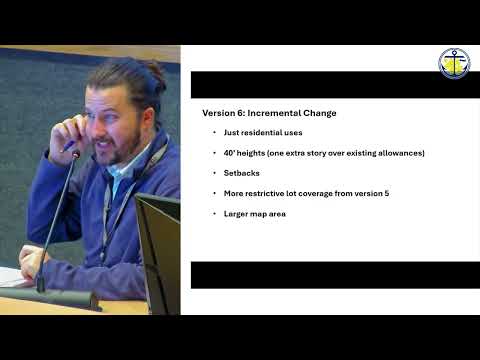
Daniel McKenna Foster, of Long Range Planning, told commissioners the overlay and plan amendments aim to concentrate housing near transit corridors and that Version 6 of the draft narrows some uses, lowers the height limit from an earlier 75-foot proposal to 40 feet, limits lot coverage to 70 percent and removes mixed-use provisions for a later, separate ordinance. "The comprehensive plan is, of course, the sort of big-picture guidance," Foster said, tracing the overlay back to the municipality's 2001 and 2017 planning work.
The commission record shows broad public engagement but sharply divided public testimony. Supporters including Jason Norris and small developers argued the overlay would unlock projects already in permitting and attract new housing, while dozens of residents and community councils urged a slower, more targeted approach, better maps and clearer analysis of parking, transit funding, drainage and seismic risk.
Graham Downey, deputy chief of staff to Mayor LaFrance, asked the commission for a recommendation and told the hearing the administration planned to "put the ordinance on pause" after the meeting to convene more collaborative conversations. "We expect after tonight that we'll put the ordinance on hold so we can convene those conversations and figure out together how we get to 10,000 homes in 10 years," Downey said.
Despite the administration's stated pause, the commission acted. Commissioner Jim Winchester moved that the commission recommend approval of the Title 21 amendment to create the overlay using map boundaries aligned with the original AO 2025-535s1 map (excluding downtown); the motion was seconded and passed. Commissioner Jeff Ron also moved that the commission recommend approval of the related amendments to the 2020 Comprehensive Plan and the 2040 Land Use Plan; that motion also passed.
Speakers on both sides urged additional, concrete work before citywide adoption. Opponents asked for parcel-level mapping, direct mail notice to affected owners, pilot areas and step-wise phasing tied to transit-service and right-of-way investments. Supporters said some projects are already shovel-ready and that doing nothing risks continued housing shortfalls and higher infrastructure costs associated with sprawl.
The record includes multiple technical tradeoffs: staff emphasized that TISDO would not change building code, fire code or environmental protections in chapter 7; that private covenants or HOAs remain enforceable; and that right-of-way and street design are separate municipal projects (for example, the right-of-way management study and design criteria manual update). Foster also described how staff considered seismic hazard zones, floodways and building-age maps when shaping the overlay boundaries.
What happens next remains a mix of process signals. The mayor's office intends to pause the ordinance to convene additional stakeholder workshops and refine technical pieces such as transit and right-of-way coordination. The commission's formal recommendations will go to the Assembly; if adopted there, implementation details (including any design standards, site-review thresholds or parking rules) will be clarified in subsequent code work.
Votes at a glance
- Case 2025-0030 (Title 21 / TISDO overlay map): Motion by Commissioner Jim Winchester, seconded by Commissioner Jared Gardner, recommending the Assembly adopt the Title 21 amendment to establish the TISDO using boundaries aligned with the AO 2025-535s1 map (downtown excluded). Motion passed (recorded vote not provided on transcript).
- Case 2025-0034 (Comprehensive Plan / 2020 and 2040 updates): Motion by Commissioner Jeff Ron recommending Assembly approval of the proposed amendments to the 2020 Comprehensive Plan and 2040 Land Use Plan; motion passed (recorded vote not provided on transcript).
What the record shows (key technical details)
- Current draft (Version 6): residential uses only (mixed-use deferred), maximum nominal height discussed at 40 feet, lot coverage reduced in the draft to 70 percent, side/back setbacks options of 0/5 and 0/10 feet discussed. - Protections retained: building and fire codes, environmental protections in chapter 7 (seismic, stormwater, drainage, waterway encroachments), landscaping and screening requirements. - Complementary efforts noted: right-of-way management study, downtown engineering study, design criteria manual update, Vision Zero work and the archives property RFP in Midtown.
The commission record and the breadth of public testimony make clear that further technical analysis and localized outreach will shape any final ordinance. The administration's stated intention to pause for additional stakeholder convenings means the next months will likely focus on pilot-area design, transit-service coordination and detailed mapping before an Assembly decision.