
Assembly repeals municipal cottage‑food licensing to align with state law after debate over raw‑milk language
Get AI-powered insights, summaries, and transcripts
Sign Up Free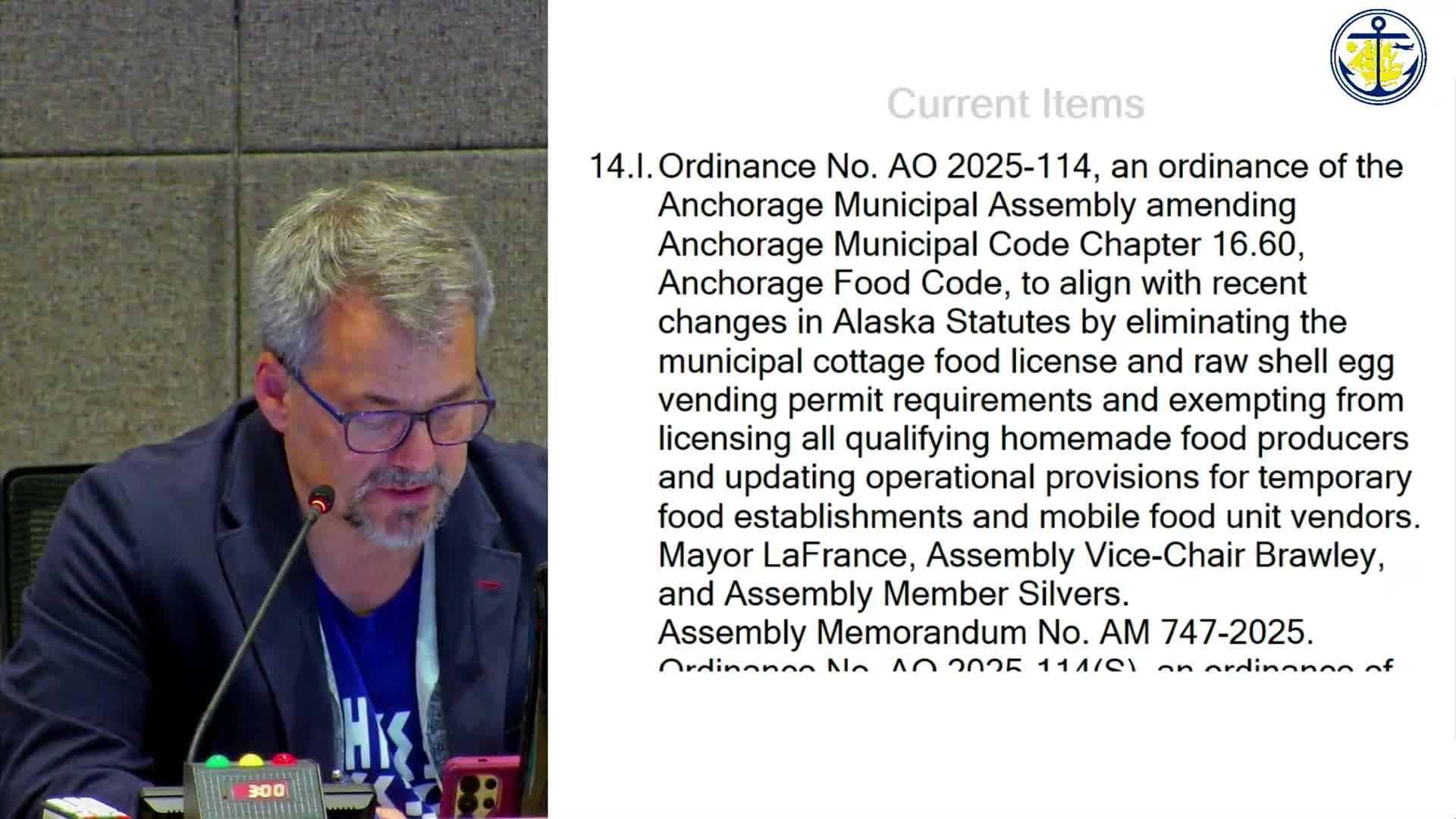
Summary
The Assembly voted unanimously Nov. 4 to amend the Anchorage food code, removing the municipal cottage food license and aligning the code with recent state statute and administrative code changes; a proposed substitute clarifying raw‑milk authority failed after extended debate.
The Anchorage Assembly adopted AO 2025‑114 on Nov. 4, amending the municipal food code to remove the municipal cottage food license and to align local rules with recent changes in Alaska statutes and the Alaska Administrative Code governing qualifying homemade food producers, temporary food establishments and mobile food units.
Representatives from Anchorage Community Land Trust and local cottage producers testified in favor, saying the municipal cottage food license placed a cap and other restrictions that limited small businesses and that there are too few affordable commercial kitchens in Anchorage for producers to scale. One baker described how cross‑contamination risks in shared commercial kitchens make certain specialty products (gluten‑free; celiac‑safe) impractical to prepare outside a dedicated home operation.
Assembly members debated a substitute amendment that would explicitly reference the applicable state registration and administrative code governing raw milk and raw milk products. Health department staff and legal counsel advised that primary regulation of raw milk is a state function and that the substitute would largely codify existing state practice rather than create a new local regulatory program; some members favored the clarity the substitute would provide, while others said adding local code language risked confusion. The substitute failed on a recorded vote and the main ordinance passed unanimously, 12–0.
The ordinance is intended to reduce regulatory barriers for early‑stage food entrepreneurs while preserving public‑health protections under state law. The health department noted remaining alignment tasks (for example, acceptance of food‑handler cards across jurisdictions) that may be addressed in future rulemaking.