Get Full Government Meeting Transcripts, Videos, & Alerts Forever!
Get email alerts on the Capital Improvement Program topic
No spam. Unsubscribe anytime.
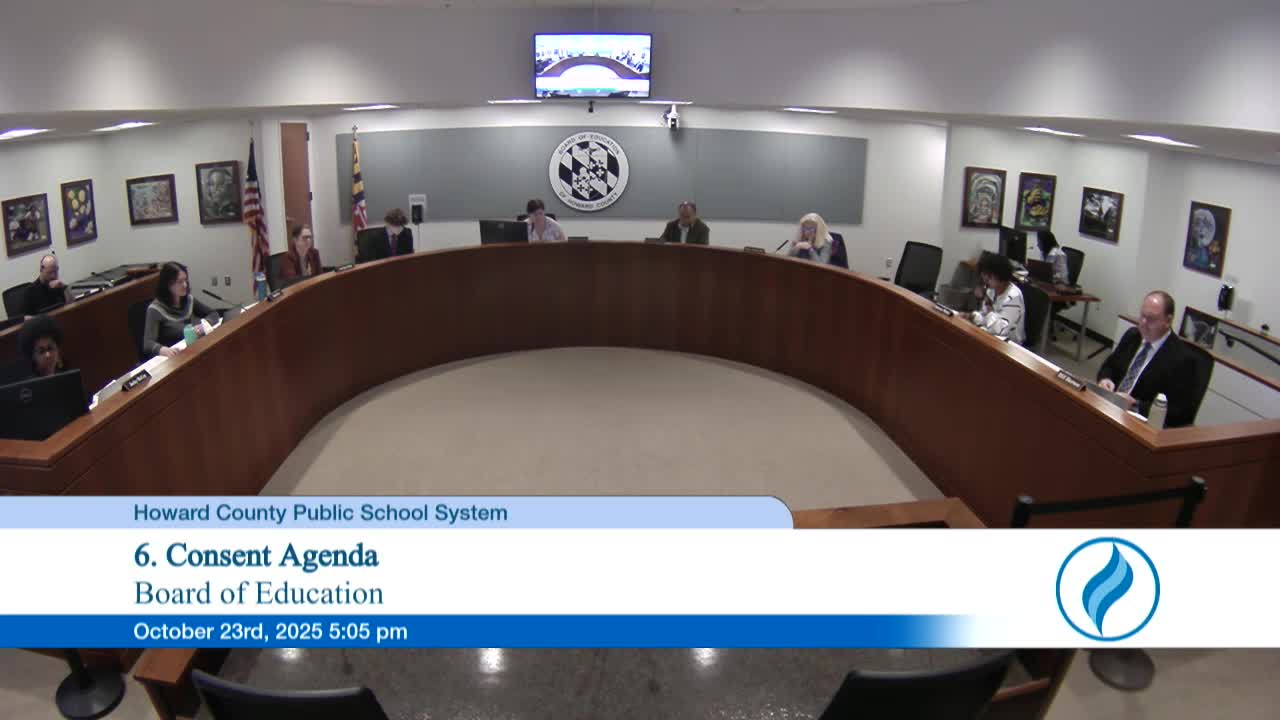
Howard County board weighs alternatives for FY27 capital budget as parents press for Centennial renovation
Summary
Dozens of parents, students and community groups urged the Howard County Board of Education on Oct. 23 to follow the district—s data-driven facilities prioritization and use part of the state—s Build to Learn funds toward renovating Centennial High School rather than the Oakland Mills project included in the superintendent—s FY27 proposal.
Dozens of parents, students and community groups urged the Howard County Board of Education on Oct. 23 to follow the district—s data-driven facilities prioritization and use a portion of state Build to Learn funding to renovate Centennial High School rather than the Oakland Mills project included in the superintendent—s FY27 proposal.
At the start of a public hearing on the FY27 Capital Improvement Program, student speakers from Centennial and Oakland Mills described mold, HVAC failures, overcrowded hallways and broken portables. "In 2022, the renovation completion date changed from 2031 to 2033, and in 2023, went from 2033 to 2036," said Sylvia Johnson, a Centennial student, summarizing what she said were repeated delays in the school—s schedule.
Why it matters: The district has a constrained local capital envelope and a one-time state Build to Learn allocation that must be assigned to eligible large projects by the state. How the board and superintendent apply the board-approved prioritization criteria and newly commissioned programmatic data will affect which schools receive major construction funding over the next decade.
What staff presented: Superintendent Michael Barnes told the board that the FY27 proposed local ask lifts up roughly $170 million of district needs and seeks approximately $90 million in local funding, of which staff estimate about $55 million may realistically be available. He and chief operating officer Cornell Brown said most of the request addresses deferred maintenance (HVAC, roofs and other systems) and systemic projects; a headline item in the proposal is a $12 million local allocation connected to a major construction project (the current proposal identifies Oakland Mills High School as the large project paired with Build to Learn funds).
Barnes framed the work as "a convergent point between old practices and new practices," and asked for board direction ahead of a Nov. 6 vote. "Every student and staff member deserves to learn in and work in an environment that is conducive to teaching and learning," he said.
Alternatives and eligibility: Capital planning staff presented four modeled alternatives for applying Build to Learn and state CIP funding. The options ranged from using Build to Learn on Oakland Mills Middle/High projects to substituting Centennial High School or splitting funds among multiple projects (elementary additions and smaller renovation packages). Dan Lubley, executive director of capital planning, noted that Build to Learn is administered by the Maryland Stadium Authority and carries eligibility rules (a minimum project construction cost threshold and the same state eligibility review). Staff said using the funds across multiple projects could lower local-year demands but might complicate cash-flow and matching requirements.
Public testimony and concerns: Parents and community organizations — including the Chinese American Parent Association, the PTA Council (PTAC) and numerous Centennial advocates — said the district—s April 9 facility prioritization list (developed through board-approved criteria) ranks Centennial as the highest-need high school and should guide FY27 choices. Multiple speakers cited the board-approved facility prioritization, deferred maintenance problems (e.g., leaking ceilings, burst HVAC that damaged classrooms earlier this year), and local growth pressures.
Board discussion and next steps: Board members pressed staff for side-by-side scoring detail comparing Centennial and Oakland Mills using the board-approved criteria and the staff—s project-level scoring. Several board members asked staff to publish the scoring templates and a line-by-line comparison before the Nov. 6 vote. Staff committed to provide the scoring spreadsheets and to return with alternative budget packages, clarifying the short-term local funding impacts of each option.
Context and constraints: Staff emphasized two points that shape near-term choices: first, the board previously affirmed some items in the long-range master plan that carry forward into the short-term CIP; second, a separate project-level scoring system was applied to prioritize smaller local projects (elevators, roofs, HVAC) and can change short-term ordering even where the larger building ranking remains unchanged. Dan Lubley highlighted that shifting how Build to Learn is allocated can change the district—s local-match requirements and the district—s timeline for achieving construction milestones.
What the board did not do: No final funding decisions were made on Oct. 23. The superintendent asked for board direction and said staff would return with more detailed alternatives for a November 6 approval vote to satisfy county council timelines.
Ending: The district will publish the comparative scoring analyses requested by board members and return Nov. 6 with budget packages that reflect any board direction on how to apply Build to Learn funds and the FY27 local project mix.