Get Full Government Meeting Transcripts, Videos, & Alerts Forever!
Get email alerts on the Hauser Mf16 Rezoning topic
No spam. Unsubscribe anytime.
Planning commission rejects MF‑16 rezoning after neighborhood concerns about sewer, traffic and floodplain
Summary
The commission voted down a proposed MF‑16 rezoning for the Hauser family property after residents cited sewer failures, traffic and historic‑district compatibility concerns. Staff had recommended medium‑density; applicant offered to downgrade from MF‑24 to MF‑16.
The Planning Commission considered a rezoning request from the Hauser family (R25‑62) to allow medium‑high density multifamily on a roughly 1.7‑acre site. Applicant representative Jake Chavis (Odyssey Engineering) said the original MF‑24 request had been reduced to MF‑16 after discussions with architects and staff.
Staff described MF‑16 as a medium‑density designation typically located along arterial and collector roads and said the request aligned with goals of the Comprehensive Land Use Plan. The applicant noted adjacency to commercial and multifamily properties and argued the site could act as a transition between downtown and single‑family areas.
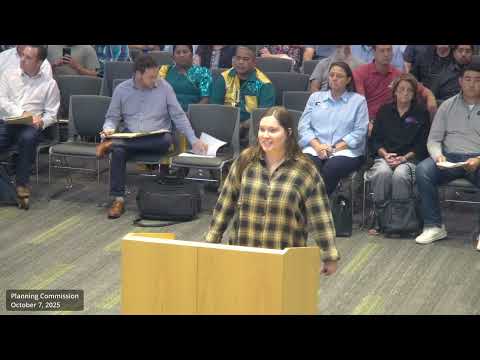
Residents from Mill Street and neighboring blocks provided detailed public comment. They raised repeated concerns about sewer infrastructure failures (reports of backups and low water pressure), flooding on the Greenway and adjacent floodplain, pedestrian and vehicle traffic impacts (including large trucks and limited intersection capacity), and compatibility with the neighborhood’s historic fabric (several homes were described as built in the early 20th century). Several speakers asked whether sewer and traffic studies would be completed before any approval.
Staff responded that infrastructure constraints would need to be addressed with a future development plan and that any development plan could trigger traffic or sewer studies, parking requirements, and floodplain review. Staff also discussed the local SEED (Springdale Elective Enhancement District) and form‑based code (NC‑2) options that could produce building types (duplexes, triplexes, fourplexes, rowhouses) more compatible with the historic neighborhood.
After listening to public comment and staff discussion, the commission voted 7–2 to deny the MF‑16 rezoning. Commissioners said they favored additional conversation about form and building type and noted the site had significant floodplain that changes how development could be sited. The applicant was advised of appeal rights to city council, and staff noted that applicants may pursue a form‑based/SEED approach or return with a revised application addressing utility and traffic concerns.
Speakers relevant to this item: Jake Chavis (Odyssey Engineering); Sharon (staff planner); Alisa Snow (resident, 804 Mill Street); Ray (resident, 615 Mill Street); Randy Cook (resident, 100 Rhodes Avenue); Jeff Bowen (resident, 604 Mill); Nathan Gardner (resident, 760 Mill Street); Bridal Guerra (resident, 519 Mill Street).
Actions: The commission denied the MF‑16 rezoning request (outcome: failed 7–2). Staff instructed the applicant about the appeal process, and recommended further infrastructure analysis and consideration of a form‑based code/SEED approach for better neighborhood fit.
Why it matters: The decision preserves the current neighborhood character pending further infrastructure upgrades or a design approach that better addresses floodplain, traffic and sewer constraints. It also signals commissioner preference for form‑based or SEED zoning in sensitive historic transition areas.
What’s next: Applicant may appeal to City Council within 15 days or pursue a SEED/form‑based code rezoning and submit a development plan that addresses floodplain, sewer and traffic engineering requirements.