
Planning commission recommends approval of six‑story, mixed‑use redevelopment at 702 University City Boulevard amid neighborhood opposition
Get AI-powered insights, summaries, and transcripts
Subscribe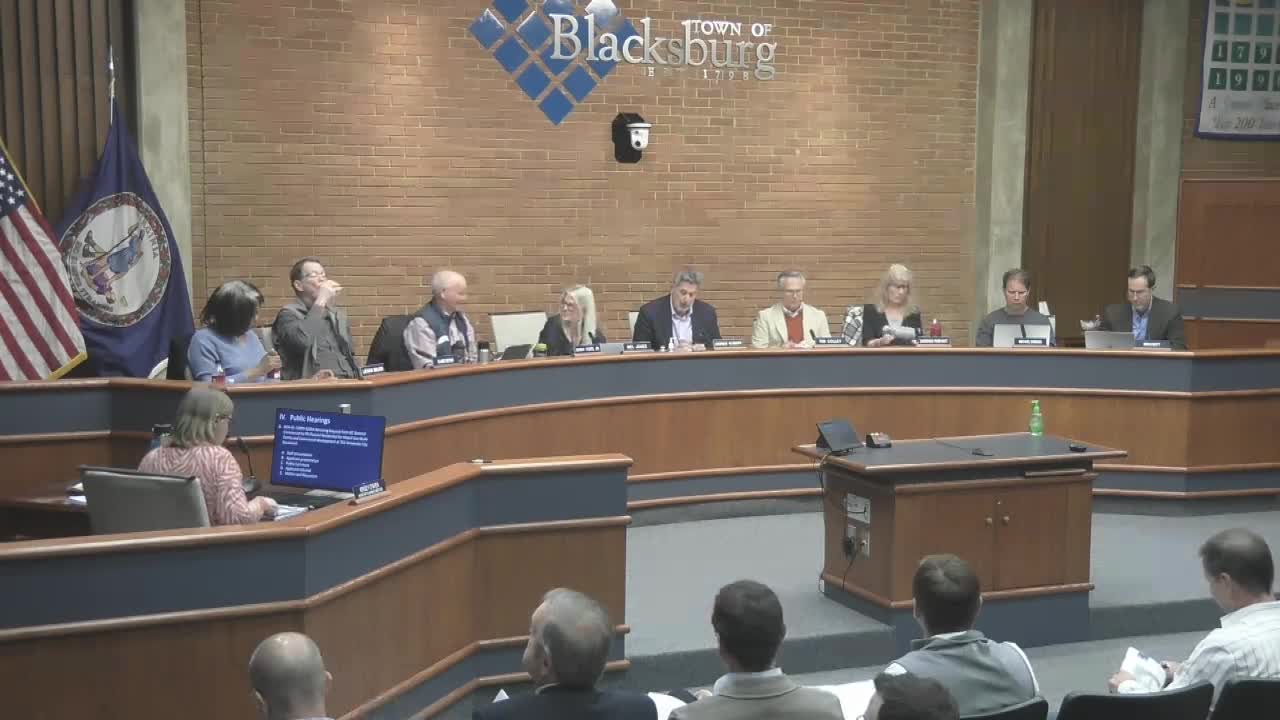
Summary
The Blacksburg Planning Commission on Nov. 4 recommended approval of a rezoning that would allow a six‑story mixed‑use redevelopment at 702 University City Boulevard containing roughly 836 bedrooms and on‑site proffers including 12.5% affordable units for a minimum of 50 years.
The Blacksburg Planning Commission on Nov. 4 voted to recommend approval of a rezoning request (Rezoning 25‑7 / Ordinance 2094) that would allow a single six‑story, mixed‑use building on about 4.5 acres at 702 University City Boulevard. The applicant proposes approximately 836 bedrooms (about 180 bedrooms per acre), a parking ratio of roughly 0.56 spaces per bedroom, at least 12.5% of units set as affordable for a minimum of 50 years, and about 30% open space largely provided through terraces and rooftop amenities.
Staff presentation Kenzie O’Shea, planning staff, said the property is currently zoned General Commercial and is designated commercial on the town’s future‑land‑use map, inside a broader “mixed‑use” bubble. The applicant requests rezoning to the Planned Residential (PR) district, which allows flexibility in district standards in exchange for binding proffers. Staff noted several areas where the application differs from typical standards: the applicant proposes roughly 5% tree canopy (the multifamily standard cited was 10%), about 30% usable open space (exceeding the 20% minimum), and a small commercial footprint (about 5,000–7,500 sq. ft., roughly 2% of the PR land area).
The application calls for a range of unit types (one‑ to five‑bedroom units) and proposes occupancy limits tied to family +2 or no more than one person per bedroom for unrelated residents. Staff also said water service is adequate but that sanitary sewer upgrades and road improvements on University City Boulevard would be required and are the applicant’s responsibility because there is no current CIP funding for those improvements.
Applicant case and changes Josh Fassbinder of Ascent Property Company argued the project advances comprehensive‑plan goals by adding housing supply, promoting walkability and concentrating student housing in a location the applicant says can absorb higher density. The development team described design changes following community and staff feedback: a 7.5% reduction in density from earlier submittals, modest increases in parking to 0.56 spaces per bedroom, additional articulation and setbacks that the team said reduced beds, and an increase in retail area to about 6,300 sq. ft. Jeff Solisco of Antunovich Associates described vertical articulation and building setbacks that removed 12 beds and created more usable open space; the team said they now propose more street‑facing amenity and retail space than in earlier versions.
Affordable housing and enforcement A town staff member (Matt) explained that the town would not operate the affordable units but would verify ongoing compliance (income verification and compliance monitoring) during the affordability period. The applicant proffered on‑site affordable units (12.5%) and said it would accept an administrative compliance program recommended by the town for verification during the proffered 50‑year period.
Public comment and neighborhood concerns Public comment ran more than an hour and included multiple residents and neighborhood representatives. Key concerns included:
- Scale and compatibility: Residents living in McBride Village and adjacent single‑story homes said a six‑story building within roughly 35 feet of some backyards would “tower over” one‑story houses and alter neighborhood character. Kaylin Carey (836 Hutchison Drive) said she spoke for 168 petition signers “strongly opposing this rezoning request.” Annika Schmurer (709 Hutchison Drive) and others described loss of sunlight and the project’s incompatibility with the neighborhood’s existing scale.
- Traffic and pedestrian safety: Speakers cited heavy traffic on University City Boulevard and Price’s Fork Road, pedestrian danger crossing four lanes to reach campus transit stops, and an asserted VDOT ranking of parts of the corridor among Virginia’s higher pedestrian‑risk corridors. Multiple commenters urged substantial pedestrian and crossing improvements before allowing new high‑density development.
- Loss of commercial uses: Several business owners and office tenants said the site contains class B office that has been difficult to lease since COVID and urged preserving commercial space or designing for office, not only retail. Commenters raised concerns that the proposed retail footprint would not replace lost office capacity or serve local business needs, and that demolition could remove vital services such as a daycare.
- Enforcement and behavior: Residents asked how occupancy limits, noise and parking would be enforced; speakers said they observe limited enforcement of occupancy limits in single‑family rentals and worried the same problems would migrate to a large, multi‑bed building.
Applicant response and proffers The applicant said it had reduced scale in response to feedback, offered management commitments (on‑site professional management 24/7, a no‑noise policy and eviction for violations) and said it would replace trees and seek to preserve existing canopy. The team reiterated that existing offices are largely vacant (they said roughly 60% vacancy) and argued redevelopment with housing is economically necessary to revive the site.
Commission discussion and vote Commissioners debated the project at length. Several commissioners highlighted the comprehensive plan’s role as community guidance and expressed concern that the site is designated commercial on the future‑land‑use map; others noted the PR district is designed to allow negotiated flexibility and that the applicant had offered significant proffers, notably the long affordability term. Commissioners also acknowledged that traffic and pedestrian safety improvements are needed but said many of those improvements require outside funding or lengthy planning and that the town’s immediate tools are limited.
After discussion the commission moved to recommend approval of Rezoning 25‑7 with the applicant’s proffers. The motion passed on a voice vote recorded in the meeting; the transcript does not include a complete roll‑call tally. The recommendation will advance to Town Council for final action.