Get Full Government Meeting Transcripts, Videos, & Alerts Forever!
Get email alerts on the Budget 2025 26 topic
No spam. Unsubscribe anytime.
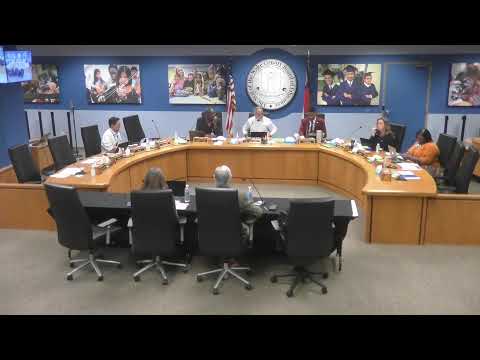
Wake County committee reviews budget adjustments after state —mini— budget; minutes approved unanimously
Summary
The Wake County Board of Education Budget & Finance Committee on Nov. 4 unanimously approved the Oct. 28 committee minutes and reviewed staff recommendations to reconcile the board—s proposed 2025'026 budget with the county appropriation and recent state action under House Bill 125.
The Wake County Board of Education Budget & Finance Committee on Nov. 4 unanimously approved the Oct. 28, 2025 committee meeting minutes and reviewed staff recommendations to reconcile the board—s proposed 2025–26 budget with the county—s final appropriation and recent state actions, including House Bill 125.
Staff said the changes are necessary because the General Assembly did not enact a comprehensive two-year state budget. Instead, lawmakers passed a limited "mini" budget (House Bill 125) that included technical adjustments affecting statewide Department of Public Instruction funding. "I want to stress that House Bill 125 is not a comprehensive state budget for a two-year period; I—ll call it a mini budget," a senior district finance presenter told the committee.
Why it matters: the committee—s recommendations will be packaged as a formal budget resolution to present to the full board on Nov. 18. The recommended adjustments affect revenues and expenditures across state, federal and local lines and include one-time fund-balance appropriations and short-term local coverage of program gaps.
State and federal changes Staff told the committee that the district—s anticipated state funding is roughly $62.6 million less than the estimate used when the board approved its proposed 2025–26 budget. That gap reflects narrower state compensation actions than the board had assumed, differences in employer matching rates, and a delay or incompleteness in state growth funding allotments. The presenter said the legislature—s action did include a roughly $104 million technical adjustment at the DPI level that restored certain prior-year funding statewide.
On compensation, the presenter said House Bill 125 authorizes step increases for many certified staff (teachers, certified instructional support, assistant principals), but noted that a number of salary steps are plateaus where moving from one step to the next does not change the dollar amount. As a result, some certified employees will receive no salary increase even though they advance a step. The presenter also said most school principals, central-office administrative and classified staff (including bus drivers, child nutrition workers, custodians and instructional assistants) are not covered by those step increases under the state action.
Federal funding is higher than the board—s estimate because several federal grants ended the prior year with larger-than-anticipated carryovers. Staff reported about $17.7 million in additional federal carryover resources (restricted DPI grants ~$10.2 million; direct federal grants ~$7.2 million; USDA ~$312,000; ROTC ~$35,000) and clarified that those increases are carryovers, not newly allotted federal funding for 2025–26.
Local and one-time fund-balance items Kimsey, the district—s senior budget director, told the committee local revenues are about $9.9 million higher than in the board—s proposed budget. The county commissioners fully funded the district—s requested county appropriation (staff noted a roughly $32,000 rounding increase), and staff have recorded several fund-balance appropriations approved since July 1: a $2.0 million targeted-assistance appropriation, roughly $600,000 from the Jewel and Altria settlement for an academic spending plan, and about $300,000 for a property-insurance gap. Staff said the remainder of the settlement funds remains reserved in fund balance.
Expenditure-side savings and costs Staff identified approximately $13.6 million in expenditure savings (including a roughly $5.2 million late state allotment that offset local spending, $4.5 million from lower-than-expected local compensation requirements, and $3.5 million from lower employer matching costs). At the same time, staff listed about $13.2 million in new or increased costs: a $3.2 million utility adjustment after closing the prior fiscal year, $2.5 million added to targeted assistance (bringing the total for this year to $4.5 million), a $1.8 million local supplement to preserve literacy coach positions after federal funding was restricted, a roughly $1.8 million reduction in career and technical education (CTE) funding from the state that the district will cover this year with local dollars, and other adjustments including $1.5 million to cover salaries/benefits from improved fill rates and higher legal costs.
Literacy coaches and CTE specifics Staff explained that the district had been paying literacy coaches from a mix of state and federal sources (state, early intervening services, Title IV). After July 1, the state told the district it could no longer charge 2.5 months of those positions to early intervening services because the district is designated as being in disproportionality; staff said they moved some costs to Title II and are proposing $1.8 million in local funds to keep the affected literacy coach positions whole for the current year. Separately, the state—s redistribution of CTE monies produced an unexpected reduction in the district—s CTE allotment (roughly $1.8 million); staff said teachers are already hired and the district will temporarily cover the shortfall with local funds.
Net position, risks and next steps When staff netted the identified savings and new costs, the result at the time of the presentation was a modest net savings of about $400,000 in the district—s over/under account. Staff characterized that amount as a fluid, in-year figure that will continue to move as additional allotments, growth funding, or unanticipated costs are recorded. Staff also identified monitoring risks for the remainder of the year: potential changes to state compensation policy, uncertain state growth funding (expected late November or December), charter-school enrollment-driven transfers, child nutrition revenue/cost balance, transportation fuel and contract variables, and the annual unemployment-insurance reconciliation.
Staff told the committee they will place a budget resolution reflecting these adjustments on the Nov. 18 full-board agenda and will continue to provide monthly budget packets showing changes after the resolution.
Action taken The committee voted to approve the Oct. 28, 2025 Budget & Finance Committee meeting minutes. Vice Chair Swanson moved approval; Dr. Ing seconded. A roll-call vote was taken to capture remote members— votes; the committee recorded unanimous approval.
Community impact and context The adjustments described affect multiple program areas and staff groups. Staff emphasized that some changes are one-time (fund-balance appropriations or carryovers), while others (for example, reduced state CTE funding or limits on federal funding sources tied to disproportionality findings) require local coverage this year and could affect planning for 2026–27. The presenter noted that operating budgets remain fluid throughout the year and that staff will return with monthly updates and any amendment recommendations.
The committee adjourned after brief board member questions and a request to present the formal budget resolution Nov. 18.