Get Full Government Meeting Transcripts, Videos, & Alerts Forever!
Get email alerts on the Public Participation topic
No spam. Unsubscribe anytime.
Equestrian community and residents press Kitsap planners for complaint data, transparency and grandfathering clarity
Summary
Dozens of residents and members of an equestrian working group told Kitsap County planners on Oct. 7 that staff had not provided enough complaint data or transparency to justify proposed equestrian-code changes.
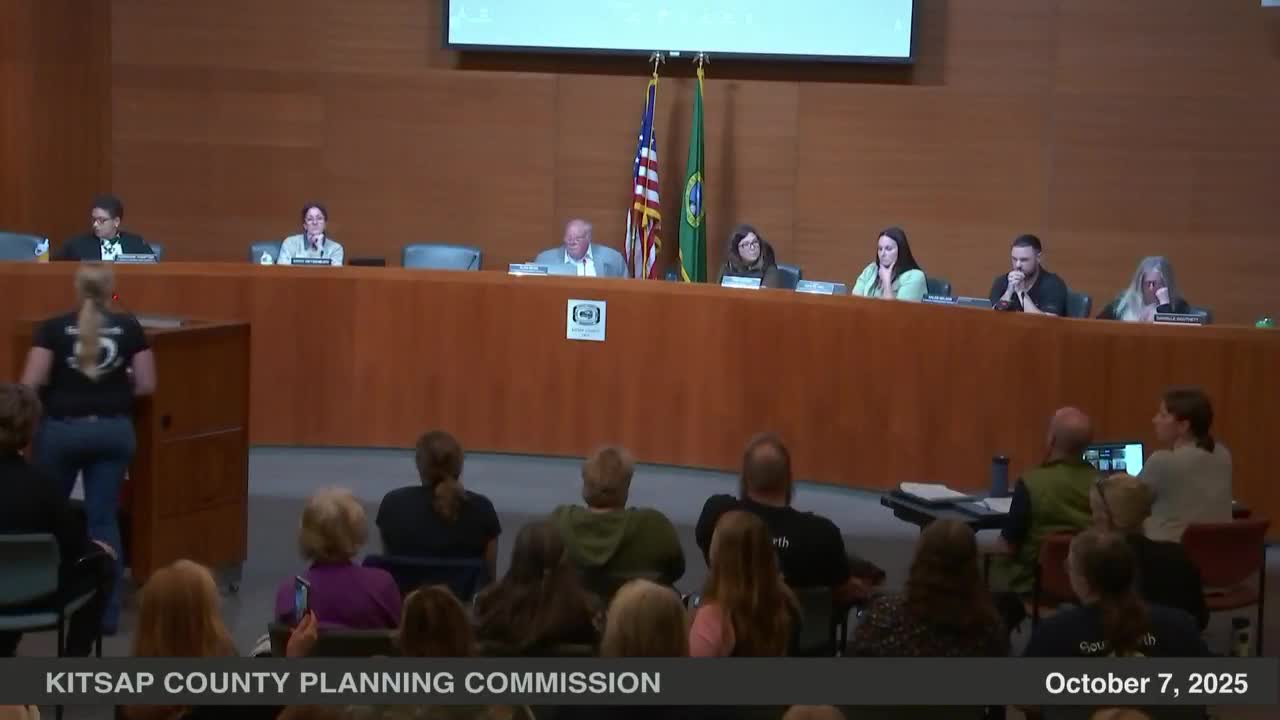
Dozens of residents and representatives of Kitsap County’s equestrian community used both public‑comment periods on Oct. 7 to press planning staff for greater transparency and precise answers about how any new equestrian rules would affect existing operations.
Speakers repeatedly requested that the county compile and disclose complaint records and case outcomes that staff said triggered the code‑change effort. "We were all incredibly disappointed on how that meeting went," said Jessie Olson, a member of the equestrian working group, after describing Thursday’s working‑group meeting. Several speakers said they had submitted public‑records requests and were still waiting for complaint files.
Several public commenters also raised broader concerns: Deborah Gates, an environmental attorney, cited the Growth Management Act’s public‑participation provisions and objected to holding a single public meeting on Sept. 11, 2025, which she described as a holiday of remembrance. "The only public meeting was held on 09/11/2025. That was designated as a holiday and a day of remembrance and day of service," Gates said in her remarks. Other speakers urged staff to prioritize enforcement of waste and encampment issues over new restrictions on equestrian properties.
Speakers from youth and nonprofit equine programs warned of potential collateral harm if code changes make facility operation more costly or uncertain. "If Year of the Rural were to go into place, 4 out of these big 7 organizations would be at risk for closure," said Miles Paden, a youth speaker who listed local organizations that serve youth through equine activities.
Multiple speakers asked for written assurances about grandfathering and nonconforming‑use treatment for existing equestrian operations. Planning staff told commissioners the proposed code would not be retroactive and noted county practice allows a two‑year window for legal nonconforming uses to be reestablished after abandonment. Staff also said the county lacks a formal registry of existing commercial equestrian operations and is considering guidance and clearer code language to address the issue.
The Oct. 7 comments series ended with the commission voting to continue deliberations to Oct. 21, which staff said will allow time to refine language, summarize complaint records and publish working‑group materials.