Get Full Government Meeting Transcripts, Videos, & Alerts Forever!
Get email alerts on the Year Of The Rural topic
No spam. Unsubscribe anytime.
Staff outlines 'Year of the Rural' proposals: childcare, equestrian code, agriculture updates and three reclassification requests
Summary
Kitsap County planning staff on Oct. 7 presented the "Year of the Rural" comprehensive‑plan chapter and draft code changes covering childcare, equestrian facilities and agriculture, and outlined three reclassification requests.
Kitsap County planning staff gave an extended presentation on Oct. 7 describing the "Year of the Rural" project, proposed code updates and three property reclassification requests.
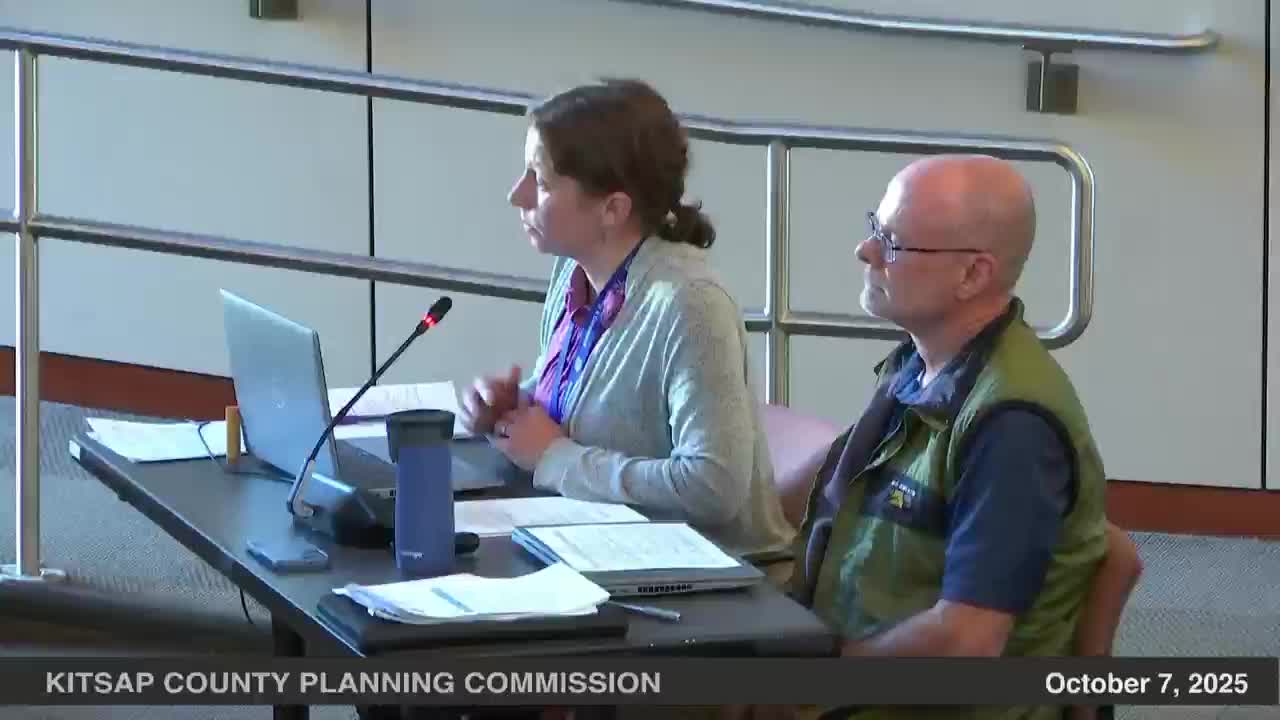
Heather Cleveland, long‑range planner and lead on the project, said the package includes a new rural and resource lands chapter for the 2024 comprehensive plan, proposed code language on childcare, equestrian facilities and agriculture, and three reclassification requests (staff reports with findings were shared for each request). She told commissioners that staff had compiled more than 300 public comments from a Sept. 2–23 public comment window and that the deliberations matrix will be updated to reflect points from those submissions.
On childcare, staff proposed aligning local definitions with state definitions and adding a permitting pathway so child-care centers and in‑home daycares can operate in most rural zones (staff said the changes would exclude greenbelt and rural-industrial zones). Cleveland said staff reviewed past conditional‑use permits for child‑care uses and designed conditions intended to avoid a formal CUP/hearing‑examiner process for eligible projects.
On equestrian facilities, staff said the proposal is intended to address land‑use compatibility where new or expanded commercial equestrian operations may affect neighboring parcels. Cleveland emphasized the proposed code is not intended to be retroactive and that thresholds for when upgrades or new paddocks would trigger permitting requirements are still being refined. She said staff convened an equestrian facility code working group (10 members: three representatives per district plus a Kitsap Conservation District representative) and scheduled additional working‑group meetings to draft code revisions.
On agriculture, staff reported recommendations from an agriculture steering committee to permit shipping containers for agricultural use and to remove certain outdated code language. Cleveland said staff were exploring ways to notify neighbors when agricultural activities begin adjacent to residential areas, and that an agriculture advisory council had not previously been established largely for staff‑capacity reasons.
The three reclassification requests were presented in individual staff reports with findings of fact: one (Scribe/McCormick) had a tentative recommendation for approval, a second (Moran) had no recommendation pending resolution of active code‑compliance issues, and the third (Stokes/Campbell) was conditionally recommended with a suggestion to remove one parcel and aggregate buildable parcels to address critical‑area constraints.
Staff said the project will continue through the working‑group process, additional deliberations and eventual review by the Board of County Commissioners. Commissioners asked for clearer evidence — including complaint summaries, examples and legal context — to support code changes before making final recommendations.