Get Full Government Meeting Transcripts, Videos, & Alerts Forever!
Get email alerts on the Municipal Budgets topic
No spam. Unsubscribe anytime.
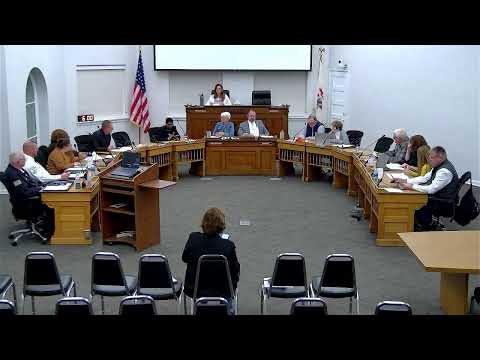
Freeport finance committee reviews 2026 water, sewer and storm budgets; major capital projects outlined
Summary
Manager Boyer, the city manager, presented the draft 2026 operating and capital budgets for Freeport’s water, sewer and stormwater utilities and described multiple large capital projects and equipment replacements the city plans to pursue next year.
Manager Boyer, the city manager, presented the draft 2026 operating and capital budgets for Freeport’s water, sewer and stormwater utilities and described multiple large capital projects and equipment replacements the city plans to pursue next year.
Boyer said the city budgeted about $3,600,000 in grant revenue for the water fund, $1,600,000 in residential service revenue (including a CPI-based water-rate increase) and $2,100,000 in capital-improvement surcharge revenue. He told the committee the budget includes an expected $100,000 payment from a PFAS settlement and that the city lowered its interest-income projection to about $250,000 for next year.
On the expense side, Boyer said staff reorganized labor categorizations and noted a $2,900,000 line for contracted infrastructure repairs and maintenance that includes the lead service-line replacement program (Phase 3), new fencing at Carroll Tank and a Willow Tank inspection. He identified $75,000 for expansion of Brick Street cold-storage building and $150,000 for mains and manholes that include seven “eye” hydrants designed to transmit acoustic pressure data and aid in locating breaks. The budget also includes funding for safety barricades, replacement machinery (a truck with crane), another arrow board and a pull-behind sign board.
For sewer operations, Boyer said residential sewer revenue is roughly $3,000,000 and the draft budget anticipates a $1,500,000 transfer from the Land Road TIF to help build the Walnut Street lift station next year. He said chemical costs are up and the sewer operating budget sets aside $175,000 for chemicals, $200,000 for engineering and equipment and plant outside services to support pump, boiler and piping work. The sewer budget includes $20,000 for outside lab testing for perfluorinated compounds in anticipation of future EPA regulation.
On wastewater capital, Boyer described completion of wastewater treatment plant Phase 1 as requiring an additional $30,000,000; he said that project is funded by an EPA loan and that the city received $5,000,000 in loan forgiveness. Park and Galena lift stations were flagged for upgrades including pump and controller work and generator installs; Boyer said generator costs on some stations could be in the range of the amounts budgeted (Park/Galena generators were listed in the materials as roughly $1,900,000 total, and Walnut lift station $1,500,000). He said sewer lining, manhole lining and clarifier maintenance are also included in the capital plan. Meadow Brook sewer expansion was listed at $1,200,000; West Demeter sewer work was also included alongside road replacement plans.
Boyer reviewed the water capital 5‑year plan. He said next year’s water main replacements associated with roadway projects are budgeted at about $820,000 and identified lead service-line Phase 4 at $2,700,000, which he described as 100% forgivable loans from the Illinois Environmental Protection Agency. Remote-site resilience was a recurring theme: Boyer proposed installing a backup generator at Carroll Tank and noted many remote sites currently lack dedicated backup power.
The committee also reviewed vehicle and equipment requests for utilities (a 10‑yard dump truck and an F‑550 with crane among items) and discussed the need for cranes when lifting pump shaft assemblies from wet wells.
Boyer closed the utility presentations with a review of pension-related budgets: the fire pension budget shows approximately $815,000 in city contributions and $360,000 in employee contributions with about $3,900,000 in retiree benefits and roughly $4,500,000 in projected invested proceeds; the police pension budget shows roughly $445,000 in city contributions and $370,000 from employees with similar invested-proceeds assumptions. He noted investment-management and bookkeeping fees for both pension funds.
The presentation drew questions from committee members about scope and timing: Alderman Stacy asked which water-main phases were pending loans and Boyer replied the city will seek grants or EPA loans and pursue outside funding as available. Committee members also asked how many storm inlets the $300,000 storm-inlet budget would address; Boyer said inlet replacement costs are typically $10,000–$15,000 apiece and the city expects to target batches of structures (he referenced a program that could target approximately 50 inlets in packages to accelerate replacement).
Manager Boyer framed several items as contingent on external funding or scheduling (for example, federal or Illinois EPA grant/loan timing and TIF transfers). No formal budget votes were taken at the meeting; the presentations were informational and intended to guide the remainder of the budget process.
Ending: The committee concluded the presentation with no immediate formal actions on the budgets; staff will return with ordinance language, funding details and final budget documents later in the process.