Get Full Government Meeting Transcripts, Videos, & Alerts Forever!
Get email alerts on the Labor Relations topic
No spam. Unsubscribe anytime.
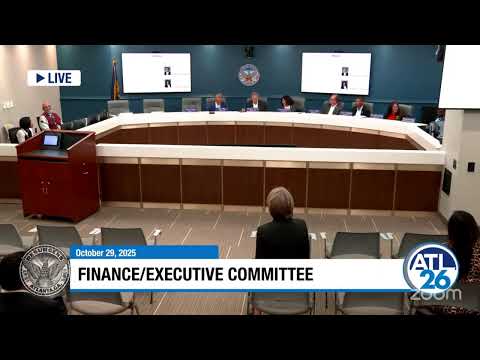
Finance committee advances substitute to let CFO set rules for payroll dues deductions; unions urge protections
Summary
The Atlanta Finance and Executive Committee advanced a substitute ordinance that would let the chief financial officer establish administrative standards determining which employee organizations are eligible for payroll dues deduction, while explicitly preserving deduction status for five currently authorized organizations.
The Atlanta Finance and Executive Committee advanced a substitute ordinance on Oct. 29 that would give the city chief financial officer authority to promulgate administrative standards for payroll dues deductions for employee organizations, while explicitly preserving the deduction status of existing recognized employee organizations.
The substitute includes a clause that "nothing in this ordinance shall interfere with the current designation of the International Association of Firefighters as the sole and exclusive bargaining agent" for Atlanta Fire Rescue under the Firefighters Mediation Act; it also lists five currently authorized organizations that would retain dues-deduction status. Committee members voted to move the substitute forward with time for affected organizations to review the text before final council action.
Why it matters: The change would shift future determinations about which employee groups can receive payroll deduction for membership dues from an ad hoc legislative process to rules set by the CFO. Proponents say a standardized administrative process creates due process and equal treatment; critics say it risks weakening longstanding recognition and voice for existing employee organizations.
Public comment featured several labor leaders. Vince Champion, regional director for the International Brotherhood of Police Officers and National Association of Government Employees, told the committee the change raises questions about whether the measure is meant merely to permit payroll deductions or to alter which organizations are recognized to speak for employees at budget hearings. "If it's just taking dues from an organization...we don't have any issue with having dues deducted," Champion said, adding that the recognition aspect—who is allowed to speak for employees—was central to his concerns (00:03:12).
Gina Pagnotta, president of PACE, said PACE supports payroll deductions but objected to draft language that she said struck PACE from recognition and removed the code's community-of-interest language. "Long as it's in there, not strike out that we don't exist," Pagnotta said, asking that PACE remain listed in the municipal code as a recognized civilian union (00:06:39).
Other commenters representing or speaking about firefighters and fire unions urged a single recognized representative for sworn firefighters. Alvin Rashad (Local 134) and Nate Bailey (president, Atlanta Professional Firefighters) described previous certification votes and court-mediated processes used to determine exclusive representation. Tyler Nelson, president of the Progressive Firefighters of Atlanta, said his group is seeking payroll deduction for its fraternal organization's members and argued it is not seeking collective bargaining rights (00:15:45).
Committee action and next steps: The substitute clarifies that existing deductions for the International Brotherhood of Police Officers; the International Association of Firefighters; the American Federation of State, County and Municipal Employees; the Professional Association of City Employees; and the Georgia chapter of the Federation of Public Service Employees remain authorized. The committee voted to move the substitute forward under the condition that the item would not be placed on consent at the upcoming council meeting, giving the affected organizations time to review the substitute and raise concerns prior to Monday's council agenda.
What the ordinance does not change: Department of Law staff and the substitute language stated the change only addresses payroll deduction procedures. It does not alter statutory bargaining designations provided by state law (for example the Firefighters Mediation Act) or existing memorandum-of-understanding processes the city uses to acknowledge employee organizations.
Looking ahead: The committee forwarded the substitute for council consideration, and members asked the administration and the unions to meet with council offices to resolve outstanding concerns before final council action.