Kittitas County reviews sheriff family budget; staff outline options to address multi-million-dollar general fund shortfall
Loading...
Summary
Kittitas County staff presented the sherifffs office and related public-safety budgets and outlined potential steps to address a multi-million-dollar general fund deficit.
Kittitas County staff presented the sherifffs office and related public-safety budgets during the boardfs Oct. 13 preliminary budget meeting, detailing personnel, operating and capital requests and identifying options to reduce a multi-million-dollar general fund deficit.
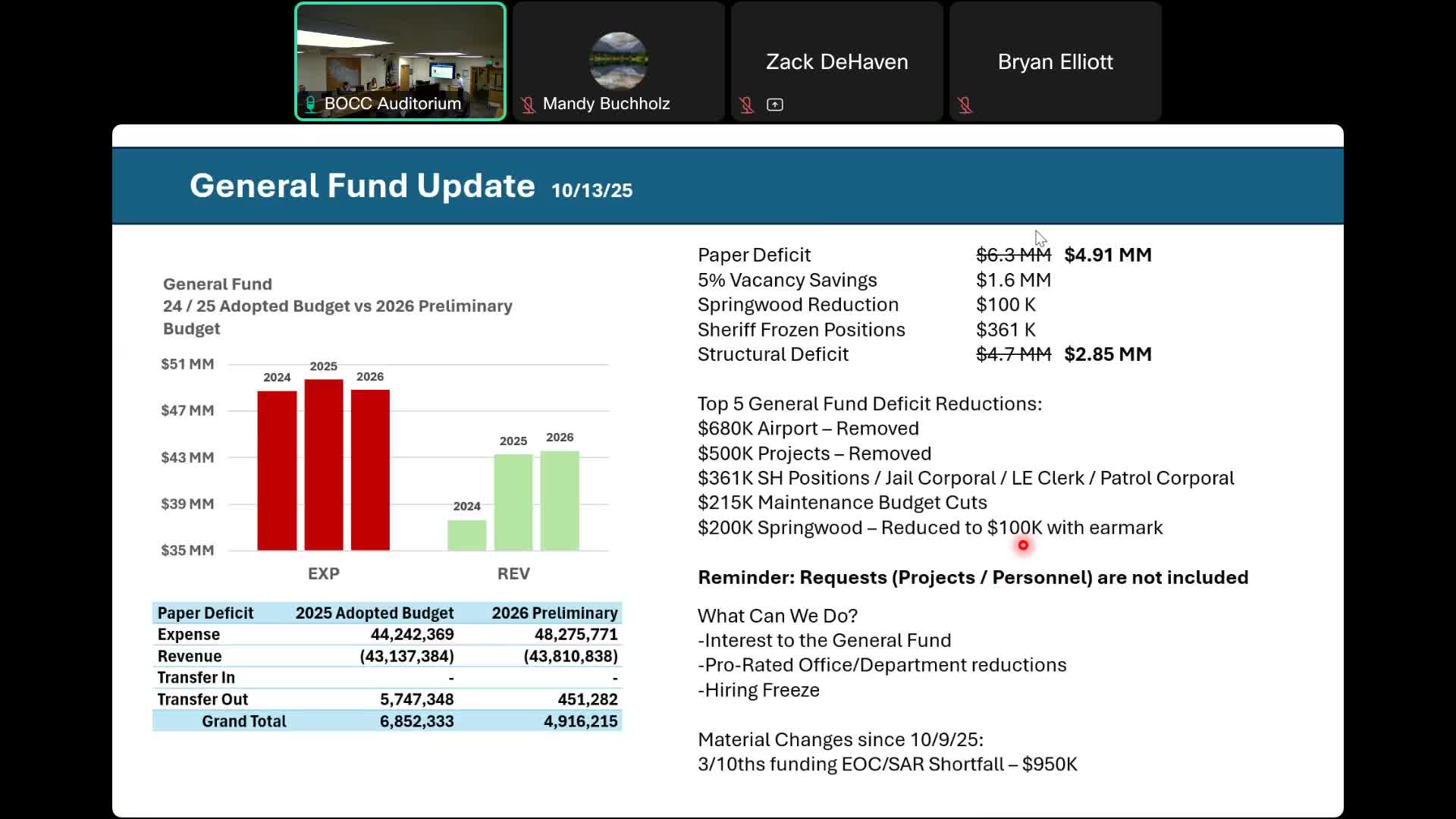
County budget staff said the countyfs "paper deficit is 4.91. With those same reductions, we're looking at $2.085," and outlined mitigation options including reallocating non-staff special revenue and internal service funds, prorated department reductions, and a potential hiring freeze. Staff said vacancy-savings estimates and additional detail would be provided at a subsequent study session.
A material change since earlier presentations, staff said, is that the county's 3-tenths criminal justice fund will provide about $950,000 toward the EOC STAR building project to complete phase 1. Staff noted that is a one-time allocation that does not directly reduce the general fund deficit but improves overall funding flexibility for the project.
Staff described the "sheriff family" as including the sheriff proper, corrections, the fire marshal, emergency management and criminal justice partners. Across that family, staff said about 85% of costs are covered by the general fund, 14% by the 3-tenths criminal justice fund, and 1% by the mental-health tax; capital expenditures are largely vehicle replacements.
Revenue-side changes include a projected increase in charges for services tied to jail bed rates, which staff said is a significant rise from 2025 to 2026. Staff also noted a decline in some federal grant revenues and that corrections-related operating costs rise with population, for example increased food costs attributed to higher jail populations.
Capital and equipment items discussed included five vehicle replacements, two enterprise leases for detective vehicles, IT capital projects, a lease-based Axon camera/taser program being moved off ARPA funding, and an evidence-room reorganization with donated password lockers and new equipment to improve evidence climate control and processing. For the evidence-area climate control and a training-room conversion, staff proposed six mini-split units; commissioners questioned whether a system-level evaluation would be preferable to multiple mini-splits.
Commissioners discussed a generator replacement request that will require rewiring and could differ from the existing unit; staff said an electrical engineer will determine the scope and cost. Commissioners generally indicated support for preliminarily approving capital requests "with funding assignment to be decided later" rather than removing them from the list.
Other items: ongoing jail rehabilitation was described as funded from a one-time jail reserve. A proposed K-9 program included a $35,000 one-time start-up figure with staff saying they were "extremely confident that at least that much will come in" through donations; ongoing operating and training costs would be covered through a foundation or other donor mechanism, staff said. A proposed mobile command post tied to a Law and Justice Council grant had insufficient funds at present.
On methodology, a commissioner asked why 2025 comparisons used adopted rather than amended budget figures; staff said they use the adopted budget for consistency but agreed to add clearer footnoting in future materials to show where later amendments (such as union contract changes) affect comparisons.
No formal votes on sheriff-specific line items, generator replacement or mini-splits were recorded in the transcript; staff will return with additional cost estimates and funding-source recommendations at a future study session.