Zoning commission hears Day 2 of omnibus text amendments on balconies, decks and lot frontage
Loading...
Summary
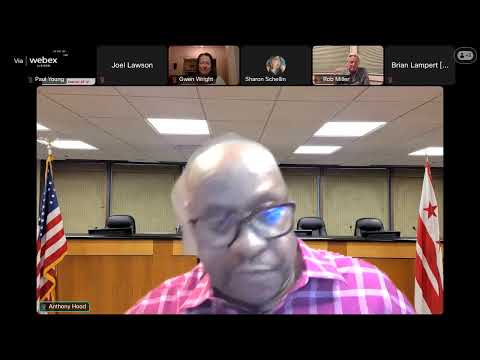
Chairman Anthony Hood convened the Zoning Commission’s second hearing on the omnibus S‑12 text amendments, which would exempt certain balconies from GFA and lot‑occupancy calculations, exempt limited ground‑floor deck area from lot occupancy, and clarify 30‑foot lot‑frontage rules for record‑lot creation in RF and RA zones.
Chairman Anthony Hood convened the second of six public hearings on the omnibus zoning text amendment case S‑12 and outlined four topics for discussion: how balconies count toward gross floor area (GFA/FAR), whether balconies count toward lot occupancy, a proposed ground‑level deck exemption, and clarification of the 30‑foot lot frontage rule for subdivisions and record‑lot creation in RF and RA zones.
The Office of Planning presented the proposals and rationale. Joel Lawson, Associate Director for Development Review at the DC Office of Planning, said the amendments are intended to ‘‘remove unnecessary barriers to housing’’ and ‘‘add clarity to the zoning regulations’’ while not proposing rezoning or changes to permitted uses or heights. Lawson described the first proposal as a straightforward change: ‘‘to exempt balconies, whether inset in from, or extending out from the facade by 8 feet or less from gross floor area’’ so that balconies are not disincentivized by counting against FAR. He told the commission that a matching 8‑foot depth exemption is proposed for lot‑occupancy calculations for open balconies.
The Office of Planning also proposed a 200‑square‑foot exemption for certain ground‑floor decks from lot‑occupancy limits, intended primarily to reduce the number of area‑variance and special‑exception cases generated by modest decks on sloping or small lots. Lawson said the 200‑square‑foot figure was chosen based on common BZA practice and would not exempt covered decks; any deck area above 200 square feet would count toward lot occupancy. OP additionally proposed adding outdoor lifts to the list of elements excluded from building area for ADA accessibility; access ramps are already excluded.
On lot frontage, OP said it will retain the minimum‑frontage requirement but clarify where it applies in RF and RA zones, avoid re‑triggering the rule for long‑standing tax lots created before ZR58, and add special‑exception relief where appropriate. Lawson described the package as intended to ‘‘remove impediments to housing’’ and to be consistent with Comprehensive Plan policy where possible.
OZ Legal Division proposed a procedural next step: Jacob Redding said OZLD would prepare a summary of testimony and opposition points and suggested the commission ‘‘consider proposed action on all of the items at the public meeting on November 20’’ so deliberation and decision‑making could be done with the summary available.
Office of the Attorney General Noel Wurst testified in support of the proposals she judged to promote housing production and reduce regulatory burdens, noting the potential for freed GFA to enable larger units or additional units, and the possibility that cross‑subsidization could benefit inclusionary units.
Public testimony split along predictable lines. ANC 6C Vice Chair Mark Eichenwald said ANC 6C supports exempting inset balconies from FAR but recommended excluding RF zones from the exterior‑balcony lot‑occupancy exemption, citing privacy concerns where rowhouses sit ‘‘cheek by jowl.’’ Eichenwald also urged reducing the proposed ground‑deck exemption to the smaller of 150 square feet or 8 feet of depth and recommended tightening the treatment of stair landings so applicants cannot effectively ‘‘double‑dip’’ by counting the same area as a noncontributing landing plus an exempted deck.
The Committee of 100, represented by Aiden Jones, urged caution, arguing the changes could reduce GFA used to calculate inclusionary zoning requirements and have other unintended consequences. Jones asked the commission to consider the tradeoffs carefully before broadly exempting balconies and decks.
Advocacy groups pressed the opposite view: Dennis Sandros of DC YIMBYs testified that the reforms would increase livability, expand outdoor access, and reduce unnecessary BZA cases. Will Tayes of the AIDC advocacy committee said the proposals would provide designers flexibility, promote better building articulation, and help add housing on unique lots. The Citizens Association of Georgetown submitted written testimony raising concerns about unintended consequences in historic districts and asked that the record remain open for follow‑up.
Commissioners praised aspects of the package while flagging issues for further work. Vice Chair Michael Miller repeatedly noted the heavy BZA caseload caused by small decks and balconies and said removing disincentives is a reasonable approach; Miller asked whether an exemption might affect the IZ calculation. Lawson and OAG both responded that exempting balconies from FAR could enable equivalent interior GFA and did not necessarily reduce IZ in practice, because the freed floor area can be used to create more or larger enclosed units subject to IZ. Several commissioners asked OP for additional detail on how many BZA cases would be eliminated by the deck exemption and whether the RF zone should be treated differently.
ANC and neighborhood testimony centered on privacy, neighborhood character, and the scale of any exemptions. ANC 6C’s suggested narrowing of the deck exemption and the request to prevent ‘‘double‑dipping’’ landings were the clearest drafting items commissioners said they expect OP to revisit. Several commissioners and commenters suggested a narrower test for applying the 30‑foot frontage clarification so the change would relieve burdens for true irregular or legacy lots without creating opportunities to assemble lots into new flag or rear‑lot development that would evade intended frontage review.
No formal votes were taken at the hearing. The commission accepted OZ Legal’s offer to prepare a summary of testimony and opposition points to support deliberations and signaled it intends to consider proposed action at the public meeting on November 20, 2025. Commissioners asked OP to return with clarifying edits and data (for example, breakdowns of BZA cases by zone) before final action.
The hearing was adjourned with the commission scheduling related omnibus items for further sessions on November 5 (additional parking and alley/garage items) and subsequent evenings in the series. The record remains open for written testimony and exhibit submissions until the close specified in the record.