Get Full Government Meeting Transcripts, Videos, & Alerts Forever!
Get email alerts on the Housing And Homelessness topic
No spam. Unsubscribe anytime.
Kitsap staff outline shelter openings, funding streams and recent affordable-housing projects
Summary
Kitsap County human services and housing staff told the Planning Commission on Oct. 21 that the county has opened a 75-person co-sheltering facility that accepts pets, is expanding severe-weather shelter operations, and is using a mix of CDBG, HOME, Consolidated Homeless Grant and local sales-tax/SEIA funds to preserve and produce affordable housing.
Kitsap County staff briefed the Planning Commission on Oct. 21 about shelter operations, homelessness outreach and the county's affordable-housing financing programs.
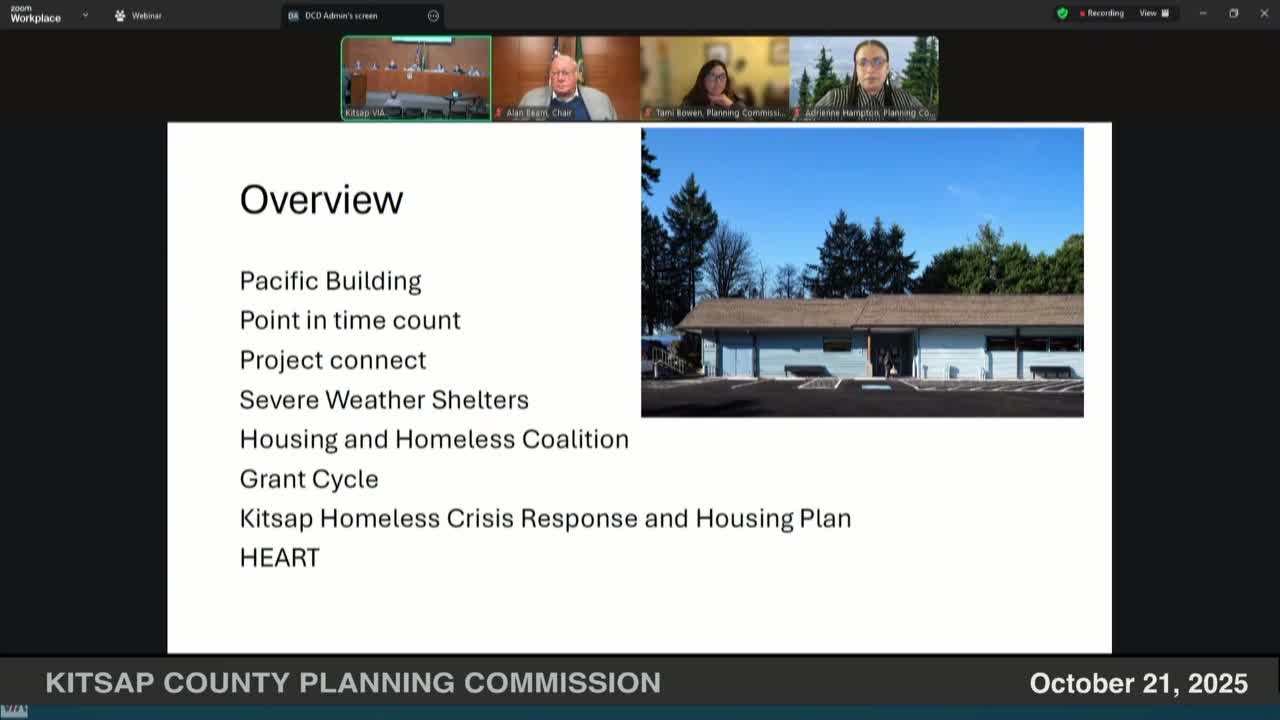
Human Services report: Carl Borg, housing/homelessness program manager, described the Pacific Building, a 75-person shelter that uses a co-sheltering model and accepts residents with pets (staff said the facility had 10 dogs, 10 cats and several other small animals in its intake). Borg outlined outreach work by the HEART team and scheduled Project Connect service fairs (Silverdale Jan. 27, Port Orchard Feb. 28, Bremerton Feb. 29) and noted that severe-weather shelters open when temperatures are forecast to drop below 32—0F for four hours.
Funding programs: Bonnie Tufts, manager of the county's CDBG and HOME programs, and Joel (Community Investments and Affordable Housing program) reviewed federal and locally authorized resources used in combination for projects: Community Development Block Grant (CDBG), HOME Investment Partnership funds, the Consolidated Homeless Grant (CHG), Housing and Essential Needs (HEN), and locally authorized sales-tax and recording-fee pools (SEIA/Community Investments and Affordable Housing). Tufts and Joel emphasized that federal funds carry compliance requirements and long affordability periods; projects commonly require multiple funding sources stacked together.
Recent project examples: staff highlighted recent county-supported projects and the county's role in financing acquisitions and preservation.
- Wyatt & Madison (HRB/Housing Resources Bainbridge): county participation of about $1.1 million toward an approximately $3.9 million total project to acquire 13 newly constructed units serving low-income households.
- Wheaton Landing (East Bremerton): staff said the county contributed roughly $1.5 million of county HOME/SEIA funds toward an $8.0 million acquisition of 24 units targeted to households at 0—0% AMI in the Bremerton School District; staff said the project was in lease-up.
- Evergreen BrightStart: described as a 30-unit acquisition supporting young adults (18'4) with wrap-around services; county funding was about $4.0 million toward a roughly $10.9 million total project.
Barriers and implementation considerations: staff and developers raised recurring barriers to new affordable housing: agency capacity to manage complex financing stacks, impact and permit fees that affect project feasibility, long planning and permitting timelines that increase cost risk, and the operational funding gap (capital funds are available for acquisition or construction but operations and supportive services are harder to finance). Tufts noted CDBG is best used for rehabilitation and HOME/SEIA are better suited for acquisition/new construction and downpayment assistance.
Why it matters: planners said the county faces a shortfall of land capacity for affordable units in the 0—80% AMI band. County staff emphasized coordination between land-use planning and programmatic funding; staff said many responses will require partnerships among DCD, Human Services, housing authorities, nonprofit developers and regional/state funders.
Next steps: staff said they will continue cross-department coordination, issue an addendum to the comp-plan EIS in early November, and use the county's annual RFP/grant cycles to distribute HOME, CDBG and SEIA awards for pipeline projects.