
County utilities director outlines local water portfolio, conjunctive management and how developers secure supply
Get AI-powered insights, summaries, and transcripts
Subscribe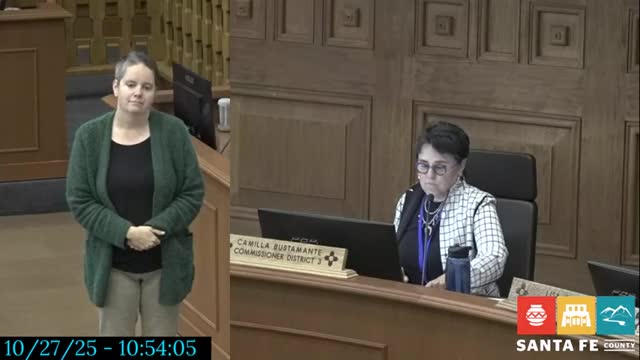
Summary
Travis Soderquist, director of Santa Fe County Utilities, told the board the county’s water portfolio is a mix of native Rio Grande rights, a small San Juan‑Chama allotment, developer‑acquired rights and access to the Buckman shared pool, and that county policy treats groundwater primarily as a supplemental, multi‑year backup through conjunctive management.
Travis Soderquist, director of Santa Fe County Utilities, told the commission the county utility maintains a mixed portfolio that includes native Rio Grande rights, a 367 acre‑foot portion of San Juan‑Chama rights assigned to the county, developer‑acquired rights assigned at the Buckman Direct Diversion, and access to the shared BDD pool that the city and county use for operational flexibility.
Soderquist described the county’s approach to “conjunctive management”: acquiring surface and groundwater rights and managing them together so groundwater serves mainly as a supplemental or emergency source, with accounting rules (a proposed multiyear rolling average) intended to store and preserve aquifer levels rather than use groundwater annually to its full permitted volume.
On new development the county requires a water budget that assigns an expected volumetric demand to a project (staff said a common planning value for a single‑family connection is 0.25 acre‑feet per year, though applicants may bring rights or pay a fee‑in‑lieu). Soderquist described the Line Extension and Utility Extension Agreement processes, and said county staff review availability and BDD capacity before approvals. He explained that water‑right transfers and new right applications are regulated by the State Engineer and can be protested and take years in complex cases.
During Q&A commissioners asked about the Rancho Viejo well transfer and the potential for alternative well sites, the availability of San Juan‑Chama water to purchase or lease, and county participation in wastewater treatment and effluent use; Soderquist said leases exist but permanent water is limited and that county participation in the city’s wastewater/return‑flow project would require negotiation of ownership and of the effluent stream under the existing intergovernmental agreement.
Soderquist also described county wastewater infrastructure projects (interceptors, lift stations and a planned expansion of the county reclamation plant) that are coordinated with growth and could affect how treated effluent is used in the future.