
Alabama Supreme Court hears dispute over private advisory committee and forfeiture clause in Banks estate
Get AI-powered insights, summaries, and transcripts
Sign Up Free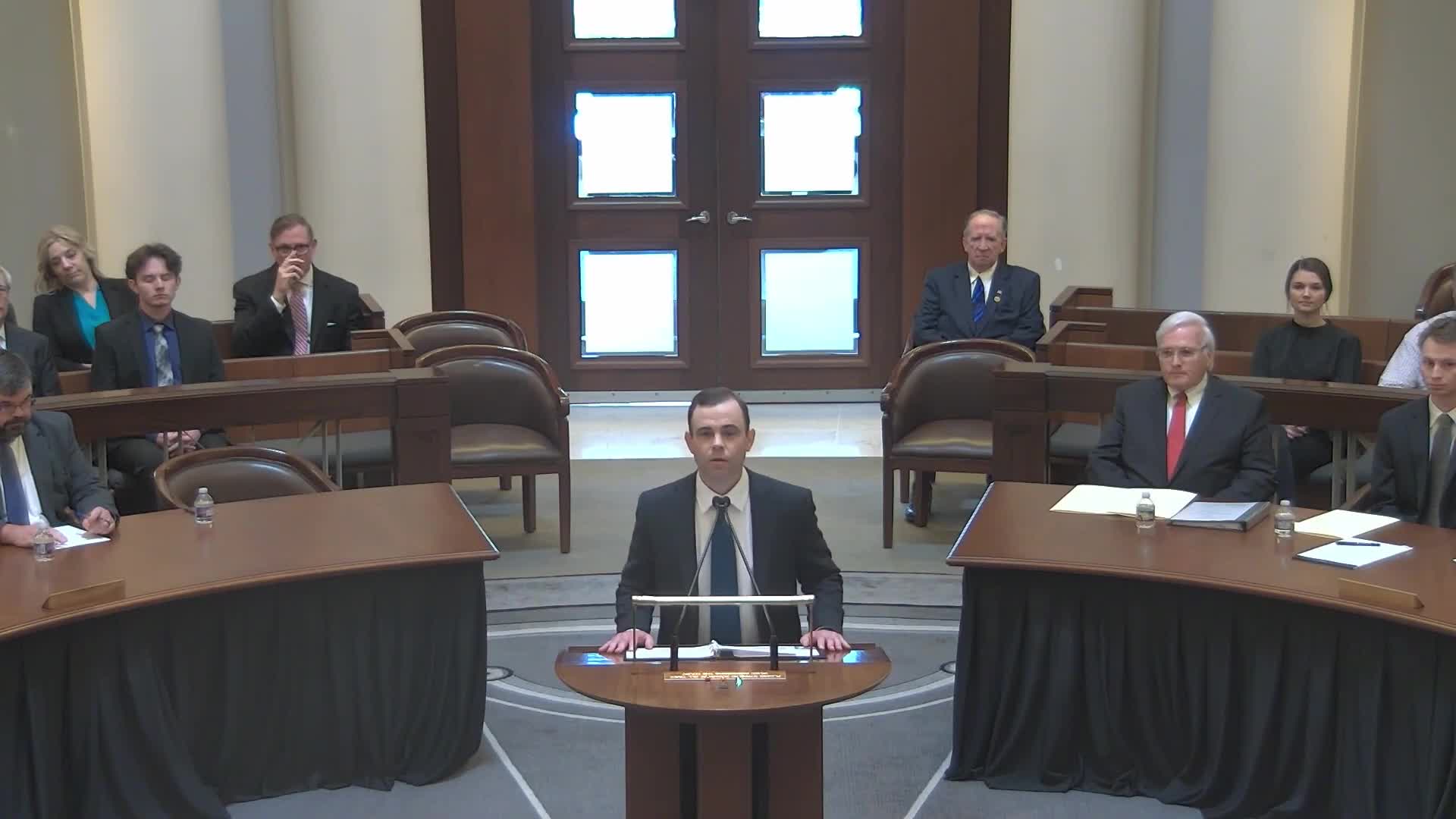
Summary
At oral argument before the Supreme Court of Alabama, counsel for the appellant argued a will provision that refers disputes to a private advisory committee and a related forfeiture clause cannot be used to deny a beneficiary the statutory right to an inventory and accounting.
At oral argument before the Supreme Court of Alabama, Chris Hamer, counsel for appellant Grant Banks, urged the court to rule that a will provision requiring disputes to be resolved by a private advisory committee and a related forfeiture clause cannot be used to deny a beneficiary the statutory right to request an inventory and accounting. "The case before the court this morning is unprecedented," Hamer told the justices, arguing that the trial court—s referral to a nonjudicial advisory committee "abdicated its judicial function." (00:01:22)
Hamer told the court that Grant, then a minor, sought only an inventory and accounting — not to contest the will—s dispositions — and that Alabama law and the Alabama Uniform Trust Code protect beneficiaries— rights to information. "Petition for inventory and accounting is not an impediment to administration; it's participating in the administration," Hamer said, urging the justices to construe any forfeiture provision narrowly. (00:44:27)
Chip Browder, counsel for appellee and the estate, defended the will—s provisions as an exercise of the testator—s testamentary intent and cited historical precedent allowing conditional dispositions. Browder told the court the testator named one committee member (an accountant, Jimmy Johnson) and provided for three members, with vacancies to be filled as the will directed, and argued the court should respect the testator—s mechanism for resolving disputes. (00:44:27)
Justices repeatedly probed both sides on consent, notice, and timing. Several justices asked whether the advisory committee—s procedure afforded due process, whether beneficiaries (especially minors) can be bound by predispute private dispute-resolution clauses without statutory authorization or explicit consent, and whether the trial-court orders referring matters to the committee were interlocutory or final. Counsel acknowledged the trial court entered stay orders directing disputes to the advisory committee and that the orders did not resolve forfeiture but deferred to the committee—s determination. (00:08:58)
The parties disputed the factual record about document production and confidentiality. The record includes an IRS Form 706 and approximately 250 pages of supporting material that, according to appellee counsel, were provided to the guardian ad litem in August 2022 and later supplemented by two bankers' boxes of business records. Appellant's counsel said the proffer of information was not the same as providing a formal inventory or accounting, and he said he and his client did not receive or sign a confidentiality agreement in a form that matched the parties' earlier verbal understanding. (00:27:47)
Counsel and the justices also discussed three events the estate has treated as possible triggers for the forfeiture provision: requests for statutory exemptions and allowances (filed August 2022), a conservatorship petition over the minor—s accounts (also in 2022), and the March 2024 petition for an inventory and accounting. Appellee counsel said the will—s clause authorized referral of "any dispute" to the advisory committee; appellant's counsel argued that interpretation would improperly strip courts of jurisdiction and that forfeiture clauses must be strictly construed under Alabama precedent. (00:49:00)
Several historical cases were cited during argument, including Donovan v. Wade (1881), Maddox v. Hartley (1832), Republic Iron & Steel (1920), and other out-of-state decisions addressing conditional disposition clauses or private dispute resolution. Counsel noted that Alabama statute permits arbitration of trust disputes only with parties' consent and distinguished trust-arbitration statutes from the facts here, where the referral did not rest on mutual consent. (00:49:00)
The court recessed after allotted argument time; the justices asked extensive questions on notice to counsel and to Grant (who had recently reached majority), the composition and compensation of the advisory committee, and whether the trial court—s orders could have been appealed earlier. The transcript shows the Winston County clerk and students were acknowledged as in the courtroom when the court recessed. (01:32:55)
If the court rules that the advisory-committee provision or the forfeiture clause is unenforceable as written, the effect could be to restore a beneficiary—s ability to seek court-ordered inventory and accounting despite a will provision purporting to require private resolution or to strip inheritance for seeking statutory relief. If the court upholds the will—s provisions, it could validate private dispute-resolution clauses in wills when applied consistently with precedent and the testator—s expressed intent. The justices did not announce a decision at oral argument.