Shoreline council opens hearings on 2026 property tax levy and mid-biennial budget; staff flags rising police costs and one-time requests
Loading...
Summary
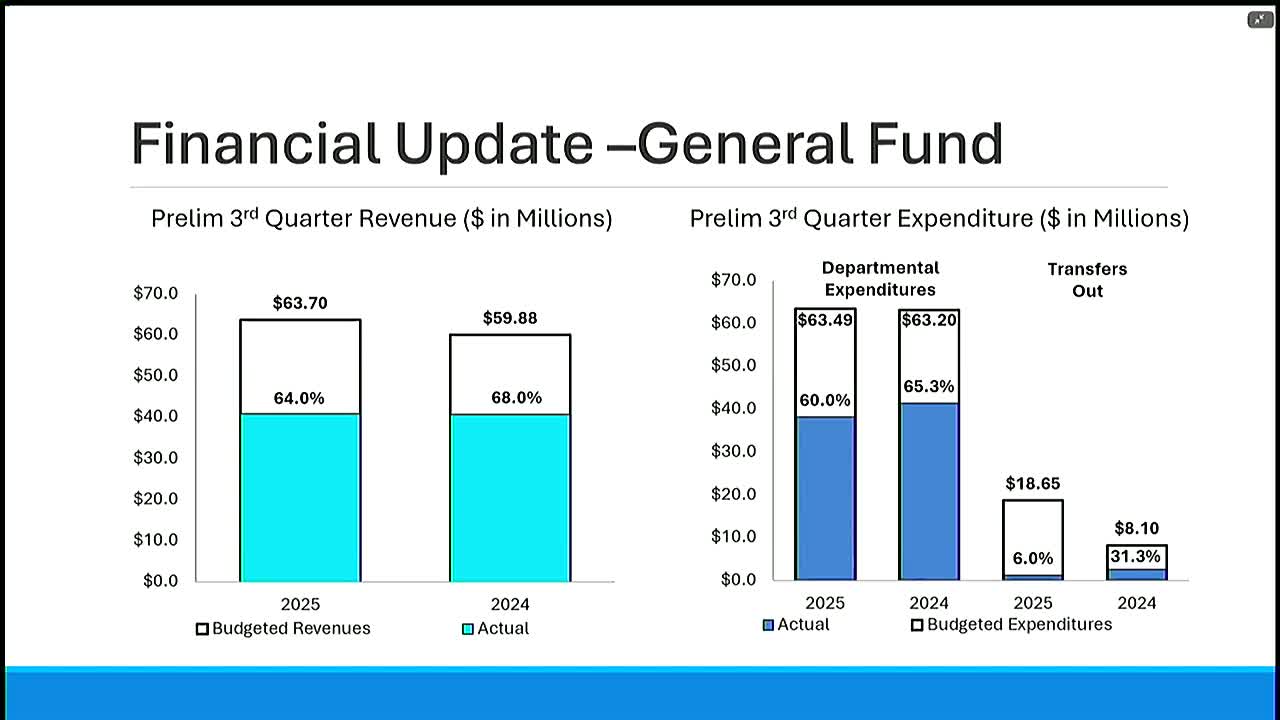
Shoreline City Council on Monday opened public hearings on the proposed 2026 property-tax levy and a mid-biennial budget review, receiving a staff financial update that showed year-to-date general-fund revenues at roughly 64 percent of budget and flagged rising public-safety costs as a key long-term pressure.
Shoreline City Council on Monday opened public hearings on the proposed 2026 property-tax levy and a mid-biennial budget review, receiving a staff financial update that showed year-to-date general-fund revenues at roughly 64 percent of budget and flagged rising public-safety costs as a key long-term pressure.
City Administrative Services Director Joe Branstetter and Budget and Tax Manager Christie Hopkins presented the quarterly snapshot and levy assumptions during the hearing on Ordinance 1041. Hopkins told the council that the city is estimating property-tax revenue for 2026 at about $25.8 million to $25.9 million, driven by a CPI adjustment of 2.683 percent plus new-construction growth and refunds; she also said voters previously approved an excess parks levy of about $2.95 million for 2026.
The presentation laid out other revenue trends the city is watching. Hopkins said general-fund expenditures were about 60 percent of budget through the third quarter and that sales-tax receipts were about 5.3 percent below the prior year, with construction-related sales tax down roughly 19 percent. Development revenue was above budget, staff said, and a large real-estate excise-tax sale helped buoy capital receipts.
Why it matters: the hearings shape the city’s tax rate and which one-time and ongoing requests move forward in the biennial budget. Branstetter said the council’s decisions will affect services, capital projects and the city’s 10-year forecast; staff presented a forecast that shows a potential deficit beginning in 2030 absent changes.
Council members and members of the public focused questions and testimony on how tax changes would translate to household costs. Resident John Bridal asked directly how levy increases affect renters: “How does that relate to us as far as what's it going to be for rent?” Council members asked staff to produce a simple homeowner example (for instance, a $500,000 home) and to explain the limits on the city’s ability to predict how landlords pass costs on to tenants.
Staff also described where mid-biennial requests would be funded. The presentation identified $2.6 million set aside for potential mid-biennial amendments and a $500,000 contingency for cost overruns on the 140 Fifth Street project. Branstetter enumerated staffing requests totaling 3.2 full-time equivalents for the amendment package, including one ongoing wastewater position and 1.367 limited-term positions, and noted several grants that are now budgeted.
Public-safety cost driver: staff emphasized police-contract costs as the largest long-term source of growth. Branstetter and Hopkins said police services represent about 32 percent of ongoing operating expenditures for the 2025–26 biennium and are expected to rise faster than CPI, citing a combination of workload, regional cost-sharing and contract changes as causes.
Fee and code updates: as part of the mid-biennial review staff proposed fee-schedule changes and new impact fees (Ordinance 1042) tied to transportation and parks, the formal inclusion of co‑living houses as a land-use category, and a 4 percent technology fee on development permits to support online permitting and system maintenance. Staff said the 4 percent fee is in line with neighboring jurisdictions and is intended to be cost‑recovery for permitting technology.
Station-area and parks comments: several public speakers urged the council to fund activation of station-area land near the North City light-rail station and adjacent to Rotary Park. Gabriel Sneed (online) said the Rotary Park activation would “provide space for local small businesses as they get started,” and Matthew DeAngelis told council, “it’s a shame that you leave this beautiful light rail station and there’s nothing to walk to,” urging a community/food-truck hub to support small businesses and station-area activation.
Council amendments and next steps: councilors discussed a set of potential amendments, including a small public–private affordable-housing pilot with Habitat for Humanity, and proposals for social-service support (utility and rent assistance and holiday food cards). Deputy Mayor Mark suggested $100,000 for utility and rent support and $50,000 for holiday food cards as a starting point for discussion. Council members were reminded by staff that potential amendments should be submitted by the end of the day Wednesday, Nov. 5, to be included in the Nov. 17 staff report.
What didn’t change: the hearing did not produce a final vote on the levy or the mid-biennial amendments; staff indicated both items will return to council following the public‑hearing period and further analysis. Branstetter and Hopkins said staff would provide the homeowner-impact examples requested by council and additional detail on ongoing-versus-one-time funding before final action.
Ending note: the council took no final action on the levy or the mid-biennial amendments at Monday’s meeting; both public hearings remain open and the items will return for future consideration.