Get Full Government Meeting Transcripts, Videos, & Alerts Forever!
Get email alerts on the Elections Redistricting topic
No spam. Unsubscribe anytime.
Louisiana House moves 2026 spring election dates to await Supreme Court guidance; debate centers on map legality and voter impact
Summary
The Louisiana House on Oct. 28 approved a measure to push several 2026 spring election dates by roughly 28 days to allow time for a pending U.S. Supreme Court decision in challenges to the state's congressional map.
The Louisiana House of Representatives on Oct. 28 approved legislation to move several 2026 spring election dates and related calendar items to allow time for a pending U.S. Supreme Court decision in litigation challenging the state's congressional map.
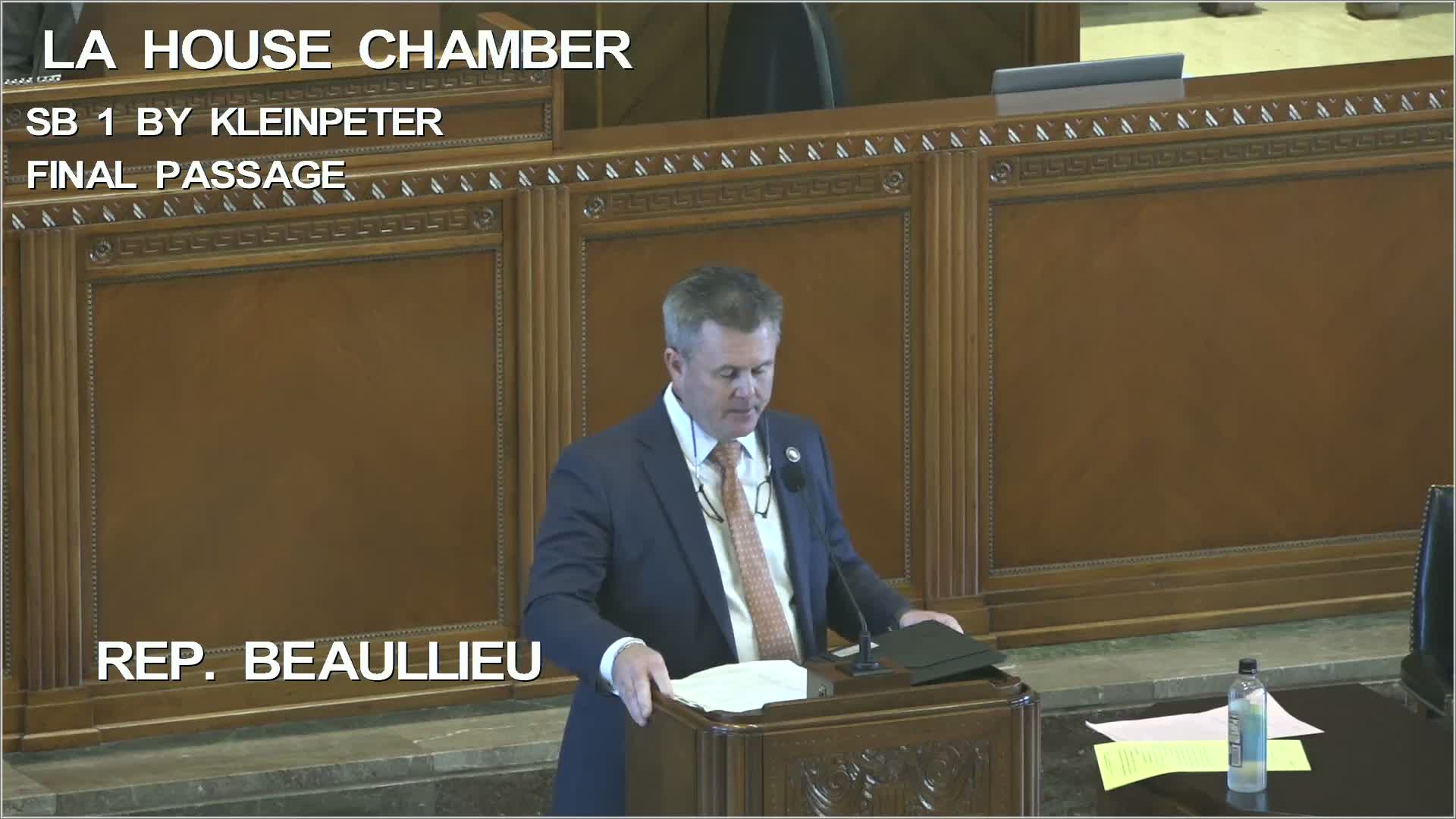
Chairman Kevin Beaulieu, author of Senate Bill 1 and chair of the House and Governmental Affairs Committee, told members the bill would push the spring primary and runoff each roughly 28 days so the legislature could await the Supreme Court's ruling and, if needed, produce a compliant map by the secretary of state's programming deadline. "We're hoping and praying that we get some clear direction," Beaulieu said, summarizing the bill's intent to "buy time" for the high court to act and for elections staff to reprogram voter files if necessary.
The bill's sponsor traced the litigation history that prompted the request. He summarized the earlier Robinson litigation and the subsequent Cali challenge, and reminded members the Western District found the most recent map unlawful; the matter is now before the Supreme Court. Beaulieu said the secretary of state had told the legislature she would need new maps by Jan. 13 to implement closed primaries in time for a spring election, which is what prompted the roughly 28-day shift in calendar dates.
Why it matters: The move affects qualifying deadlines and the timing of primaries and runoffs for the 2026 congressional cycle. Supporters framed the bill as routine scheduling to preserve the state's ability to deliver an orderly election if the Supreme Court requires map changes. Opponents said the change would compress the time available for litigants and courts to fashion remedial maps and risk voter confusion, and they warned it could be used tactically to limit effective judicial relief or to reduce minority representation.
Key provisions and logistics
- The House debate included repeated references to a Jan. 13 deadline the secretary of state gave for receiving a compliant map so election programming for closed primaries could be completed. The sponsor said the 28-day change was derived from that programming deadline and consultation with the secretary of state.
- The bill temporarily eases the geographic requirement for nominating petitions for congressional candidates for this cycle so petition signers do not have to be strictly from the existing congressional district lines. The sponsor said the change was intended to avoid unfairly denying ballot access if district lines shift between now and qualifying.
- The measure grants the secretary of state emergency rulemaking authority under La. R.S. 49:962 "if necessary" to adjust forms and dates to implement the calendar change and minimize administrative disruption.
What lawmakers argued
Supporters: Beaulieu and other backers said the change is administrative and designed to avert repeated, costly litigation cycles that have accompanied recent map draws. Beaulieu cited litigation costs and the state's history of repeated courtroom contests over successive maps and argued that brief calendar flexibility could reduce rushed remedial sessions.
Opponents: Several members, including Rev. Noel and Representative Lorveden, sharply criticized the bill. Rev. Noel warned that moving dates "compresses the calendar" and could be used to "insulate a political map from scrutiny," and said the change would narrow the practical window for courts to provide remedial relief under the Purcell line of cases. Representative Lorveden told colleagues, "This bill is unfair and unjust," arguing the shift could dilute Black voting strength and increase voter confusion.
Other operational concerns raised during the floor exchange included possible conflicts with university graduation dates in mid-May, the practicalities of verifying petition signatures if district lines change, and whether the legislature would consider repealing the closed-primary law if timing made implementation impossible.
Votes at a glance
- Senate Bill 1 (move spring 2026 election dates): final passage, 73 ayes, 29 nays. Outcome: approved.
- Companion bill to move the date for submitting proposed constitutional amendments and related ballot scheduling (companion to SB1): final passage, 73 ayes, 28 nays. Outcome: approved. (Speaker noted amendments on the May ballot include teacher pay, Saint George school system proposal and other items.)
- House resolution urging Congress to reimburse states that use nonfederal funds to continue SNAP benefits during a federal shutdown: adopted, 101 ayes, 0 nays.
What the bill does not decide
The legislation does not change congressional district lines or the content of any map; it only adjusts the election calendar and related procedural items. It does not predetermine how the legislature would draw maps if the Supreme Court requires changes; the sponsor repeatedly said options such as repealing closed primaries or calling a special session would be addressed later if necessary.
What comes next
The bill passed on final passage and will become law subject to the usual enrollment and transmittal steps. Lawmakers on both sides said they expect further litigation or litigation-related developments; the underlying Cali litigation remains before the U.S. Supreme Court and its timing and scope will determine whether the legislature must reconvene to alter maps before the 2026 cycle.
Ending note
Members who opposed the calendar change framed their objection not as an administrative complaint alone but as a concern that moving dates now could reduce remedies and public confidence in elections. Supporters said the modest calendar shift was a pragmatic step to give the state time to respond to whatever the Supreme Court decides.