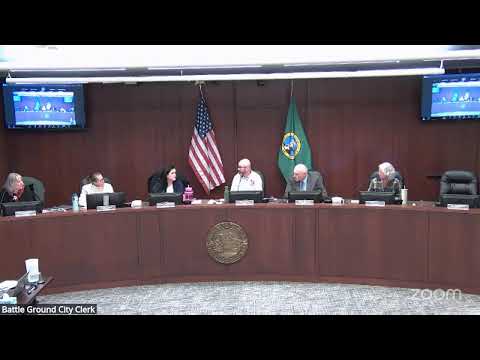
Council asks for enforcement pilot and cost estimates before deciding on automated traffic cameras
Loading...
Summary
After staff described legal rules and program details for automated traffic safety cameras, councilmembers raised concerns about timing, staffing and public reaction. Council directed staff to develop a two-month emphasis patrol plan and cost estimates for review before moving forward with cameras.
Battle Ground City Council heard detailed staff briefings Nov. 3 about automated traffic safety cameras (ATS cams), state legal requirements and program constraints and directed staff to provide a short enforcement pilot plan and associated costs rather than move immediately toward camera deployment.
Mark (city staff) told council that the Revised Code of Washington limits the images ATS cameras may collect to vehicle and license-plate images during violations, caps fines (for example, $290 for school speed-zone violations and $145 for other infractions), and requires that images be reviewed by authorized personnel before citations are mailed. He also said state law restricts how revenue from cameras can be used, requires signage at camera locations and—starting four years after placement—requires a portion of revenue be deposited into the Cooper Jones active transportation safety account.
"By law, CAMS can only record images of a vehicle and its license plate and only while the violation is occurring," Mark said during his presentation. "The registered owner is presumed responsible for the violation, and ATS cam infractions do not become part of the vehicle owner's driving record."
Councilmembers pressed staff on operational details including who can review images (civilian employees trained and supervised or sworn officers), projected workload from high-infractions locations, whether citations would block vehicle registration until paid, and how the city would meet equity requirements for programs started after Jan. 1, 2024. Several councilmembers said they wanted to see the effect of the speed-limit reductions the council enacted recently and the impact of planned traffic-calming work (roundabouts on SR 503) before committing to camera technology.
Deputy Mayor Bowman moved that staff develop a plan for emphasis traffic patrols at prioritized locations (SR 502/503, Main & 20th, the high school area), including a two-month testing period and cost estimates for overtime or staffing; Council directed staff to return with that plan and the likely budgetary impact. Chief Flynn and staff noted that reviewing infractions can create a material workload: one city example cited potentially thousands of violations at a single intersection in a year and several hours per week of review time per camera location.
Council did not take a vote to adopt ATS cameras; instead it directed staff to return with a pilot enforcement plan and cost estimates for council review.
Councilmembers also discussed the subjective community reaction to cameras and privacy concerns, and staff highlighted MRSC (Municipal Research and Services Center) resources as examples of other jurisdictions'9 adopted policies.
Council asked staff to include projected citation volumes, expected staffing needs for image review, vendor-compensation models (purchase versus lease), and potential uses of camera-generated revenue in the follow-up report.