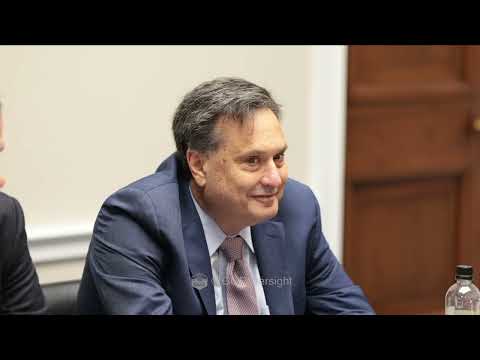
Former Chief of Staff Ronald Klain: Biden’s June 2024 debate was “very weak,” but remained decision-maker
Loading...
Summary
Ronald Klain, who served as White House chief of staff until Feb. 7, 2023, told the House Committee on Oversight and Government Reform that President Joe Biden’s June 27, 2024, debate performance against Donald Trump was “a very bad debate” and that debate prep at Camp David the week before “did not go well.”
Ronald Klain, who served as White House chief of staff until Feb. 7, 2023, told the House Committee on Oversight and Government Reform that President Joe Biden’s June 27, 2024, debate performance against Donald Trump was “a very bad debate” and that debate prep at Camp David the week before “did not go well.” Klain, who advised the president’s 2024 campaign, said he had urged an early debate to address voters’ concerns about Biden’s age but that the debate did not have the intended effect.
Klain said he helped prepare a campaign memorandum dated April 15, 2024, that recommended an early debate to rebut age-related doubts, and he warned the committee he had been “wrong” about the debate’s outcome. He described two kinds of debate preparation at Camp David: informal question-and-answer exchanges around the dining table and two formal mock debates in the theater room with Bob Bauer playing the role of former president Trump. "Practice did not go well," Klain said, adding that he and others observed the president had not reviewed the cards prepared for timed debate answers: "when I looked at the cards, there were no slashes," a notation Klain said Biden routinely used to manage his lifelong stutter.
Klain described medical treatment for an upper respiratory illness at Camp David and said he had "no knowledge" of nonmedical staff giving medications such as Ambien. He told the committee White House medical staff, not political aides, handled the president’s medications and treatments.
Klain said he and campaign and White House advisers concluded quickly that the debate answer about health care (the remark later paraphrased in coverage as "we finally beat Medicare") was politically damaging. He recounted telling campaign staff and members of Congress "we're fucked" (he declined to confirm exact profanity), and said he received at least one call from a major donor who told him there would be no more donations and urged the president to drop out. Klain said he pressed White House leaders, including Jeff Zients, to keep the president in Washington and to summon members of the House and Senate to give them more direct exposure to the president’s abilities rather than send him to the scheduled Camp David weekend and Vogue photo shoot.
Klain said he urged a more public-facing approach to shore up political support after the debate — including calls and personal meetings with members of the progressive caucus — but that he met resistance from White House managers who “had a plan” and preferred to follow an established schedule. He recounted a readout from Rep. Pramila Jayapal that the progressive caucus call “went poorly” and that members were not prepared at that time to issue a public statement of support.
Asked about whether the debate changed his view of Biden’s fitness to govern, Klain drew a distinction between debate performance and the capacity to make presidential decisions: "there was no question that he had the acuity to be president," Klain said, while acknowledging normal age-related changes such as reduced energy and more frequent memory lapses. He told the committee he learned of Biden’s decision to withdraw from the 2024 race when Jeff Zients called him shortly before the public announcement and that he thought the withdrawal was a mistake.
Why it matters: Klain’s account provides the committee and public a detailed, on-the-record explanation from a senior adviser about the campaign’s internal debate strategy, observed debate preparation shortcomings, immediate political fallout, and the internal push-pull over whether Biden should be more publicly engaged after the debate. Klain’s testimony underscores a separation he repeatedly stressed: poor debate performance, he said, harmed political prospects but did not, in his view, equate to an inability to carry out presidential duties.
What the witness said next: Klain told the committee he had worked as an adviser to authors and journalists and had spoken to several journalists about the campaign; he also agreed the age question was a persistent political issue and said he had advised the campaign to focus on future policy priorities for a second term. He said many of the campaign’s message choices (for example, an emphasis on infrastructure projects) reflected long-held tendencies and were politically less effective on issues such as inflation.
What this did not show: Klain denied any White House or campaign effort to conceal presidential incapacity, and he said he had not been told of anyone outside the White House giving the president medications. He also rejected the suggestion that staffors outside the medical team carried out presidential duties when Biden could not.
Provenance: Evidence supporting this article includes Klain’s Camp David and debate-prep descriptions (transcript start 00:23:52 — 00:34:56) and his account of donor and congressional reactions after the debate (transcript start 00:50:48 — 01:06:22).
Ending: Klain’s testimony frames the June 2024 debate as a political turning point for Biden’s reelection campaign — in Klain’s view a recoverable political failure that nevertheless precipitated a donor and congressional backlash — while maintaining that the former president retained decision-making authority during his term.