Get Full Government Meeting Transcripts, Videos, & Alerts Forever!
Get email alerts on the Capital Budget topic
No spam. Unsubscribe anytime.
Wauwatosa committee adopts $179.3 million five‑year capital plan, approves $23.57 million 2026 budget
Summary
Wauwatosa — The Financial Affairs Committee voted 8‑0 on Nov. 4 to adopt a five‑year capital improvement plan totaling $179,317,039 and to approve a 2026 capital budget appropriation of $23,569,440.
Wauwatosa — The Financial Affairs Committee voted 8‑0 on Nov. 4 to adopt a five‑year capital improvement plan totaling $179,317,039 and to approve a 2026 capital budget appropriation of $23,569,440.
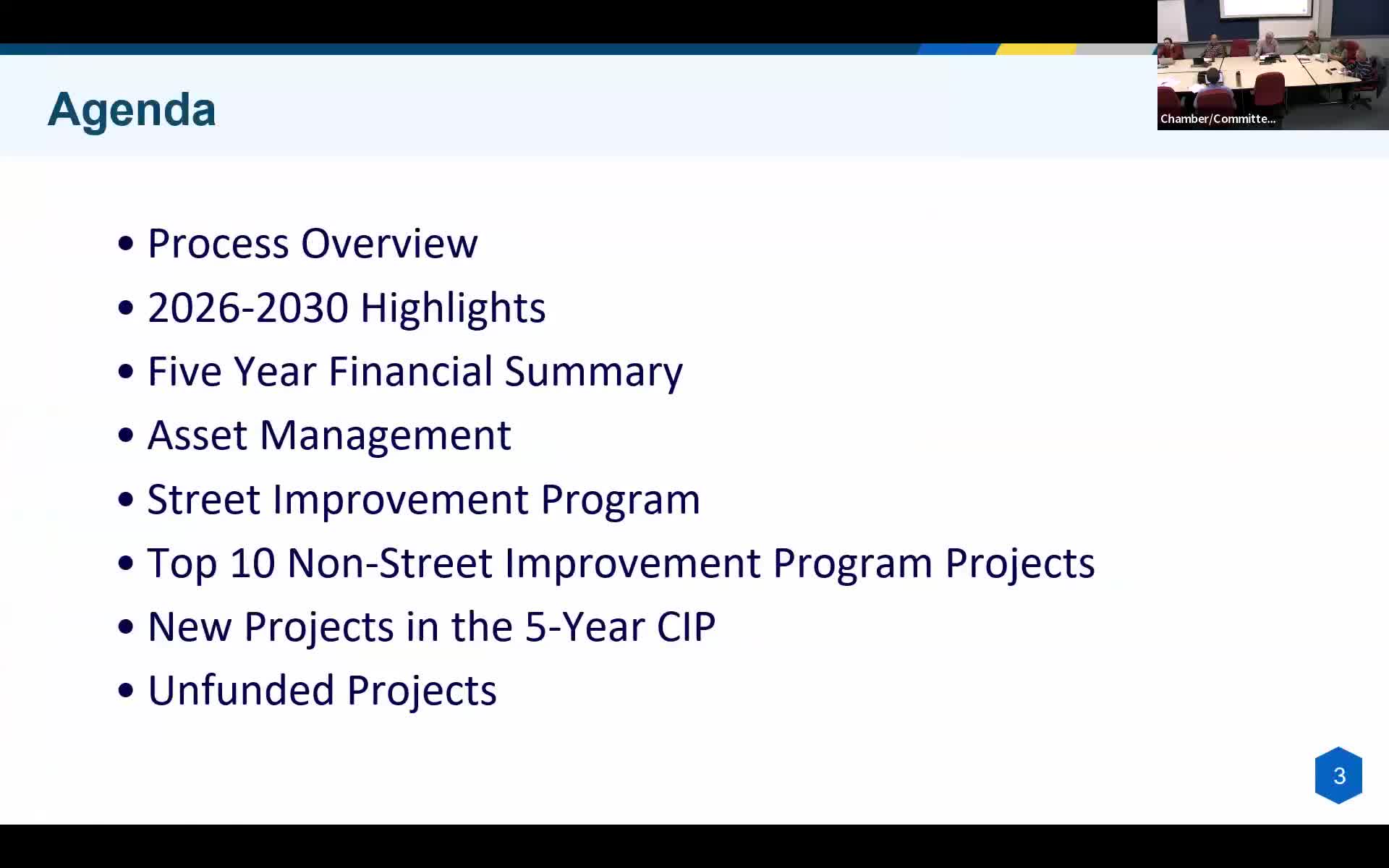
John, city finance director, told the committee the city presents a five‑year plan but can only adopt the first year as the 2026 budget; he said the five‑year plan should be seen as policy direction for later projects. “Within that five year plan, we balance revenues and expenditures,” John said during the presentation. He added the presentation this year shows full project costs with grant revenues listed separately to reflect the scale of work included.
Why it matters: staff said the plan includes nearly $54 million in grant funding over five years, which reduces direct city capital obligations for many roadway projects but does not apply to water and sanitary work. “None of [the grant dollars] can be used for water,” a presenter said, and staff warned that large water components on grant‑funded road projects (North Avenue and the I‑181 corridor) will increase borrowing for the water utility and put upward pressure on water rates.
Key details: staff described the plan as a mix of large DOT corridor projects and local street work. Major projects called out in the presentation include North Avenue (split into separate municipal agreements for roadway and bridges), the I‑181 corridor, Blue Mound/Highway 18 involvement, and several local street reconstructions including Perry Court and Center Street. Staff said the CIP now shows gross project costs including DOT and other partner shares so readers can see the full scale of projects and the grant dollars that support them.
Financial context: staff noted the city’s cash‑finance target is 40 percent; the plan currently shows a cash‑finance percentage near 54 percent driven largely by federal grant receipts from the bipartisan infrastructure law. Presenters cautioned that the cash‑finance percentage will decline as grant‑funded projects are completed. The five‑year plan includes $34 million in water‑related investments (all sources), notably higher than recent years; the staff presentation included modeled water‑rate scenarios projecting future increases necessary to cover anticipated borrowing, with significant uncertainty in long‑range forecasts.
Flood recovery and separate track: staff emphasized that projects related to the August floods are being tracked on a separate planning track while the city continues an appeal of FEMA’s public assistance decision. City officials estimated roughly $2 million in unreimbursed public infrastructure costs today but said that amount is uncertain pending geotechnical results, FEMA and state decisions and ongoing insurance claims.
Grants, dependencies and risk: committee members asked how projects would proceed if DOT, MMSD or other grant funding changed. Staff said projects that rely on outside funding would not move forward without that funding; they would be rescoped, eliminated or tabled, rather than shifting general tax burden to cover entire grant shortfalls. Staff highlighted specific grant programs referenced in the plan, including Transportation Alternatives Program (TAP) projects, a $850,000 congestion‑mitigation and air‑quality grant for signal work, an FRA grade‑separation study (federal grant $1 million, city share $250,000), and MMSD funding for sanitary sewer lining in a meter shed.
Other items included: the CIP also includes non‑road investments such as fiber‑optic backbone work (city and school district coordination and partial reimbursement), replacement of at least one rear‑loader refuse truck in 2026 (projected ~50 percent stormwater utility funding for the vehicle because of its mixed uses), fire station maintenance items and roof/solar projects, Hart Park restroom replacement (design approved; additional funding added to cover inflation), skate‑park lighting (planned with donor fundraising to cover roughly 50 percent of cost), and placeholders for unfunded needs such as the 68th Street bridge and Research Park infrastructure updates.
Vote: Alder Phillips moved to approve the five‑year plan and the 2026 capital budget appropriation; Alder Gustafson seconded. The committee adopted the plan and budget by voice vote, 8‑0.
Next steps: the capital budget will be combined with the operating budget for Common Council action at the Nov. 8 meeting. Staff said detailed project sheets and funding‑source breakdowns are included in the meeting packet and will be used for further committee and council review.