Seattle Council unanimously adopts resolution expanding emergency authority to address SNAP disruptions
Loading...
Summary
Seattle City Council on Nov. 3, 2025 unanimously adopted Resolution 32186 to modify a mayoral civil emergency proclamation and give the executive broader authority to distribute emergency resources across schools, senior centers, meal providers, community centers and food banks to address SNAP disruptions caused by the federal shutdown.
Seattle City Council on Nov. 3, 2025 unanimously adopted Resolution 32186 to modify a mayoral civil emergency proclamation issued Oct. 30, 2025 in response to disruptions in Supplemental Nutrition Assistance Program (SNAP) benefits caused by the federal government shutdown.
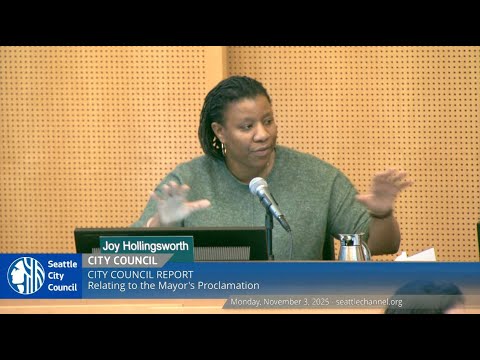
Council President Sarah Nelson opened the special meeting and the council moved, seconded and approved the resolution by roll call. Council Member Hollingsworth, the sponsor, said the change "acknowledg[es] that the various orgs that help with food access beyond food banks" are included and that the amendment "gives the executive the flexibility to distribute" funds through multiple channels.
The resolution modifies the mayor's proclamation to clarify that emergency response efforts may support the full spectrum of established food systems in Seattle, including meal providers for children and seniors, community centers, schools, food banks and other distribution channels. Central staff counsel Lauren Henry and Central Staff Director Ben Noble told the council the mayor's Oct. 30 proclamation quoted an estimate that roughly 50,000 Seattle residents receive SNAP benefits totaling about $16,000,000 per month, and that the proclamation was issued under Seattle Municipal Code 10.02.010.
Staff explained the proclamation delegates two types of authority: (1) to the director of the City Budget Office to authorize spending of emergency funds, including contracting to increase food availability; and (2) to city department heads to permit use of city facilities, equipment and reassignment of personnel to assist emergency operations. Staff outlined the council's options under SMC 10.02.010, including confirming, modifying or rejecting a mayoral proclamation; the council chose to adopt a modification.
During discussion council members voiced urgency and frustration with the federal shutdown's effects on food access. Council Member Rivera described the situation as "completely unacceptable" and urged swift action; Council Member Strauss said the federal government has primary responsibility for SNAP but the city must act while the shutdown continues. Members and staff discussed operational questions including distribution timelines, storage and transportation costs, and which local channels would be used. Staff noted the city's emergency subfund currently holds just over $85,000,000 and that mayoral public information referenced about $8,000,000 the administration had in mind for a roughly two-month window (November'December); staff characterized the $8,000,000 figure as the mayor's public estimate, while the proclamation itself did not specify a dollar amount.
The council adopted the resolution by roll call with nine in favor and none opposed. Following the vote the chair signed the resolution.
The resolution as adopted affirms that emergency resources may be distributed across diverse food-access channels and directs the mayor, in consultation with council, to identify public funding sources and demonstrate an equitable plan for resource and staffing distribution. The measure does not specify exact allocations; council and staff said distribution decisions and operational details will be carried out by the executive branch under the authorities clarified by the resolution.
Clarifying details discussed in the meeting included the city's emergency subfund balance ("just over $85,000,000"), the mayor's public figure for emergency response spending (reported as about $8,000,000 over two months), and the mayoral proclamation's cited estimate of roughly 50,000 SNAP recipients receiving about $16,000,000 per month in benefits. Staff emphasized operational constraints such as refrigeration, transportation and staffing costs for last-mile distribution.
Council members repeatedly framed the action as an urgent, temporary response to a federal disruption rather than a long-term funding solution. Several members said the action was not sustainable without federal action to restore SNAP benefits. The council instructed staff and the executive to proceed with distribution planning under the modified proclamation and to report back on sources and deployment plans.