
Orland Park trustees table Bridlewood rezoning after residents and trustees raise concerns about density, trees and runoff
Get AI-powered insights, summaries, and transcripts
Sign Up Free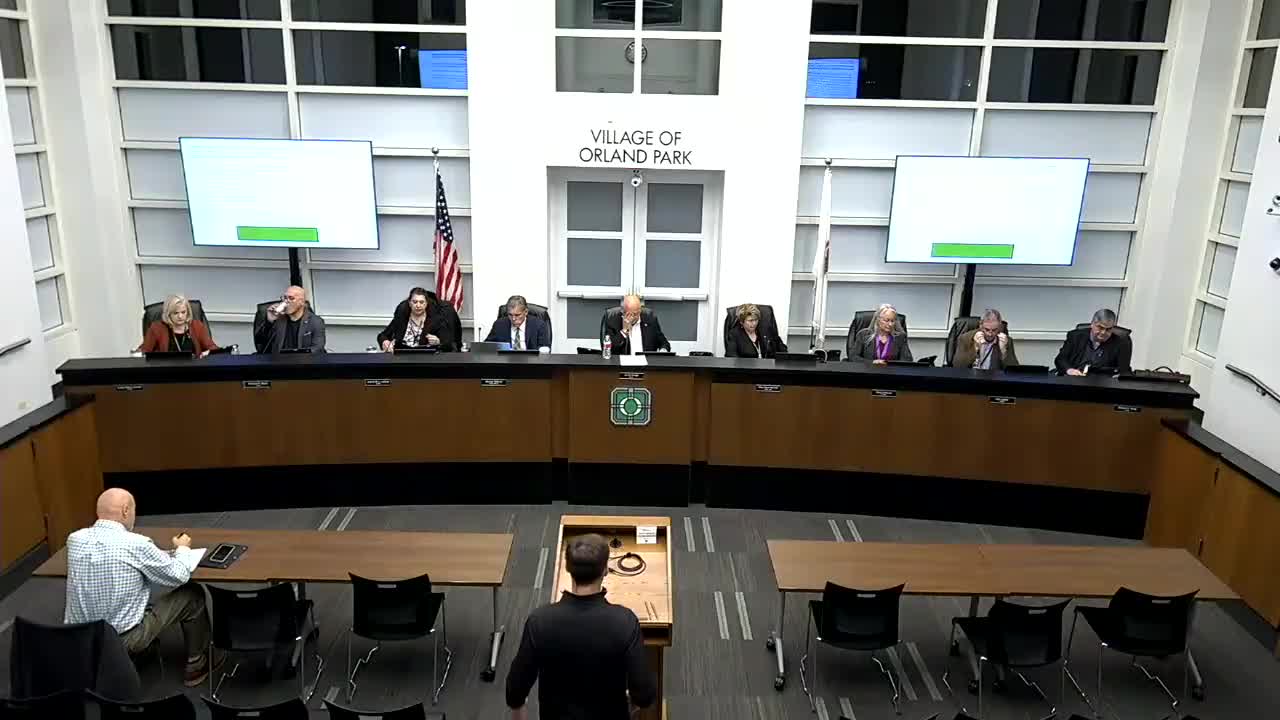
Summary
Trustees at the Orland Park Committee of the Whole on Oct. 20 tabled consideration of the Bridlewood residential plan development (case 2025-0171) after residents and several trustees raised concerns about tree removal, steep slopes, stormwater control and a proposed public path adjacent to existing yards.
Trustees at the Orland Park Committee of the Whole on Oct. 20 tabled consideration of the Bridlewood residential plan development (case 2025-0171) after more than an hour of public comment, developer presentation and trustee questions.
The move came after residents and multiple trustees pressed the petitioner for clearer answers on tree removal, stormwater calculations, the density of the proposed neighborhood and a walking path that some neighbors said would run along rear yard lines.
Brandon Howdy of 5 Old Tamarack Lane told the board: “A lot of us bought acre lots and expected a lot of privacy. ... This proposed development would have 50 trees cut down that are in the center of the property at the highest point that is the focal point of the whole neighborhood.” Cindy Tenalia, another neighbor, asked trustees to “vote against the rezoning for Bridlewood on A Hundred And Eighth,” calling the parcel one of the last undeveloped scenic sites in Orland Park.
The petitioner's representative said the developer reduced unit count from an initial maximum to 20 units and emphasized the product is aimed at empty-nester buyers. Land planner Nick Paterra said the plan preserves about 65% of the site as open space, proposes 260 new trees and a communal walking path, and relies on on-site detention and swales to manage runoff. The petitioner said it retained ERA for engineering and that “every single water issue has been addressed. There will be no all water will be captured on-site and released properly.”
Several trustees voiced differing perspectives. Trustee Katsenas said the parcel ''is magnificent' and that the proposed layout felt like townhomes that do not fit the neighborhood character; he committed to vote against the project in its current form. Trustee Lawrence said he walked the property and noted both the scenic value and market demand for ranch-style homes; he suggested talking further with the developer. Trustee Malani and Trustee Healy said they were "on the edge" and would like adjustments, including possibly fewer units. Trustee Lawler urged staff to clarify whether the path could be removed as a compromise.
Staff described the key approvals before the board: a zoning map amendment from E-1 (default zoning) to R-3 for the planned development, two modifications related to right-of-way and parkway widths, and site/landscape plan approval. Staff said the site sits partially within 50 feet of a non-tidal wetland (off-site) and that the R-3 plan allows clustering that preserves contiguous open space and tree canopy under HOA control, whereas straight R-2 development could place trees on private lots and make them vulnerable to later removal.
Trustees asked staff and the petitioner to return with the traffic study recommendations, final engineering memos clarifying slope and stormwater numbers, sight-line analyses for the new intersection elements and options for buffering the adjacent yards. The board made a motion to table the item so staff could gather and present the technical follow-up; the motion passed by roll call. Mayor Dodge said staff would contact the petitioner and residents about the next steps.
What happens next: staff will review the traffic study and final engineering, coordinate jurisdictional questions for the adjacent unincorporated portion of A108th Avenue, and return to the board with supplemental materials. The petitioner and neighbors will be notified of the next meeting date.