Board approves 06/30/2025 actuarial valuation as funding position improves
Loading...
Summary
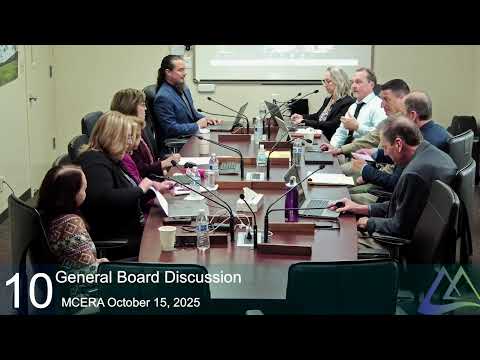
The Mendocino County Employees Retirement Association Board of Retirement on Nov. 4 approved the retirement system’s 06/30/2025 actuarial valuation after a presentation by Segal.
The Mendocino County Employees Retirement Association Board of Retirement on Nov. 4 approved the retirement system’s 06/30/2025 actuarial valuation after a presentation by Segal. The consultants reported stronger-than-expected investment returns and higher payroll that together reduced the plan’s unfunded accrued liability and lowered the aggregate employer contribution rate.
Segal principal Todd Tausser told trustees the plan experienced a strong market year and an actuarial return above the plan’s 6.5% investment assumption after Segal’s five‑year asset‑smoothing was applied. "Not to bury the lead, it is certainly we're going in the right direction in the funding of the plan," Tausser said, pointing to recognized gains in the valuation and deferred gains that will provide a buffer in future years.
The valuation shows the combination of investment gains and higher payroll reduced the plan’s unfunded liability more than expected for the year; Segal described approximately $8 million of UAL decrease due to investments and offsetting items that together produced a net further reduction beyond the expected paydown. Segal reported the aggregate employer contribution rate fell from 41.82% to 40.27% (a 1.55 percentage point decline). Member contributions increased marginally in the aggregate from 10.24% to 10.28% driven by demographic shifts.
Why it matters: trustees heard that while investment outperformance has improved funding, a long-standing ‘‘restart’’ amortization layer remains the dominant source of UAL payments and creates a projected contribution‑rate cliff when that layer rolls off in the 2030s. Tausser summarized the amortization chart and said, "When that's finally paid off, you'll see payments drop dramatically for our plan once we get there. That's really dominating why payments are so high currently on the unfunded liability side."
Segal walked the board through sources of valuation change: investment gains, a small contribution‑timing loss, additional contributions because of payroll growth, higher salary increases that raised liabilities, and lower‑than‑expected cost‑of‑living adjustments that produced some gain. The firm explained how its five‑year smoothing policy has been applied; this valuation recognized 20% of the current year’s large investment gain and deferred the remainder to future valuations so that those gains can offset possible future losses. "We have about $31 million of this year's gain that we're going to still be recognizing in the future," Tausser said.
Trustees questioned options to reduce future contribution volatility. Segal and trustees discussed (a) modestly lengthening asset‑smoothing windows, (b) phased reductions in contribution rates rather than a single large cut, and (c) amortization method changes such as level‑dollar rather than level‑percent of payroll — the latter raises near‑term payments but reduces future acceleration if payroll growth is uncertain. Segal also noted that a one‑time county use of ending pension‑obligation bond payments could shorten the large restart layer but cautioned such funding would benefit the entire multi‑employer plan, not only the county employer.
Segal confirmed the board will perform its triennial experience‑study and assumptions review early next year. Andy Young said the board’s conservative assumptions have raised measured liabilities in the past but also better position the fund for the long term.
Board action: Chair Land called for a motion to approve the funding valuation. The motion was moved, seconded and approved on roll call: Trustee Haschak — Aye; Trustee Quincy Cromer — Aye; Trustee Harris — Aye; Trustee Kubison — Aye; Chair Land — Aye. The board approved the valuation as presented.
What’s next: Segal will return to present its triennial experience‑study and any proposed assumption changes. Trustees asked staff and Segal to model mitigation options for the restart layer and possible measured approaches to lower contribution rates as the plan's funding improves.