
Poudre School District: students with IEPs show typical academic growth but lag in on‑time graduation rates
Get AI-powered insights, summaries, and transcripts
Subscribe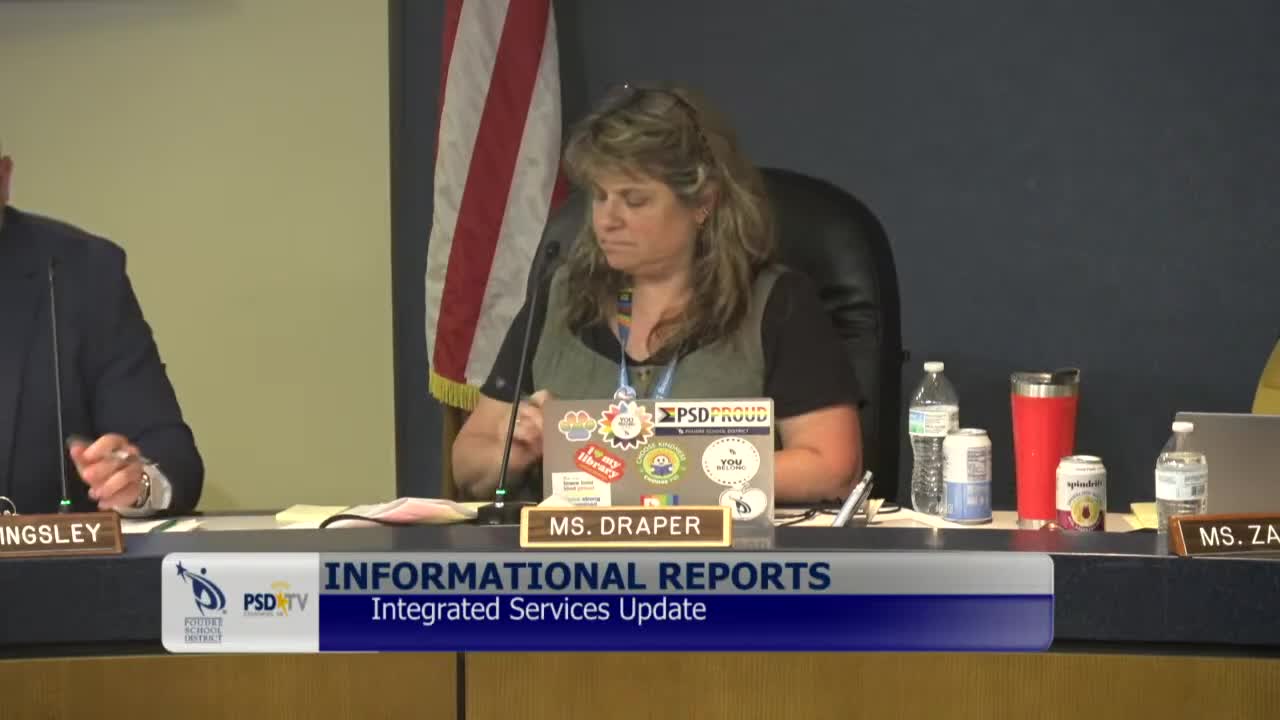
Summary
Poudre School District officials told the Board of Education on Nov. 4 that students served by IEPs are making typical year‑to‑year academic growth but are graduating on time at lower rates than their peers.
Poudre School District officials told the Board of Education on Nov. 4 that students served by IEPs are making typical year‑to‑year academic growth but are graduating on time at lower rates than their peers. During an extended Integrated Services presentation, district staff said achievement and growth metrics are roughly in line with statewide outcomes, while the district’s on‑time graduation rate for students with IEPs remains below comparable districts and below the district’s overall graduation rate.
“Those numbers indicate that that group of students has got slightly more than a year’s growth in a year’s time,” said Dr. Duane Schmitz, the district’s chief institutional effectiveness officer. Dr. Schmitz told directors that growth effect‑size measures on NWEA MAP tests show students with IEPs achieved roughly a year’s growth and sometimes a bit more.
At the same time, Integrated Services Director Dr. Jody Rommel described several concrete drivers that the district has identified: students not meeting graduation requirements on time; past resource constraints that limited 18‑to‑21 services; the absence until this year of a diploma pathway for students on alternative standards; and inconsistent systems alignment and coding of graduation data. “We opened our Transition Pathways Academy,” Rommel said, “which expanded our ability to serve all students who qualify for 18 to 21‑year‑old services.” She added the district’s first EEO diploma pathway resulted in 18 students earning a diploma last spring instead of a certificate of completion.
The presentation included several measures and figures the district is tracking: the district reported about 87% of multi‑categorical students now spend at least 80% of their day in general education settings; about 51 students supported by IEPs are still in high school past their fourth expected year (a principal driver of the lower on‑time graduation rate); and 18 students with IEPs dropped out last year (a figure that has ranged 13–19 over the past five years). Half of the students who dropped out were identified as experiencing housing instability.
District officials said testing participation differences also caught their attention: participation rates for statewide assessments among students with IEPs are lower than for students without IEPs. Dr. Rommel noted multiple ways the district measures progress and said teams are encouraging families to participate in state and local assessments when appropriate.
Community members and staff who spoke during public comment urged the board to keep inclusion high while also ensuring that supports, staffing and transitions prepare students for adulthood. Advocate Aaron Green told the board that differences in graduation rates between Poudre and neighboring districts are stark and called under‑identification and low graduation rates a civil‑rights concern: “By under identifying 3 to 4% of the children, PSD is denying 900 to 1,200 students a free and appropriate public education,” Green said.
Superintendent Mike Kingsley framed the discussion as the first of several planned conversations. “We have a very important conversation to have tonight,” Kingsley said in his remarks ahead of the presentation, requesting the governance team and community “open our hearts and minds and continue to be curious” about why students with IEPs are not trending positively on graduation.
Next steps the district outlined include proactive, individualized planning for students at risk of not graduating on time; outreach to high schools to develop school‑level plans with case managers, counselors and principals; expanded communication and training for registrars, counselors and staff on graduation requirements and coding; and continued expansion and outreach for transition programming that connects students to adult services and community employment opportunities. District staff said they will return with more detailed data and recommended actions as the work continues.
Board members pressed staff for additional disaggregated figures and trends and asked for follow‑up reports with exact counts by grade and by school for students with IEPs, participation rates on assessments and deeper analysis of the 51 students still enrolled past their fourth year. Rommel said school‑by‑school outreach and individualized planning are already under way and that an IS social worker has been assigned to help families navigate adult‑services enrollment and wrap‑around needs.
The board did not take formal action on the Integrated Services presentation; staff said they will present additional analysis and recommended interventions in follow‑up sessions.