Get Full Government Meeting Transcripts, Videos, & Alerts Forever!
Get email alerts on the General Fund topic
No spam. Unsubscribe anytime.
Scappoose council reviews general‑fund shortfall, weighs levies, franchise fees and utility bill charge
Summary
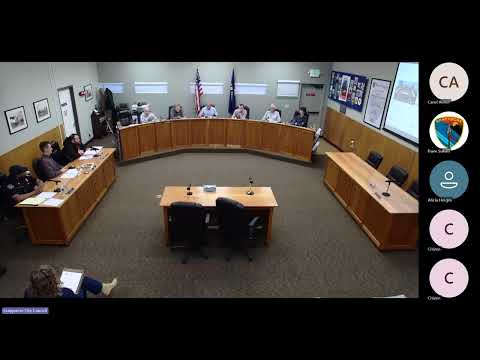
Scappoose — Assistant City Manager NJ Johnson told the Scappoose City Council at a Oct. 6 work session that the city can balance its books today but faces a long‑term deficit in the general fund that must be addressed.
Scappoose — Assistant City Manager NJ Johnson told the Scappoose City Council at a Oct. 6 work session that the city can balance its books today but faces a long‑term deficit in the general fund that must be addressed.
"While we're able to balance our budget today, looking forward into the future, we do have a deficit in the general fund that we need to find some way to address," Johnson said as he opened a staff presentation on the city's general fund and possible revenue remedies.
Johnson described three scenarios. The "bare bones" scenario would balance the budget only by cutting staff, deferring maintenance and halting special projects; Johnson said it would remove roughly four police officers. The "quality operations" scenario, which Johnson presented as the typical standard for well‑run cities, showed an approximate $1 million deficit; an "aspirational" scenario showed roughly a $2 million gap.
Why it matters: the general fund supports core city services — administration, planning, police, municipal court and parks — and represents about one‑quarter of Scappoose's overall budget. Councilors said decisions will affect police staffing and community services and that council must set service‑level goals before choosing revenue sources.
Options presented
Local option levy: Johnson outlined local option levies as a voter‑approved route that must be renewed every five years and is especially complicated in Columbia County by Measure 5 and Measure 50 limitations on assessed value growth and by tax compression when multiple districts levy. He cautioned that levies are politically difficult now and that compression can reduce the effective revenue when many taxing districts are near the statutory cap.
Franchise utility fees: Staff identified franchise fees on utilities (power, natural gas, garbage, telecom and potentially water/wastewater) as a significant revenue option. Johnson said telecom was already at the 7% level commonly used by cities, but that raising PUD and natural‑gas franchise fees to statutory maxima could produce material revenue. He estimated a near‑term opportunity of roughly $350,000 from electric and gas if contracts and timing allowed; he also noted gas and electric contracts do not expire until 2032–2033 in some cases. Staff said applying a 7% franchise fee to stormwater and wastewater could yield about $450,000 annually and recommended phased implementation to avoid disruption to enterprise funds and ratepayers.
Utility bill 'general service' fee: Staff described a council‑approved fee placed on city utility bills (not a property tax) as a council‑level action that does not trigger Measure 5/50 compression. Based on a town‑hall survey and a rough account count (about 2,800 billed accounts), staff said a flat example of $10 per month for public safety plus $5 per month for parks would raise approximately $500,000–$550,000 per year. Staff emphasized careful outreach and clear labeling on bills so customers understand the charge is a city service fee rather than a water‑only rate increase.
Development fees and collections: Staff noted a prior fee study increased planning/permitting fees to about 75% cost recovery and that development fees have limited ceiling revenue. Councilors asked staff to model full cost recovery scenarios. Councilors also asked about past uncollected municipal court revenue; staff said pursuing collections could produce one‑time revenue and that some cities contract with outside collection firms.
Council questions and next steps
Councilors repeatedly urged staff to start by defining the desired service level — notably police staffing. Johnson and other staff said Scappoose currently has about 12 sworn officers and that getting to industry averages (roughly 1.8–2.4 officers per 1,000 residents by various benchmarks) could increase costs; staff estimated roughly $150,000–$160,000 budgetary impact per officer when benefits and overhead are included. Johnson said the city currently has approximately $1.7 million in unappropriated reserves and about $6.0–$6.5 million in cash carryover; staff estimated those balances could sustain operations for several years if drawn down but would not be a long‑term solution.
Councilors asked staff to return with: contractual analysis of franchise agreements and any opportunities to renegotiate, detailed revenue modeling for a utility bill fee (including tiering or commercial/industrial differentials), and an analysis of raising development fee cost recovery. Staff said they would also compile comparative case studies and legal/regulatory guidance (county assessor worksheets, Oregon Secretary of State rules for ballot measures) to support council decisions.
"I think it's very important that we're doing this now," Councilor Tyler Elm said, urging public outreach and transparency. Councilor Miller said he wanted to be explicit about how a fee appears on city bills: "When I get the bill from the city, I'm thinking this is water and water infrastructure," Miller said, adding that clear labeling and community education will be important if the council pursues a fee.
The council did not take formal action. Staff will return with more detailed numbers and contract reviews to inform any future decisions and public outreach planning.