Get Full Government Meeting Transcripts, Videos, & Alerts Forever!
Get email alerts on the Land Use topic
No spam. Unsubscribe anytime.
Planning Commission unanimously backs El Pomar use variance for Penrose property
Summary
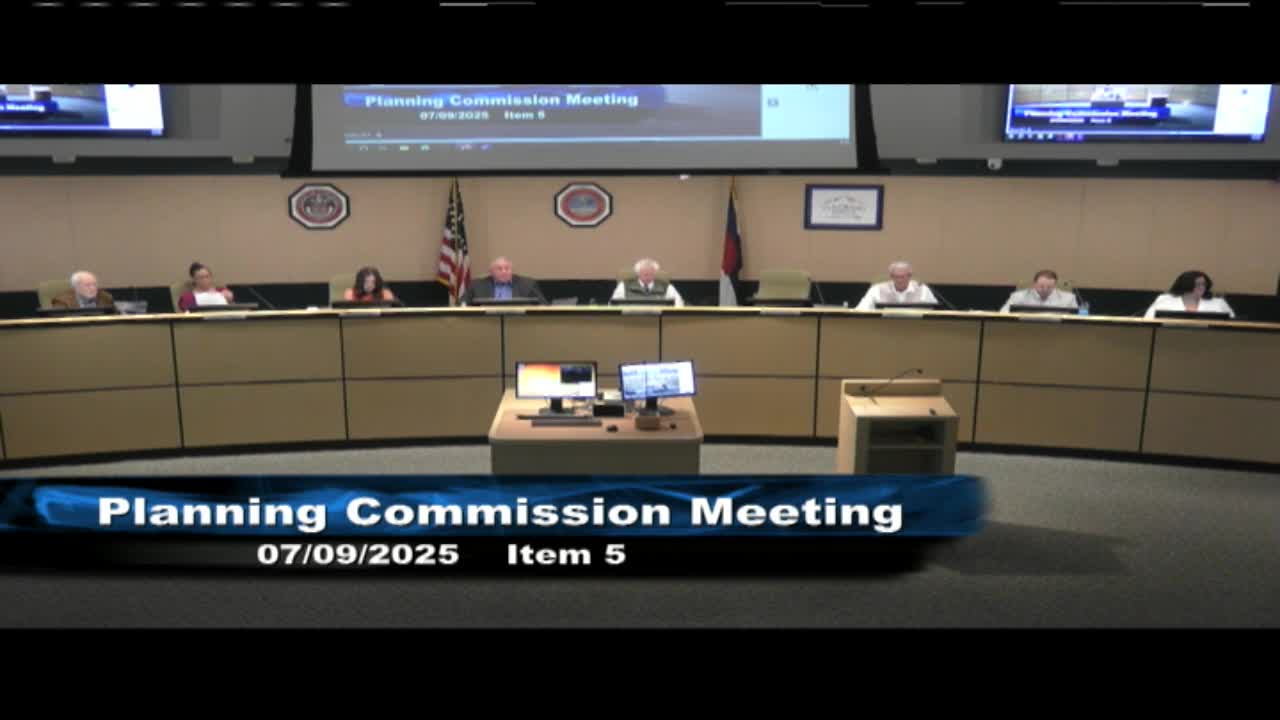
The Colorado Springs Planning Commission voted unanimously July 9 to recommend City Council approve a use variance allowing the El Pomar Foundation to convert a former memory‑care building at 2 Penrose Boulevard into a nonprofit conference and education center.
The Colorado Springs Planning Commission voted unanimously July 9 to recommend City Council approve a use variance (UVAR‑25‑0004) allowing the El Pomar Foundation to establish a nonprofit conference and education center at 2 Penrose Boulevard, a roughly 3.24‑acre parcel in Council District 3.
City planning supervisor Tamara Baxter told the commission the property is zoned RE (single‑family estate) with hillside and wildland‑urban‑interface overlays and that the existing structure most recently operated as a residential memory‑care facility. The application requests a specific use variance rather than a rezoning; staff notified neighbors via 131 postcards and received no written public comments. Baxter said the variance would allow uses including meeting and assembly space, conference and administrative offices, archival storage, a chapel, supporting kitchen space and outdoor gathering areas, and that a development plan has also been submitted showing no change to the building footprint.
Chris Lieber of NES, representing the applicant team, said El Pomar is seeking a narrowly defined, “surgical” use that preserves the site’s residential setbacks and historic character while enabling year‑round nonprofit convening and limited administrative space. “This provides an opportunity to really reconnect what was once all part of the Spencer and Julie Penrose residence and to enhance visitor experience,” Lieber said, describing circulation that will continue to use the existing front entrance on Mesa for most guests and service/emergency access limited to Penrose Boulevard.
Kyle Hebble, president and CEO of El Pomar Foundation, outlined the foundation’s mission of grantmaking, leadership development and community convening and described the property’s history, including prior stewardship by the Sisters of Charity and prior operation of a memory‑care facility. “We believe this will be a benefit to nonprofits and the citizens of Colorado Springs for decades to come,” Hebble said.
Applicant materials and staff presentations addressed neighborhood outreach, site design, and traffic. The applicant reported an April 7 neighborhood meeting attended by roughly 80–100 neighbors, conducted guided site tours, and made design adjustments in response to concerns about screening, lighting and wildlife. A traffic analysis compared the proposed use to the prior memory‑care operation and concluded that most nearby intersections would continue to operate at level of service A, with the Mesa intersection operating at level of service B during some peak hours; the applicant said no negative roadway impacts are expected.
Commissioners voiced general support while raising planning‑code questions. Commissioner Robbins praised the preservation focus and traffic plan; Commissioner Casey said the proposal met required criteria. Commissioner Cecil asked whether the city needs clearer, city‑wide zoning definitions for conference‑style facilities, noting that legacy zones such as Planned Cultural Resort (PCR) did not carry forward into the current Unified Development Code.
After brief questions — including confirmation from the applicant that a southern adjacent parcel would be handled through the city’s development‑plan review (not an additional use variance) — a commissioner moved to recommend approval to City Council and Commissioner Casey seconded. The commission recorded a unanimous vote to forward the recommendation.
The commission also completed routine business earlier in the meeting: members appointed Commissioner Marty Rickett as acting chair for the day, approved the minutes of the June 11, 2025 meeting, and approved the consent calendar; those procedural items passed on voice or roll‑call votes as recorded in the minutes. Staff read appeal instructions before adjournment, noting that affected parties have 10 days (through July 21, 2025) to file an appeal under City Unified Development Code §7.5.415.
The matter will next be considered by City Council under the standard review path for use‑variance recommendations; the commission’s record includes the applicant’s development plan and the neighborhood meeting notes.