Get Full Government Meeting Transcripts, Videos, & Alerts Forever!
Get email alerts on the Criminal Appeals topic
No spam. Unsubscribe anytime.
Appeals panel hears arguments on sufficiency of evidence in Commonwealth v. Prairie
Summary
An appellate panel considered whether evidence was sufficient to convict Christopher Prairie of operating under the influence and negligent operation after two lane crossings and field sobriety testing; counsel for both sides argued whether issues should have gone to a jury and the case was submitted for decision.
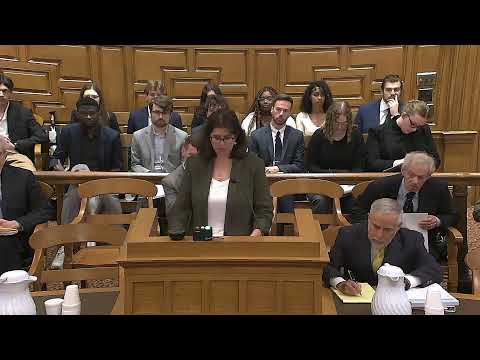
An Appeals Court panel heard oral argument on the sufficiency of the evidence in Commonwealth v. Christopher Prairie (Docket No. 2024P528), addressing whether there was enough proof to sustain convictions for operating under the influence (OUI) and negligent operation of a motor vehicle. After argument from both sides, the panel submitted the case.
Attorney Dan Ciccarolo, representing Christopher Prairie, told the panel that the trial evidence did not establish that Prairie drove in an unsafe manner or possessed the requisite general intent for the crimes charged. Ciccarolo said the police testimony reported only two lane crossings and described the second crossing as an involuntary action: "sneezes sneezing is a non intentional reflex action," he said, arguing that an involuntary reflex cannot satisfy the intent element required for the offenses and that the trial court should have granted the defense motions for required findings.
Ciccarolo also challenged several other indicia the Commonwealth relied on. He disputed the significance of the officer's testimony that it took "200, 300 yards" for the cruiser to stop, saying that distance equated to only a few seconds and that the record did not establish whether it was safe to pull over on the roadway. He contested the import of field sobriety testing, noting that although the defendant made "a couple errors" on one walk-and-turn attempt, he successfully completed subsequent repetitions, and that a one-leg stand difficulty was attributable to a prior leg injury corroborated by the defendant's mother. Ciccarolo said booking behavior and the defendant's coherent answers also weighed against diminished capacity.
Counsel for the Commonwealth, identified in the transcript as Rosella Alcori, urged the panel to apply the Lattimore sufficiency standard, which requires the evidence to be viewed in the light most favorable to the Commonwealth and any conflicts to be resolved by the jury. "When considered in the light most favorable to the Commonwealth, was sufficient to convict the defendant," Alcori said, arguing that testimony that the vehicle swerved across the center line twice and that the second swerve nearly caused a head-on collision supported both negligent operation that endangered the public and a reasonable suspicion leading to an OUI arrest.
A justice asked whether a jury could disbelieve the sneeze explanation and infer another cause for the swerve; the Commonwealth answered that conflicting inferences are the jury's province under established precedent. After rebuttal and brief questioning, counsel rested and the panel submitted the case. The court then took a short break to reconstitute the panel for the next argument.
The record on appeal cited by defense counsel included Commonwealth v. Gunter and Commonwealth v. Van Winkle; defense counsel also referenced United States v. Bailey in discussing intent. The Commonwealth cited the Lattimore sufficiency standard and quoted Commonwealth v. Woods (and earlier cases cited therein) on resolving conflicts in the evidence.
The panel did not announce a decision at argument. The case was submitted for further consideration by the judges.