
WeGo Market opens at Elizabeth Duff Transit Center, ties food access to transit expansion
Get AI-powered insights, summaries, and transcripts
Subscribe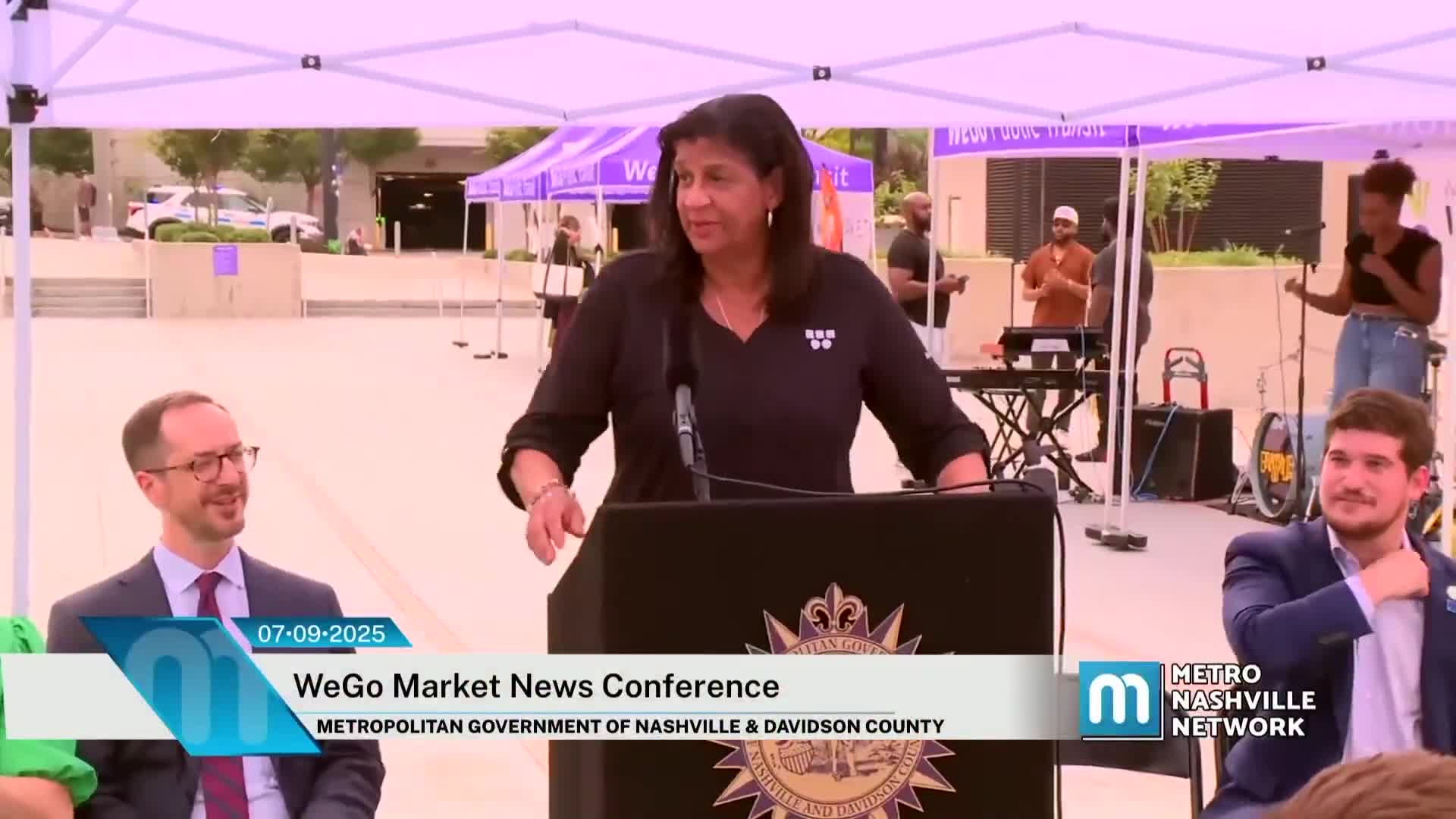
Summary
WeGo Public Transit and the Nashville Farmers Market on Thursday launched a pop-up WeGo Market at the Elizabeth Duff Transit Center in downtown Nashville, officials said at a news event.
WeGo Public Transit and the Nashville Farmers Market on Thursday launched a pop-up WeGo Market at the Elizabeth Duff Transit Center in downtown Nashville, officials said at a news event. The market pairs local vendors with a transit hub to expand access to fresh food for downtown riders and nearby residents.
The market is part of a broader effort funded by the city's "Choose How You Move" initiative, officials said. "Improving access to healthy food is one of the key objectives of our system," said Steve Bland, CEO of WeGo Public Transit. Bland said the referendum's funding will allow WeGo to build additional transit centers, park-and-ride facilities and expand service.
"We work very hard for equitable transit for all," said Gail Carr Williams, chair of the WeGo board. Williams introduced the market partnership and urged attendees to visit the vendors.
Councilmember Jacob Coopin (District 19) said the pop-up market will operate on the second and fourth Wednesday of each month through October from 2 to 5 p.m. "Bringing fresh, healthy, local food to where people already are," Coopin said, citing recent store closures and local grocery access challenges as context for the pop-up effort.
Sabrina Sussman, who the city described as a new transit leader with prior experience at the U.S. Department of Transportation, described specific service changes tied to the referendum. She said the city is increasing frequency on six of the busiest routes and named several by corridor: Route 55 (Murfreesboro Pike) will run with buses approaching in less than 15 minutes overnight; Route 6 (Lebanon Pike) will move from hourly to every 30 minutes; and Routes 56 (Gallatin Pike), 23 (Dickerson) and 50 (Charlotte) will also see improved frequency. "That is your half penny at work," Sussman said.
Sussman also described changes to paratransit: the on-demand service can now be scheduled as little as 15 to 30 minutes in advance and two new WeGoLink zones will provide discounted trips by Uber, Mobility Solutions and ZTrip for riders in parts of Maplewood, Broadmoor and areas along Elm Hill Pike outside Donaldson to reach transit stops.
Bland and Sussman noted workforce and operations expansions that support the service increases. Bland said WeGo graduated 22 new bus operators from the WeGo Academy, and officials said the referendum funds will support 12 additional transit centers over time.
Mayor Freddie O'Connell framed the market as one example of coordinated investments the referendum enables. "This is how Nashville is supposed to work," O'Connell said, thanking partners including WeGo and the Nashville Farmers Market. He highlighted public-safety investments enabled by the referendum, saying the city funded 29 new transit-division officers and that there have been "zero reports of any violent or property crime at any of WeGo's transit centers" in the past two weeks and a roughly 50% reduction in crime at transit locations year-to-date.
The mayor also announced a forthcoming request for information (RFI) on food-security projects designed to gather ideas from community leaders, grocery operators, food advocates, developers, farmers and residents. "The RFI isn't yet a formal proposal request. It is an open invitation for ideas," O'Connell said.
Speakers also addressed federal funding changes that affect local food programs. Officials said Second Harvest Food Bank of Middle Tennessee could lose about $3 million in purchasing power after the local USDA-linked purchase assistance program was canceled; they cited a Congressional Budget Office estimate that a recent federal bill would cut about $230 billion from supplemental nutrition programs over 10 years. The mayor and others said local efforts like the WeGo Market are one way to mitigate gaps in food access.
Darryl Lane, director of the Nashville Farmers Market, described the market's long history in Nashville and thanked market staff and vendor manager Yolanda Manning for organizing vendor participation.
The city asked attendees to view further information at nashville.gov and noted that the Metro Nashville Network recorded the event.
Votes or formal council actions were not taken at the event; the announcements were promotional and programmatic rather than legislative.