Get Full Government Meeting Transcripts, Videos, & Alerts Forever!
Get email alerts on the Brt Action Plan topic
No spam. Unsubscribe anytime.
NVTA technical advisory committee reviews preliminary BRT survey; staff to seek endorsement after further analysis
Summary
The Technical Advisory Committee for the Northern Virginia Transportation Authority received preliminary public engagement results for a regional BRT action plan, with staff reporting 587 completed surveys and more than 4,600 pop‑up interactions and asking the committee to review recommendations before an anticipated June 18 endorsement request.
The Technical Advisory Committee for the Northern Virginia Transportation Authority (NVTA) on Monday received preliminary findings from public engagement for a proposed regional bus rapid transit (BRT) action plan, including pop-up events and an online survey conducted April 18–May 19.
Project consultant Billy Bona said the engagement effort included 10 pop-up events and both in-person and online survey responses. “In total, we received 587 completed surveys from across Northern Virginia,” Bona said, and the team recorded more than 4,600 pop-up interactions; 27% of those in-person interactions were in Spanish.
Committee members were reminded there was no action for the body at the meeting because a quorum was not present. The committee will be asked to consider an endorsement of the action plan at its June 18 meeting, staff said, with a subsequent briefing scheduled for the Authority on July 10.
Why it matters: NVTA staff described the action plan as a nonbinding blueprint intended to help the region coordinate funding requests and align local planning. If jurisdictions seek NVTA funding for BRT projects in future Six‑Year Program cycles, staff said, NVTA would like those requests to be compatible with the blueprint so that the pieces can work as an interoperable regional system rather than as isolated local projects.
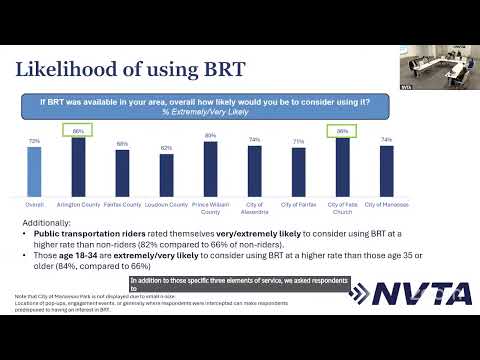
What the survey shows: Respondents generally reacted positively to the proposed network and service concept, with staff reporting that 63% felt the proposed system would serve “all or most” of the places they need to go. On operating hours and frequency, the report showed 85% and 82% respectively saying proposed spans and frequencies would meet their needs. Overall, 72% of respondents said they were “very likely” or “extremely likely” to consider using the BRT system, though staff emphasized the sample was self‑selected and not statistically representative of the full region.
Respondents prioritized reliability and on‑time performance over onboard amenities: dedicated lanes and other measures to maintain speed and reliability were most often selected as highest priorities (27%); ‘‘service that reliably shows up on time’’ was chosen by 25%.
Route preferences and likely use: When asked to identify up to three lines they would be most likely to use, respondents most often selected the routes identified in the study as line 26 (I‑95 corridor), line 21 (I‑66 corridor) and line 16 (Fairfax Boulevard). Work commutes were the top trip purpose for selected lines, followed by shopping and entertainment. Respondents indicated they would most often use BRT on weekdays during morning and afternoon peak periods, with an average intended use of about 3.1 days per week.
Technical analysis and coordination: Staff characterized the route‑level technical analysis as showing “strengths and weaknesses,” with many routes demonstrating strong performance on the metrics NVTA uses, including congestion reduction relative to cost — a legislatively mandated evaluation criterion. Staff also said the project team has coordinated extensively with jurisdictional planners and other regional initiatives such as local transit strategic plans and the Better Bus work.
Modeling and federal funding: Committee members asked whether the FTA STOPS modeling tool applies to BRT; staff confirmed STOPS has been used for BRT corridors and for Small Starts/CIG applications, but noted differences between corridor‑level and regional modeling that jurisdictions should consider if they later pursue FTA funding.
Implementation challenges: Committee discussion highlighted the principal barriers to deployment: finding capital and operating funds; securing curb and roadway space for dedicated lanes without unacceptable impacts to existing travel lanes; negotiating interjurisdictional operator agreements and memoranda of understanding to ensure interoperable service; and coordinating land‑use and zoning to support station‑area ridership growth. Members also stressed traveler information and real‑time data as essential to attract riders.
Next steps: Staff said they will finish analysis of open‑ended survey responses, perform deeper cross‑tabulations, and refine recommendations for the report to be presented for potential endorsement on June 18. Staff also recommended further peer exchanges, continued jurisdictional coordination, and additional analysis where the STOPS tool or other modeling choices would affect funding applications.
Procedural note: The committee did not take formal action on minutes from the prior meeting — they were tabled because a quorum was not present — and members moved to adjourn. The BRT briefing will return to a future meeting when the committee can consider endorsement.