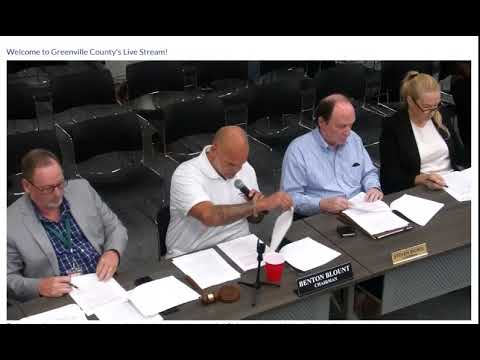
Greenville County holds joint workshop on proposed cluster-housing ordinance revisions
Loading...
Summary
A joint Greenville County Council and Planning Commission workshop examined proposed revisions to the county's cluster-housing rules in Article 24 of the Land Development Regulations, focusing on open-space calculations, density tables and definitions.
A joint Greenville County Council and Planning Commission workshop examined proposed revisions to the county's cluster-housing rules in Article 24 of the Land Development Regulations, focusing on open-space calculations, density tables and definitions. Commissioners and stakeholders discussed a draft redline that includes suggested reductions in minimum open space for some categories and several alternate density figures for residential zones.
The draft under review included a requirement that preliminary plans supply a density table listing gross acres, permitted density per acre, required open space and total dwelling units proposed. Staff noted multiple red-line edits, including a suggested reversion of minimum open space from 70% to 50% for several zoning categories (R-6 through R-20a) and proposed density increases for some zones (examples discussed in the meeting: R-6 from about 4.8 to 7.3 units per acre; R-7.5 from about 3.8 to 5.8; R-10 from about 2.9 to 4.4).
"This is a workshop, and this is just a start'. When we wrote this, there were some stuff that we would leave out. But this is not ink. This is pencil, so to say," Vice Chairman Bradley said, urging a balance between citizens' and developers' interests. Bradley and other commissioners said they wanted the language to produce "meaningful" open space rather than fragmented bits of land that provide no recreational or ecological function.
Several commissioners and speakers raised specific drafting problems. One commissioner argued that the term "navigable body of water," which appears in a minimum-area provision, invokes a federal definition tied to interstate commerce and could create a loophole for small local creeks: "We don't have any bodies of water in Greenville County that transport commerce," the commissioner said, and urged replacing or clarifying that term so streams and riparian buffers are addressed correctly. Commissioner Manning questioned draft language that would allow "private waters" to be counted as open space, saying private stormwater or wetlands may not be usable open space and proposing alternative wording such as "recreational waters."
Ellis Forrest, a developer who attended the stakeholder meeting, urged procedural changes to avoid last-minute rejections: "If I'm developing a property, I would like to know if you agree that the open space is appropriate, the dimensions are appropriate before I bring it in front of you to be voted for you to vote yes or no so that I can make the appropriate changes," he said, asking for clearer expectations prior to the preliminary-plat submission.
Developer Coleman Shouse gave a case example of Boxwood, a 30-acre R-12 project that produced 112 lots under earlier rules, and warned that the updated density tables as drafted would reduce yield: "If I did Boxwood today, I could only get 70 lots on what is now 112," he said, urging caution before changing baseline yield calculations.
Councilor McGahee and other elected officials framed many resident concerns around infrastructure and traffic rather than only aesthetics. "The biggest concern isn't the way they look'. It's the traffic they produce and the infrastructure demands," McGahee said, adding that commissioners must weigh constituent complaints about congestion and school and road capacity when considering policy changes.
Stakeholders and commissioners proposed several procedural and drafting remedies: (1) a consolidated definitions section that clarifies "open space," "common area," "developable," and "undevelopable" land; (2) a presubmittal or early-notice process for adjacent neighborhoods to review concept designs before large investments are made by developers; (3) explicit rules for what fraction of riparian buffers or tree-covered areas may count toward open-space totals (for example, permitting a percentage of wooded riparian buffers to be counted as passive open space rather than 100%); and (4) staff modeling of how the proposed changes would affect land consumption and infrastructure needs (roads, sewer, schools). Staff acknowledged they had not yet modeled land-consumption impacts and said they would do so before the next workshop.
Commissioners also discussed alternative approaches used in other counties: some jurisdictions achieve setbacks and separation from abutting properties by requiring a fixed distance from property lines and roads (examples cited included a 75-foot setback from an outer property line and 200 feet from a road in other counties) rather than counting those buffer areas as open space. The committee said such models would be examined as possible compromises.
Public commenters and some commissioners stressed that open space should be "meaningful": large contiguous areas for recreation or ecological function rather than small fragmented remnants. Several stakeholders said that riparian buffers and wooded areas can be meaningful even if not recreationally usable, and they asked for a clear table or percentages allowing portions of different types of land (timbered, riparian buffer, passive conservation) to contribute to the open-space requirement in defined amounts.
Next steps agreed at the workshop included scheduling a follow-up workshop with a publication deadline for proposed red-line changes and asking staff to provide modeling of potential changes' impacts on land use and infrastructure capacity. The meeting closed after a voice-motion to adjourn.
No formal ordinance adoption or land-use approvals occurred at the workshop; participants agreed to continue drafting and to return with additional modeling and revised text for further review.