Get Full Government Meeting Transcripts, Videos, & Alerts Forever!
Get email alerts on the County Budget topic
No spam. Unsubscribe anytime.
County finance consultant warns Senate Bill 1 will shrink tax base, shifts pressure to income taxes
Summary
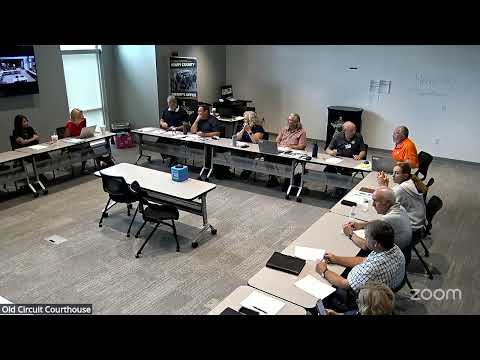
Jason, a consultant with Baker Tilly, told the Henry County Council at a July work session that recent state legislation known in the meeting as "Senate Bill 1" will reduce the county's property tax base and shift more revenue responsibility to local income taxes.
Jason, a consultant with Baker Tilly, told the Henry County Council at a July work session that recent state legislation known in the meeting as "Senate Bill 1" will reduce the county's property tax base and shift more revenue responsibility to local income taxes.
"One of the things that you heard over and over again was property taxes were too high," Jason said, summarizing lawmakers' intent and the bill's effects on deductions. He explained the bill will expand homestead deductions and add a credit equal to $300 or 10% of a homeowner's net tax bill, whichever is less, phased in through 2031; it will also phase in deductions for the 2% classification (rental, agricultural and certain institutional property) and raise the de minimis exemption for business personal property (effective 2027) to allow much larger equipment exemptions.
The net effect, the consultant said, is smaller taxable value for the county and overlapping taxing units, which in turn increases the county's circuit breaker losses and makes it harder to collect the same revenue without raising rates. "If you have a reduction in tax base," he said, "to be able to generate the same amount of revenue that you need, we're going to have to increase tax rates." He warned, however, that many taxpayers are already at statutory caps and would not pay more, producing additional revenue losses.
Baker Tilly presented modeled figures showing a projected circuit breaker loss of roughly 14% for 2024, about 12.6% for 2025 (estimates), and an incremental shortfall tied to SB1 of about $510,000 in 2026 in the firm's conservative scenario. The consultant said those shortfall estimates rise in later years as the new deductions phase in and that the outcome depends on future assessed-value growth: stronger assessment growth could offset some losses, sluggish growth could make the shortfall worse.
Jason also outlined a major overhaul to local income tax (LIT) law that takes effect in 2028 in the modeling. Under the new method, the multiple LIT "buckets" the county and cities currently use'EDIT, PSAP, EMS, judicial and others'will be consolidated. The county may adopt a county LIT up to 1.2% and retain the county share; fire territories and smaller municipalities may receive separate allocations. "It has given the counties a lot more flexibility," Jason said, but he added that the change also places more distribution decisions and political pressure on county leaders.
As a result, the presentation recommended preserving healthy fund balances and rainy-day reserves because income tax revenue is more volatile than property tax revenue and takes longer to recover after downturns. The consultant advised against spending down reserves now and urged planning for 2028 when many LIT allocations will move to the general fund or require new interlocal agreements.
The report showed particular stress in the county's local public health service fund after state-level reductions: Baker Tilly estimated local receipts could fall from roughly $1.0 million to about $285,000, and the firm proposed shifting roughly $800,000 of expenses to county levy modeling to sustain services.
County officials asked for follow-up work: the consultant said the analysis will be updated when 2026 assessed values are available and agreed to provide the presentation materials to staff. Officials discussed options for debt service reserves, bonding for bridges, and whether to transfer remaining LIT fund balances into the general fund or to set them aside in a rainy-day or debt-service reserve to protect future bond payments.
The presentation did not propose formal decisions; instead it provided a planning baseline and asked the council and commissioners to consider options as they draft 2026 budgets and prepare for statutory LIT changes in 2028. Jason recommended keeping ending balances where possible and reassessing major capital and personnel commitments as the county receives updated valuations and state guidance.
Ending: County staff requested updated modeling once 2026 assessed values are available and asked Baker Tilly to deliver revised numbers; the council and commissioners scheduled follow-up budget work sessions to set levy and spending priorities ahead of the statutory deadlines.