Get Full Government Meeting Transcripts, Videos, & Alerts Forever!
Get email alerts on the Municipal Budget topic
No spam. Unsubscribe anytime.
St. Pete Beach presents preliminary 2026 budget with $3.2 million parking transfer, fee study and reprioritized capital projects
Summary
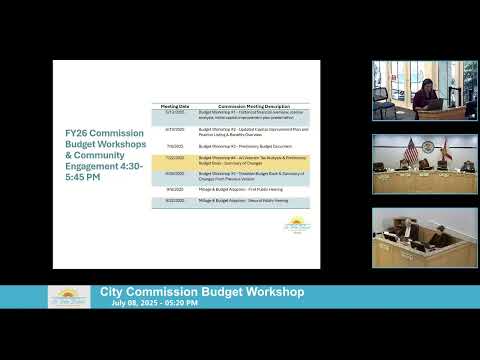
Devin Schmidt, finance director for the City of St. Pete Beach, presented the city's preliminary 2026 budget at a July workshop, saying staff would concentrate on operating and personnel numbers while returning capital project details from prior workshops.
Devin Schmidt, finance director for the City of St. Pete Beach, presented the city's preliminary 2026 budget at a July workshop, saying staff would concentrate on operating and personnel numbers while returning capital project details from prior workshops.
"We're gonna focus primarily on our operating personnel revenues since we've already spent two workshops on our capital projects," Schmidt said, summarizing the meeting's scope and the review process that began in April and included the finance budget review committee.
The budget staff set several assumptions and follow‑ups for the commission. Ad valorem receipts are currently estimated at about $15.1 million after applying a 4% early‑payment discount, based on staff's finding that roughly 70% of taxpayers pay in November to claim that discount. Staff noted roughly 91 potentially vacant properties that could affect collections. The budget assumes roughly $2.6 million in insurance recoveries and an expected $4 million in FEMA Category A/B debris reimbursements arriving within 12–18 months; those recoveries are planned to be transferred into capital projects.
A new parking fund created for 2026 is projected to transfer $3.2 million to the general fund to help cover streets, beaches, parks and a portion of public safety contracts. Schmidt said staff will monitor parking month‑to‑month; parking revenues began rebounding in March and the current estimate is conservative.
The city is conducting a fee study to review user charges across departments. Schmidt said the finance committee recommended the city consider passing consumer credit‑card convenience fees to customers for parking, a practice adopted by peer communities. Recreation and aquatics revenue projections were reduced and staff said they were working to reestablish a gym at the recreation center to restore services and revenue generation.
Personnel and cost assumptions include a 2.6% cost‑of‑living increase based on the May CPI, no projected increase in employee benefits due to favorable claims experience, and an assumed worst‑case 27% increase in workers' compensation and property/casualty insurance while staff works with carriers on deductible strategies.
Schmidt described a shift of fleet and facilities responsibilities to subject‑matter departments, and a move to plan vehicle replacement on a scheduled, costed cycle so funds are set aside at the time of replacement. Staff also proposed two limited‑duration positions in the building fund (a permit coordinator and an inspector intern) and recommended reclassifying a 0.75 finance technician to a full FTE.
On capital projects, the finance budget review committee and commission requested continued progress on Fire Station 22; Gulf Winds Drive was pushed to 2027; the Boca Ciega Drive complete‑street bid from 2024 (about $5.4 million) was reduced in scope, and staff will seek a one‑year extension on a $1.5 million FDOT grant that expires in 2025. Pass‑a‑Grille Way seawall work is planned as a design‑build award with design and permitting in fiscal 2026 and construction starting in 2026 for completion in 2027. The Don Cesar stormwater project was elevated to a higher priority and will proceed in phases; lateral service pipe replacement was moved to priority one.
Commissioners asked a series of follow‑ups. One commissioner asked whether the resiliency fund, originally intended to receive 50% of ad valorem increases under the comp plan, could be diverted to CIP needs; Schmidt said staff could consider it but wanted to follow the fund's intended purpose and noted the fund has been used for one resiliency project since 2023. Another commissioner expressed concern that stormwater cleanouts are only about 25% complete roughly nine months after the storms and asked whether contracting out could speed completion; Schmidt said he and Public Services Director Camden Mills would review options and return with recommendations.
A commissioner asked for clarification of items previously designated as legal requirements (for example, cameras in parks) so the commission could better weigh priority‑one allocations; staff agreed to compile statute/requirement detail for future meetings. Another question about an approximately $210,000 administrative fee in the building fund drew a staff explanation that the fee is a cost allocation to cover shared services (human resources, IT, finance, city attorney) and that staff will refine departmental cost allocation during 2026.
There were no formal votes or ordinance readings at the workshop; staff said they will incorporate commission direction and committee recommendations and return with a revised draft, including a more detailed ad valorem analysis (homestead vs. non‑homestead and residential vs. commercial) and tentative budget materials for a later meeting in August.
The workshop closed after questions and staff committed several follow‑ups: produce the fee study results when available, provide legal/statutory clarifications for items labeled legal requirements, report back on options to accelerate stormwater cleanouts (including contracted alternatives), and refine department‑level cost allocations.