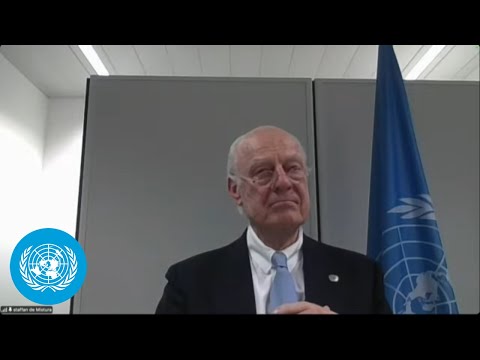
UN official Dimastura says Security Council resolution 27 97 provides framework for negotiations
Loading...
Summary
An official identified in the transcript as "Mister Dimastura" said Security Council resolution 27 97 provides a framework for negotiations aimed at a mutually agreed solution to the Western Sahara dispute and that the United Nations will call on parties to submit proposals, including Morocco's expanded autonomy plan.
BRUSSELS — An official identified in the transcript as "Mister Dimastura" said Security Council resolution 27 97 provides a framework for negotiations aimed at a mutually agreed solution to the Western Sahara dispute and that the United Nations will call on parties to submit proposals, including Morocco's expanded autonomy plan.
"The resolution 27 97 is significant," the official said, adding that it "provides, and I stress this word, a framework for negotiations. It does not prescribe an outcome, which will, as always, in order to be sustainable, be the result of negotiations conducted in good faith." He described the United Nations Secretariat as "like a sailing boat" that needs sustained engagement from Security Council members to move negotiations forward.
Why it matters: The statement signals the UN's intent to move from a Security Council text to a process of talks. The official said the UN's immediate follow-up will be to invite all parties to submit proposals and suggestions so the UN can develop a negotiating agenda. He also said the UN would take Morocco's expanded autonomy plan into account once it is submitted.
Details from the briefing: The official said the penholder and named envoys were proactively engaged in producing the resolution and listed the parties the text identifies: Morocco, the Polisario Front, Algeria and Mauritania. He said the resolution contains several elements intended to help bridge positions, including an openness to ‘‘genuine autonomy’’ proposals, an explicit call for negotiations without preconditions, and a concern for funding for refugees.
On timing and next steps, he said: "we are eagerly awaiting to see from Morocco the content of an expanded and updated autonomy plan as requested in my address to the Security Council 10/16/2024 and announced by His Majesty the King Mohammed VI in his recent address." He added that, "our own follow-up plan will be initially to call all the parties to submit proposals and suggestions in order to allow the UN to develop a ... agenda for direct or even, if necessary, indirect talks."
He also expressed satisfaction "for the extension of minerals until October 2026," as spoken in the briefing, and said that extension would help create the atmosphere of stability needed to accompany future negotiations.
Questions from reporters: When asked whether the resolution is "very pro-Moroccan" or favorable to Western Sahara inhabitants, the official said the text is a framework and that positive "atmospherics" exist but that the "real work" of negotiating remains ahead. On whether the Polisario Front supported the text, he declined to paraphrase the group's position and said the UN would engage the Polisario following the resolution.
What the statement does not say: The briefing did not record any formal agreement, vote or commitment from the parties. The official did not give details of Morocco's expanded autonomy plan, did not provide a timetable for formal talks beyond a general suggestion to "talk in about a month," and did not describe what the referenced "extension of minerals" precisely means in operational or mandate terms.
The official concluded by saying he was ready to take one or two questions and encouraged further engagement; reporters pressed on the balance of the resolution and on refugee funding and modalities for negotiations.