Get Full Government Meeting Transcripts, Videos, & Alerts Forever!
Get email alerts on the Waste Management Organics topic
No spam. Unsubscribe anytime.
Lake County OKs organics-processing fee, sets new rates for Jan. 1, 2026
Summary
The Board of Supervisors approved mirror amendments to two franchise agreements to add an organics processing pass-through fee and allow voluntary curbside food-waste collection in the existing green-waste cart; the board set the effective date for the new rates as Jan. 1, 2026 and approved an outreach period before billing changes take effect.
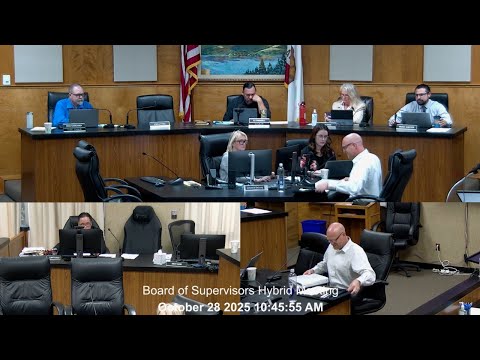
The Lake County Board of Supervisors on Oct. 28 approved Amendment 3 to franchise agreements with Lake County Waste Solutions Inc. and South Lake Refuse Company LLC to add an organics processing pass-through fee and to permit voluntary curbside collection of food waste in the county's green-waste carts. The board voted 4-0 to adopt identical amendments as amended to make the new rates effective Jan. 1, 2026.
Public Services Director Lars Ewing told the board the amendments respond to higher volumes of green and food waste and rising processing (tipping) fees at local recovery facilities. "On average for a residential customer with a 32 or 30 gallon cart, we're talking about anywhere between $1.2 and $1.5 give or take per month," Ewing said, describing the change as a pass-through similar to landfill tipping fees or fuel adjustments.
The amendments follow recommendations from Lake County's Solid Waste Task Force and reflect state policy under SB 1383, the short-lived climate pollutant program that aims to reduce organic material sent to landfills and recover edible food. Ewing noted that Lake County operates under a rural waiver that exempts the county from SB 1383's mandatory organics-collection requirement; the county is nonetheless pursuing a voluntary curbside option.
Ewing and board members described operational benefits the county expects if food waste is added to curbside green carts: standardization of curbside collection across jurisdictions, reduced landfill inbound organics and associated methane, and financial savings from reduced landfill airspace use. Ewing noted that the county's landfill already operates a landfill-gas collection and control system that must be managed in accordance with state rules.
During public comment and board questioning, staff and hauler representatives described where the material would go and how it would be handled. Ewing said most green waste currently goes to the privately owned Quackenbush Mountain Resource Recovery Facility adjacent to East Lake Landfill; some loads may go to a material recovery facility in Ukiah. Bruce McCracken, a representative of Lake County Waste Solutions, told the board, "Food waste will be collected in the green can. It composts well. We have no issues with it," and cautioned customers against placing noncompostable plastics or bags in the carts.
Board members raised concerns about adding costs for residents already facing near-term pressures. Several supervisors proposed, and the board accepted, amending Section 6.3 of each amendment to specify that the new rates would be effective Jan. 1, 2026, while educational outreach to residents could begin earlier. Staff said outreach (newsletters and community meetings coordinated with municipal advisory committees and the haulers) would precede any billing changes.
Both amendments were approved by motion and second and carried by a 4-0 vote. The approved actions direct staff to finalize contract language setting the effective date and to continue coordination with the haulers on an education campaign ahead of the rate change.
The contracts remain separate franchise agreements for Lake County Waste Solutions and South Lake Refuse Company LLC even though both companies are under a common parent company (Waste Connections) and Lake County Waste Solutions recently assumed operational control of South Lake Refuse. The amendment adds an explicit pass-through for organics processing in each contract and the board required the effective date be set to Jan. 1, 2026.