
Baltimore County officials urge backyard flock owners to tighten biosecurity, register birds and report sick poultry to Maryland Department of Agriculture
Get AI-powered insights, summaries, and transcripts
Subscribe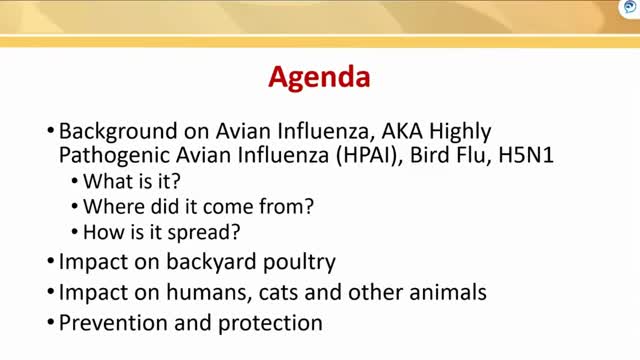
Summary
Baltimore County health and agriculture officials told residents during a virtual webinar that highly pathogenic avian influenza (HPAI, commonly called bird flu) remains a statewide threat and urged backyard flock owners to strengthen biosecurity, register their birds with the Maryland Department of Agriculture and report any sick or dead poultry immediately.
Baltimore County health and agriculture officials told residents during a virtual webinar that highly pathogenic avian influenza (HPAI, commonly called bird flu) remains a statewide threat and urged backyard flock owners to strengthen biosecurity, register their birds with the Maryland Department of Agriculture and report any sick or dead poultry immediately.
Dr. Alex Chen, a county health presenter, said the current concern centers on the H5N1 strain, which arrived in North America in late 2021 and has since mixed with local viruses. "If you do have sick birds, you are to call them 24 hours a day," Chen said, referring to the Maryland Department of Agriculture’s reporting line. He noted the virus moves widely via migratory waterfowl and can reassort with other influenza strains.
Why it matters: officials said HPAI has caused deadly outbreaks in poultry and has crossed into other species, including dairy cattle (reported decreases in milk production and an estimated ~2 percent mortality among affected cattle), domestic and zoo cats, and marine mammals. In the United States there have been about 70 confirmed human cases to date, mostly mild, and one death in Louisiana; panelists said there is no evidence of sustained human‑to‑human transmission.
Key recommendations and local rules
- Biosecurity: keep birds indoors where possible; restrict visitors to coops; use separate footwear or shoe covers when entering flock areas; change clothes and shoes after contact with other birds; disinfect equipment and prevent rodent access. The presenters emphasized removing bird baths and standing water that could attract wild waterfowl.
- Registration and testing: backyard flock owners must register with the Maryland Department of Agriculture (MDA). If owners suspect avian influenza, MDA should be contacted immediately at (410) 841‑5810 rather than waiting for a veterinary visit, the panel said. MDA handles testing and can arrive on site; turnaround times for test results can be as fast as 24 hours.
- Egg sales and small producers: anyone selling eggs must register with MDA’s food safety/quality program and follow Maryland egg law labeling and packaging requirements. University of Maryland Extension has additional guidance on packaging and storage for small producers.
- Events: MDA has suspended poultry shows, sales and swaps in Maryland through May 1; the state will reassess the directive at the end of April.
Pets and non‑poultry animals
County officials advised pet owners to reduce exposure risks. "If you can bring cats inside, that's safer," said the county veterinarian, who noted cats have shown more severe disease in reported cases. Dog owners should supervise animals to prevent hunting or scavenging dead birds and avoid feeding raw meat or raw milk to pets. Officials reiterated that any animal showing signs after contact with wild birds or sick livestock should prompt a call to MDA or to a healthcare provider for humans.
Response if a flock tests positive
Panelists said that when an infected premises is confirmed, MDA typically depopulates affected birds and provides instructions on site cleaning and the timeline for safe repopulation; movement of poultry out of control zones generally requires state permits. The presenters described a control strategy that includes a hot zone (commonly a one‑mile radius) and additional warm/control zones around infected sites with staged restrictions on movement.
Public health context and data sources
Speakers pointed listeners to public maps and outbreak data from USDA and the U.S. Fish and Wildlife Service for wildlife and farm detections. They recommended seasonal influenza vaccination for humans to reduce the chance of simultaneous human and avian infections that could promote viral reassortment. The panel said no broadly available HPAI vaccine for animals or humans exists at this time.
Local context
Jessica Armacost of the Baltimore County Office of Agriculture reviewed county requirements: the county’s backyard flock license runs three years, allowable flock size depends on property size, and roosters are not permitted. Armacost encouraged owners to contact the county office for zoning and licensing questions.
Resources and how to get help
Panelists said webinar materials and a recording will be posted on the Baltimore County Department of Health and Animal Services websites. For suspected sick or dead poultry, Maryland Department of Agriculture: (410) 841‑5810. University of Maryland Extension and the American Veterinary Medical Association also maintain guidance pages for small producers and pet owners.
The county closed by encouraging residents to register flocks, report illness promptly and to check county and state sites for updates; officials said they may hold follow‑up webinars if the situation changes.