Get Full Government Meeting Transcripts, Videos, & Alerts Forever!
Get email alerts on the Community Spaces topic
No spam. Unsubscribe anytime.
Isla Vista CSD releases new community‑space reservation, pricing and insurance rules
Summary
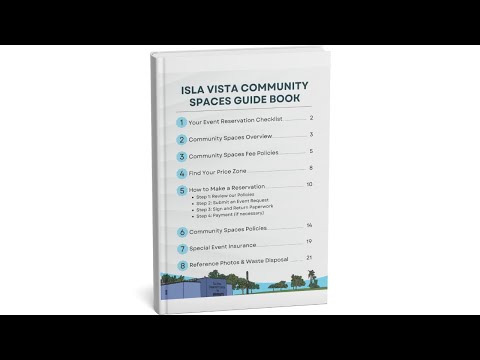
Maya, community programs and engagement manager for the Isla Vista Community Services District, led a training session introducing a new Community Spaces Guidebook that updates how residents, student groups and organizations reserve district facilities, how fees are set and when insurance is required.
Maya, community programs and engagement manager for the Isla Vista Community Services District, led a training session introducing a new Community Spaces Guidebook that updates how residents, student groups and organizations reserve district facilities, how fees are set and when insurance is required.
The guidebook prioritizes public access, staff said, with a sliding‑scale fee structure tied to whether an event is open to the public and to time‑of‑day pricing. "Events should be free or low cost if they provide a high community benefit, like a service or a resource, are open to the public, or occur during nonprime times," Maya said.
Under the new schedule, prime times are generally Monday through Thursday from 5 p.m. to midnight and Friday through Sunday from noon to midnight. Monday and Friday receive modest discounts compared with the weekend. The district described a color‑coded hourly system: hours in some zones are free, others low cost or high cost, and mixed‑hour events are billed proportionally across those zones. Staff gave concrete hourly examples: the community center's low/high rates are $20 and $25 per hour, and the community room's low/high rates are $8 and $10 per hour; setup and cleanup are included in billed hours.
Sliding‑scale eligibility: Isla Vista residents may apply for reduced fees by providing proof of residence, enrollment in a low‑income program (for example, CalFresh) and the event's overall budget. Nonprofits and businesses may qualify based on organizational operating budget: entities with an operational budget below $1,000,000 are likelier to qualify for lower rates while those with budgets at or above $1,000,000 are likelier to pay higher rates. Student clubs follow the same open/closed rules: open events are lower cost, closed events carry higher fees.
The district also changed its prior prohibition on charging admission. Admission may be charged only if one of three conditions is met: the event is raising funds for a registered nonprofit, the fee covers event production costs (with a requested breakdown of how revenue will be used), or the organizer obtains approval from the IVCSD board after a formal request. Maya said organizers who charge admission without prior approval will receive a formal warning, be required to refund profits, meet with staff and may face probation.
Reservation mechanics and timelines: organizers must submit event requests on the district calendar and include total hours, expected attendance, the color zone, whether they are applying for sliding scale, and whether the event is open or closed to the public. Within three days of submission, staff (Leslie, the community spaces project manager) will email required forms; reservations are not finalized until applicable paperwork and payment are received. Most large events require insurance, and staff advised organizers to submit large or high‑risk requests at least one month in advance. High‑intensity, nonrecurring events (conferences, festivals, weddings) can be requested as far as six months to a year ahead of time.
Insurance and hazard tiers: the district provides insurance options that are categorized by hazard level. User events span Hazard 1 (low risk: recitals, seminars, indoor meetings), Hazard 2 (outdoor meetings, events with alcohol, farmers markets) and Hazard 3 (live entertainment, carnivals, nightclub‑style shows). Instructor/recreation events that are instructional and exceed 100 people have flat rates: $58 for music/art/nonathletic classes and $105 for athletic activities. Organizers must submit event details (organizer contact, address, date/time, expected attendance, hazard level, alcohol plans and vendor sales information) and wait for insurance coverage to be confirmed before the event.
Operational rules and enforcement: every reservation requires a checkout form after each use; failure to file risks suspension of future reservations until the form is completed. Organizers are responsible for setup and cleanup. The district said moderate cleaning violations carry a $100 professional cleaning fee; severe violations carry a $200 fee and may lead to up to one year of probation if unpaid. Cancellations must be made at least 48 hours in advance.
Other facility notes: available spaces include the community center, community room and a conference room in the 970 Building; the district shares a parking lot with IVRPD and pointed out additional lots at Pardall and Embarcadero Del Mar. Users must not discriminate or harass, smoking is prohibited on district property, occupancy limits are set by the fire department, and organizers may not make permanent alterations to facilities. Food is allowed but the district does not provide catering and is not a party to contracts between organizers and private caterers. Keys should be returned to the lockbox after unlocking; the presenter recommended returning keys immediately to avoid lockouts. Trash must be emptied into the district dumpster at the end of events.
Contact and next steps: organizers should watch the district calendar for quarterly reservation windows (winter opens Dec. 1, spring Mar. 1, summer May 1, fall Sept. 1) and contact the community spaces project manager, Leslie, via the reservation email communityschedule@alibuscsd.com for forms, payment links and insurance guidance.
Ending: Maya closed the training after walking through photos of the spaces and logistics and invited attendees to ask follow‑up questions.