Get Full Government Meeting Transcripts, Videos, & Alerts Forever!
Get email alerts on the Capital Outlay topic
No spam. Unsubscribe anytime.
Committee reviews preliminary five-year capital outlay plan and facility assessments for Tangipahoa Parish
Summary
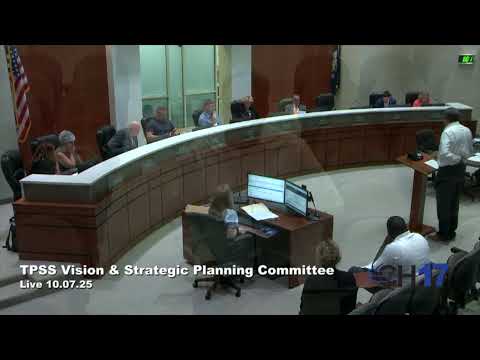
A Tangipahoa Parish strategic-plan committee reviewed a preliminary five-year capital outlay plan and facility-assessment snapshots. Staff presented estimated project costs, a cash-flow view of capital outlay funds and recommended priorities; the plan is informational and will be revised as needs change.
A Tangipahoa Parish strategic-plan committee reviewed a preliminary five-year capital outlay plan and facility-assessment snapshots during a meeting where staff presented project cost estimates, fund balances and a proposal to simplify school-level allocations. No formal motions or votes were recorded in the transcript of the discussion.
Committee members were shown a phase-based plan and cost estimates for capital work. "Phase 1, there's about, $710,000 of estimated cost on the Laronjay girls locker room that should be finished this year," staff said. The presentation described Phase 2 as "about $51,000,000," with roughly $10.7 million expected to be spent in 2526. Staff also reported that roughly $4,700,000 remained to be paid for GEM HVAC work in 2526.
On the district's cash position, staff reported a beginning capital outlay balance of $73,565,000 and a projected total available for 2526 of about $87,000,000. "It looks like based on these numbers going back up that we'll spend about 26,000,000 this year, and then we'll have $50.61 to carry over to the next year," the presenter said. Committee members and staff clarified that the annual inflow shown (about $13.07) is derived from the second sales-tax penny and that some sales-tax revenue previously serviced a bond (referred to in the meeting as "o w dylan") recorded in debt service.
Staff proposed combining two school-level funding pots — the $2,800,000 small capital outlay allocation and the general allocation — into a single "school allocation" to simplify principals' decision-making while maintaining current approval processes. Asked how much the small capital outlay equates to per student, staff divided the $2,800,000 by an approximate student population (about 18,000) and noted the per-student figure is roughly $147.
The committee discussed how the assessments, prepared by CSRS and reviewed against work already completed, produced a one-page priority list for each school that maintenance will use to schedule repairs. The presenter said the prioritization begins with safety and security work, then moves to items that prevent further deterioration, such as drainage and electrical systems. The presentation also noted that the board had voted earlier in the meeting to replace electrical service at Kentwood and at Amy Lee Elementary; staff said those projects appear in the assessments and are being addressed.
Staff emphasized the plan is a "living document" intended for public input and for internal cash-flow planning, not as authorization to begin contracts. The presenter described the document as cash-basis (not accrual) and noted that large contracts are encumbered when signed even if cash is spent over multiple years. Committee leadership said snapshot links would be posted for public review and urged committee members to share them with constituents.
The meeting closed with a reminder that the five-year view represents only part of a longer-term need (committee members cited 10–15 years of facility upgrades) and that priorities will change if emergencies occur. The committee adjourned after agreeing to post the assessment snapshots and continue refining the living plan.