Get Full Government Meeting Transcripts, Videos, & Alerts Forever!
Get email alerts on the Redistricting topic
No spam. Unsubscribe anytime.
Senate committee advances implementation bill after fraught hearing on one‑time mid‑decade redistricting plan
Summary
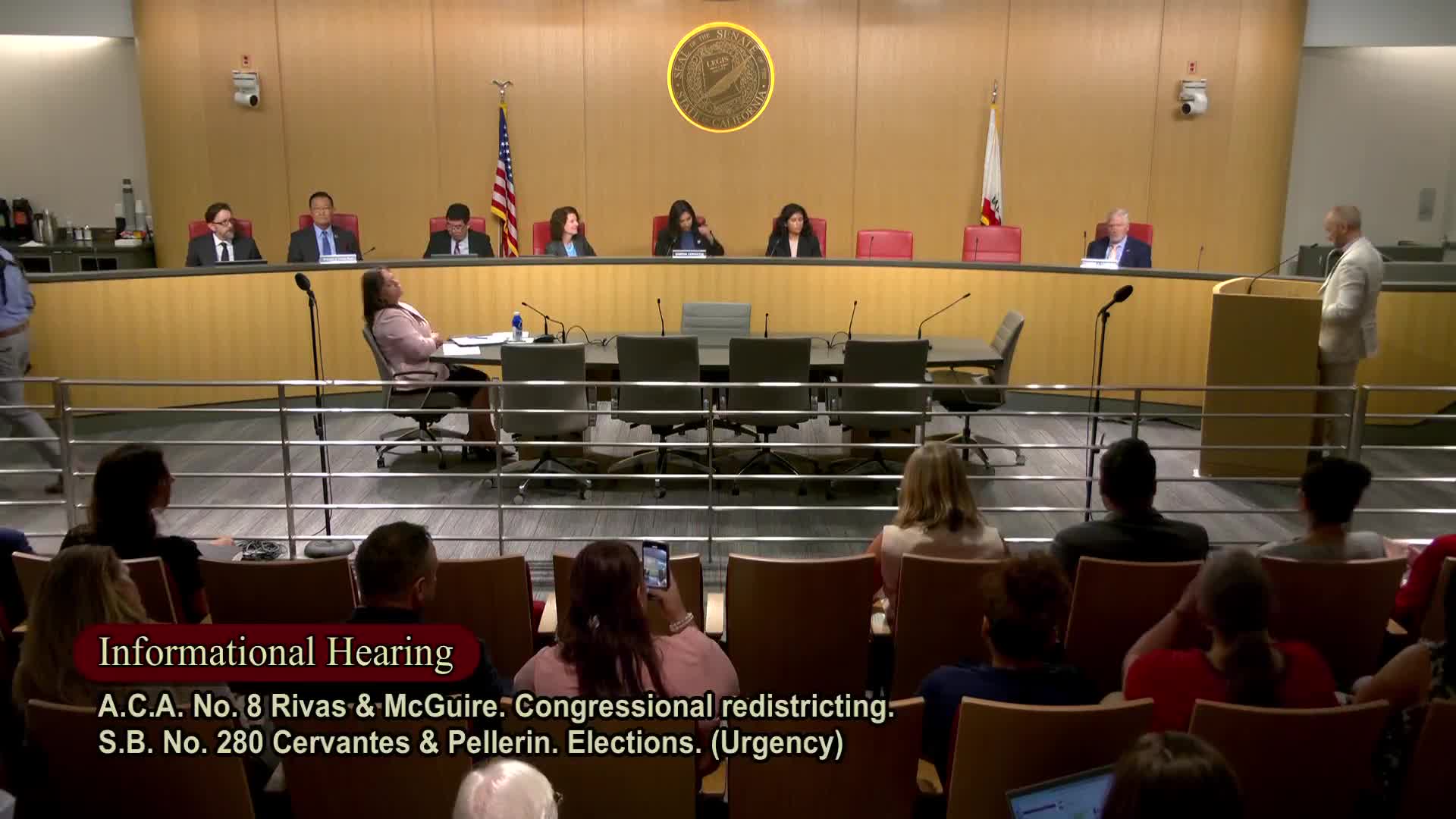
SACRAMENTO — The Senate Elections Committee on Constitutional Amendments on Wednesday heard testimony on a package of measures that would allow California voters to enact a one‑time mid‑decade congressional redistricting plan if other states redraw their maps.
SACRAMENTO — The Senate Elections Committee on Constitutional Amendments on Wednesday heard testimony on a package of measures that would place a one‑time, voter‑approved mid‑decade congressional redistricting plan before Californians only if another state adopts new congressional maps that take effect between Aug. 1, 2025, and Jan. 1, 2031.
Senator Sabrina Cervantes, chair of the committee, opened the informational hearing by calling the proposal a defensive response to what supporters described as an effort by President Trump and Republican state officials, particularly in Texas, to "rig" the 2026 congressional map. "We will not allow red states to strip seats in Congress," Cervantes said in her opening remarks.
The legislative package is centered on Assembly Constitutional Amendment 8 (ACA 8), which would amend the California Constitution to authorize a one‑time mid‑decade statewide congressional map that would take effect only if other states adopt mid‑decade maps meeting the measure—s trigger conditions. SB 280 would provide statutory authority and appropriations to call and administer a statewide special election on Nov. 4 to put ACA 8 before the voters and to preserve the June 2026 primary schedule; AB 604 contains the proposed temporary congressional maps to be presented to voters if ACA 8 is approved.
Supporters said the package preserves Californians— power at the ballot box while responding to an extraordinary threat. "If we don't fight back, federal attacks on reproductive health care will only get worse," Jody Hicks, CEO of Planned Parenthood Affiliates of California, said in testimony supporting the package. Sarah Sadwani, a former member of the California Citizens Redistricting Commission, told the committee she supported asking voters to have the final say in this moment, describing the proposed action as a necessary check on what she called "attacks on free and fair elections."
Opposition witnesses included former CRC commissioners Connie Archbold Robinson and Jean Raya, who urged the committee to preserve the independent commission—s role and to release the data and rationale behind the proposed maps. "This new map was developed by legislators and their consultants behind closed doors," Robinson said, arguing the commission—s process had been more transparent and had produced competitive districts.
Committee members pressed authors and witnesses about several technical points: how the trigger works, whether the proposal is a partisan attempt to increase one party—s seats, what data were used to draw the proposed maps, how long the maps would be available for public inspection, and how much the special election would cost. Authors and technical witnesses said the maps are based on the 2020 decennial census data and that the proposed maps had been posted online for public review; the proponents also said voters would have roughly 74 days to review the maps before the election and that the voter guide would include visual depictions of the maps.
On cost, estimates cited during the hearing varied: a committee witness said the election appropriation would be approximately $200 million to $250 million to the Secretary of State and county registrars for administering a statewide special election. Committee members asked where that funding would come from given state budget pressures and the state general fund outlook; authors said the bill provides the appropriation for that election administration.
Opponents and some senators said the proposal risks undermining the independent commission created by voters and argued California should not "mirror" the alleged tactics of other states. Proponents countered that the package is narrowly tailored and would only take effect if other states first enact mid‑decade partisan maps that change congressional apportionment.
The committee did take formal action on AB 604, the implementing map bill. Senator Limon moved the measure to the Appropriations Committee. A roll call recorded the measure as moved out of the committee with four ayes and one no: Senator Cervantes — aye; Senator Allen — aye; Senator Limon — aye; Senator Umberg — aye; Vice Chair Choi — no. The action sends AB 604 to the Senate Appropriations Committee for further consideration; no final statewide ballot or constitutional change is in force absent voter approval of ACA 8.
Copies of the proposed maps and the legal descriptions were posted on legislative committee websites during the week leading up to the hearing; authors said those materials would be linked in the sample ballot and the voter guide if a special election is called. The bills and the maps remain subject to further committee action and to any changes the Legislature might make before a measure is placed on the ballot.
What remains unresolved from the hearing: opponents pressed for more transparency on who drafted the map variants that were posted and requested additional public participation mechanisms; supporters said the plan preserves the independent commission for the regular decennial cycle while giving voters an option if other states move first.
The committee—s action on AB 604 does not itself change district lines; it advances a bill that would implement the maps only if voters approve the constitutional amendment specified in ACA 8 and the trigger conditions are met. The matter will return to the Legislature, and the proposed special election will occur only if triggered and funded as described in SB 280.