Get Full Government Meeting Transcripts, Videos, & Alerts Forever!
Get email alerts on the Racial Disparities Youth Incarceration topic
No spam. Unsubscribe anytime.
Residents debate causes of racial disparities in youth incarceration at Riviera Beach workshop
Summary
During a breakout exercise at the Riviera Beach workshop, small groups used Cook County statistics to argue competing explanations for disproportionate Black youth involvement in arrests and transfers to adult court. Positions ranged from systemic racism to family structure to policy design.
A structured breakout at the Riviera Beach workshop asked small groups to defend alternate explanations for racial disparities in juvenile arrests, using Cook County (Chicago) statistics as a test case.
Organizers gave teams the same data: in Cook County Bryant cited, 31% of youth are white, 29% are Black and 34% are Hispanic, yet 73% of youth arrests and 87% of transfers to adult court were for Black youth. Six groups were assigned positions and each presented a short defense.
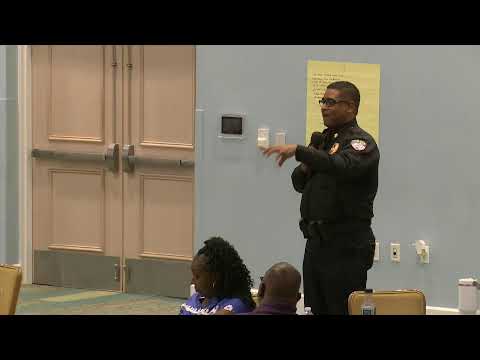
Pastor Isaac Lane, speaking for a group that emphasized family structure, said absence of fathers could reduce household structure and advocacy for children and contribute to pathways into the system. "When you don't have a dad in the home, it's...low confidence, lack of structure and discipline," Lane told the room.
Another group argued the system is structurally racist and rooted in historical policies, citing the 13th Amendment's language and later criminal‑justice policies that disproportionately affected Black communities. A spokesperson for that group summarized the position as: the system and historical policy decisions continue to drive disparities.
A third group defended a counterposition — that disparities reflect differing offending rates rather than systematic bias — led by Dr. Saint Hill, who framed incarceration as a consequence of criminal behavior and an instrument of social protection. Other groups pointed to policy features (mandatory minimums, juvenile transfer policies) and socioeconomic pressures affecting single‑parent households.
Attendees questioned how policies could be changed; panelists and audience members pointed to state legislative routes and local reentry and support programs. A participant noted Palm Beach County maintains reentry programming for youth and adults and described task‑force links to services.
The breakout did not produce a consensus: presenters left the audience with competing explanations and a recognition that multiple factors — policy choices, policing practices, socioeconomic conditions and family dynamics — are all invoked in local debate. Workshop organizers said the purpose of the exercise was to surface differing viewpoints and encourage continued conversations in future sessions.