Get Full Government Meeting Transcripts, Videos, & Alerts Forever!
Get email alerts on the Police Community Relations topic
No spam. Unsubscribe anytime.
Riviera Beach workshop urges collaboration, accountability between police and community
Summary
At a Riviera Beach community workshop, trainer Dwayne Bryant and city police leaders urged residents and officers to strengthen collaboration and accountability to improve public safety and community trust.
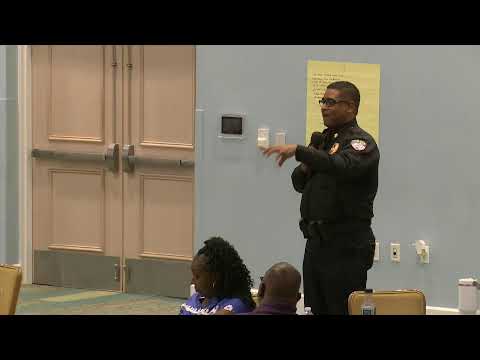
At a Riviera Beach community workshop, trainer Dwayne Bryant and city police leaders urged residents and officers to strengthen collaboration and accountability to improve public safety and community trust. Bryant, who trains law enforcement nationally, framed the evening around shared responsibility and local data showing enforcement patterns.
The workshop matter‑of‑factly reviewed Riviera Beach policing figures: Bryant said the department issued 6,355 citations in 2024, that 40% of contacts were written warnings and that citation recipients were disproportionately Black (66% of citations versus 33% for white residents). He also presented workforce demographics, saying the Riviera Beach Police Department is majority African American while the city population is 65.4% Black and that women made up roughly 17% of the department.
Those numbers set the tone for a discussion about accountability and leadership. Chief Michael Coleman, who joined the session, said his department reviews body‑worn camera footage and conducts investigations when officers violate policy. "I'd rather get rid of that officer before I lose my community," Chief Coleman said, arguing that removing officers who have eroded trust can protect both the department and public safety.
Bryant pressed for clearer lines of communication: residents should report misconduct when they see it and police leaders should act on credible complaints, he said. He also used examples from other jurisdictions to broaden the conversation about what counts as criminal behavior, saying corruption and misconduct by public officials and judges can be as harmful as street crime.
The trainer ran a short enforcement module, showing dashcam clips in a "roll the stop" exercise to illustrate how officers decide whether to cite drivers. He also highlighted local programs and recommended more community events and youth services as preventive measures; Bryant cited Baltimore's investments in summer camps and extended recreation hours as an example of non‑enforcement strategies that preceded crime reductions.
Local officials said the department already holds regular public meetings and seeks to expand outreach. Major Gordon described weekly and monthly community touchpoints and invited residents to call an accountability line when they see problems. Anita Jenkins, director of Riviera Beach's Community Redevelopment Agency, and other local leaders attended and were recognized during the event.
The workshop closed with a call for continued engagement and a planned part 3 in the series to address behavioral styles and deepen collaboration. Bryant offered materials and a workbook titled Stop for residents and youth to use as conversation starters.
Bryant and local leaders emphasized that improving outcomes will require both departmental accountability and sustained community involvement rather than one or the other alone.