Get Full Government Meeting Transcripts, Videos, & Alerts Forever!
Get email alerts on the Grade Separation Study topic
No spam. Unsubscribe anytime.
Forney holds open house on six route options for proposed railroad bridge; residents raise property impact concerns
Summary
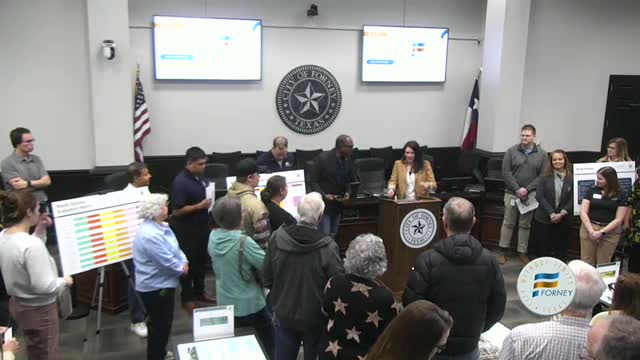
FORNEY, Texas — City of Forney staff and consultant WSB presented a route‑and‑feasibility study for a proposed grade separation (bridge) over the railroad at a public open house, showing six corridor options, planning‑level cost estimates and maps of potential right‑of‑way impacts.
FORNEY, Texas — City of Forney staff and consultant WSB presented a route‑and‑feasibility study for a proposed grade separation (bridge) over the railroad at a public open house, showing six corridor options, planning‑level cost estimates and maps of potential right‑of‑way impacts.
"My name is Carl Zook, assistant city manager for the city of Forney," Zook said at the start of the meeting, noting the open‑house format and that comment forms and an online survey will be used to collect public input for city council. Mayor Jason Robertson summarized the bond process that funded initial work, saying a citizen bond committee formed in 2021 recommended projects that became Proposition E, and that the roadway project including a potential bridge was among those items.
"Our firm is contracted with the city of Forney to perform the route and feasibility study, which is why we're all here tonight," said Carla Easton, the lead consultant from WSB. Easton said Proposition E was shown as a $52.7 million package and the grade‑separation project was authorized for $29.9 million. She described the study's purpose as evaluating options for environmental and community impacts, mobility, geometry, construction considerations and total project costs so the city can narrow to a preferred option.
The consultant presented six color‑coded options and planning figures: Far West (4‑lane arterial, 545‑foot bridge, about 3.5 acres of right‑of‑way, planning cost about $27–29 million); Pinson Road (2‑lane collector, 593‑foot bridge, about 1.1 acres ROW, $22–24 million); Oak Street (2‑lane collector, spans Main, the railroad and Broad, 735‑foot bridge, 1.6 acres ROW, $30–32 million); Chestnut Street (follows existing Chestnut, 726‑foot bridge, 0.9 acres ROW, $29–31 million); and two Far East variants (Option A to the US‑80 frontage road, 495‑foot bridge, 2.1 acres ROW, $22–24 million; Option B terminating at Regal Drive, $21–23 million). Roll plots, plan/profile drawings and evaluation matrices for each option were on display for attendees to examine and comment on.
Residents repeatedly asked whether "right‑of‑way acquisition" could mean losing a home. In response officials clarified that property acquisition and displacement are possible where right‑of‑way impacts occur and that property owners would be compensated under applicable acquisition procedures. Mayor Robertson and other council members said they were not seeking to "take anybody's house" and emphasized that the open house is part of gathering public input and exploring other options.
Attendees asked about traffic counts downtown and the effect of a bridge on local traffic patterns. City staff and the consultant said detailed vehicle counts for state roads come from the Texas Department of Transportation (TxDOT) and that the project's traffic engineers can perform or supply local counts if a particular option advances. Officials also said a grade separation generally improves safety compared with at‑grade crossings and that funding matches from the city can help attract state or federal grants and regional discretionary funds (for example through North Central Texas Council of Governments and TxDOT). They cautioned that major projects involving TxDOT and railroad coordination can take many years to progress from study to construction.
Easton said the project remains conceptual and that the next step is to compile comments from the open house and return results to city council in late spring or early summer. She said a later phase would refine a preferred option, include stakeholder coordination (railroad, TxDOT), perform more detailed feasibility work and update design and cost estimates.
Exhibits at the meeting identified environmental constraints including FEMA floodplain, historic properties and churches. Officials said the displayed evaluation matrices compare options using consistent criteria so council can reference the analysis when weighing whether and where a bridge should be pursued.
Most importantly, staff urged attendees to complete a comment form or the online survey; those responses will be compiled and presented to city council to inform any next steps.
Votes or formal council actions were not taken at the open house; the session functioned as a public information and input meeting.