Lifetime Citizen Portal Access — AI Briefings, Alerts & Unlimited Follows
Jupiter panelists highlight wastewater reuse, living shorelines and community stewardship to "preserve paradise"
Loading...
Summary
Local utility, county and conservation leaders on a Town of Jupiter panel described how wastewater recycling, shoreline projects, natural-area restoration and resident engagement work together to protect the Loxahatchee watershed and the town's coastal environment.
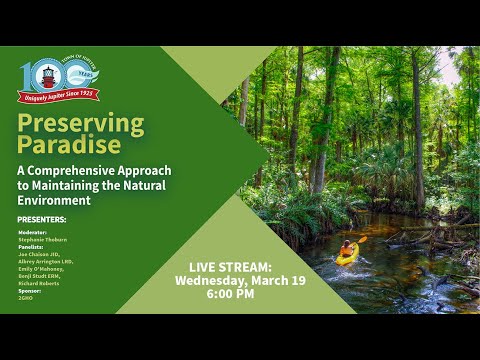
A panel hosted by the Town of Jupiter to mark the community's centennial heard Tuesday that maintaining the town's ecological health depends on coordinated utility work, targeted restoration projects and stronger community connections to wild places.
Town of Jupiter Assistant Director of Planning and Zoning Stephanie Thoburn opened the program and introduced the five panelists drawn from utilities, county resource management, landscape design and state parks.
The nut graf: Panelists described concrete steps residents and agencies can take now'from using treated recycled water for irrigation and installing living shorelines to protecting natural areas with conservation easements'to slow saltwater intrusion, reduce stormwater impacts and preserve habitat as development continues.
The Loxahatchee River District, the local wastewater utility, "collects and treats effectively and actually treats so well that it's been officially recycled," said Aubrey Arrington, science director at the Perry Institute and longtime Loxahatchee River District leader. Arrington said the district manages roughly $180 million to $190 million in treatment and storage assets and directs treated "IQ" (irrigation-quality) water to local golf courses, which reduces withdrawals from wetlands and the aquifer.
"You may not have ever thought wastewater was beautiful, but it's a beautiful thing," Arrington said, describing the public-health and ecological benefits of centralized treatment and reuse.
Jupiter Inlet District Executive Director Joe Chasen summarized the inlet authority'created by the state legislature in 1921'and its continuing role in keeping the inlet open and managing shoreline impacts. "In 1921, we purchased a 600-foot wide strip of Jupiter Island'from the ocean to the bay'for $1,500," Chasen said, as he described historic efforts to stabilize an intermittently closing inlet and the district's 92-square-mile service area.
County environmental staff stressed the scale of local natural areas and restoration work. Benji Stu, who leads outreach and science communication for Palm Beach County Environmental Resources Management (ERM), listed sites in the town limits such as Jupiter Inlet Lighthouse Outstanding Natural Area, Delaware Scrub and North Jupiter Flatwoods and pointed to artificial reefs, beach and dune restoration, Sawfish Island (recently renamed Karen Golanka Island) and large-scale hydrologic restoration in the Loxahatchee watershed.
Stu highlighted one small example of why local habitat matters: a Delaware Scrub wetland that supports two species of large salamanders, noting that some individuals can "stay dormant for up to 5 years waiting for the rains to return." He and other panelists argued that seeing and experiencing wild places builds the public support needed to protect them.
Panelists also recounted past restoration efforts: county and local agencies installed a demonstration living shoreline at the Jupiter Lighthouse in 2020'21 and completed a series of oxbow restorations in the 1990s that collectively increased river length by about one mile; the oxbow projects required a first maintenance event roughly 30 years later.
On challenges, panelists emphasized water-related threats. "We have saltwater intrusion," said Emily O'Mahony, president and managing principal of 2GHO Incorporated, a landscape architecture firm. O'Mahony urged limiting new sprawl and increasing redevelopment density within existing urban areas so stormwater is managed in place and infiltration can help counter saltwater intrusion.
Benji Stu pointed to a policy milestone: "In October, our Palm Beach County Commission voted unanimously on a resolution to place third party conservation easements over all of our natural areas," he said, calling the move a concrete way to lock in protection by granting an accredited land trust authority to enforce conservation restrictions.
During audience Q&A, residents asked about porous pavement, canopy cover and the effect of septic systems in Jupiter Farms on water quality. Panelists said pervious pavement and expanded tree canopy can reduce heat-island and runoff effects but noted cost and developer uptake as practical constraints. Aubrey Arrington said most homes east of I-95 in the service area'about 99% by his estimate'are connected to sewer, while areas west of I-95 (including Jupiter Farms) remain largely on septic; he said civil works and alternative engineering solutions could be explored to raise water quality in those areas.
Panelists closed with practical advice for residents'volunteer with local agencies and friends groups, reduce irrigation and pesticide use, plant native species, visit parks and river programs, and contact local elected officials to support funding and policies that protect natural areas. "Explore, experience, and connect," Arrington said of the local river center'an invitation echoed by county and municipal speakers.
The panel and audience discussion underscored an integrated approach: utilities and districts supply engineered solutions such as wastewater reuse and inlet management; county and nonprofit partners restore habitat and shorelines; designers and codes shape redevelopment; and an informed, engaged public provides political support for long-term protection. The town's centennial, panelists said, offers a chance to translate that history into durable protections for Jupiter's natural places.