Get Full Government Meeting Transcripts, Videos, & Alerts Forever!
Get email alerts on the Residential Infill topic
No spam. Unsubscribe anytime.
Council committee defers residential-infill bill tightening turf, tree-credit and stormwater rules
Summary
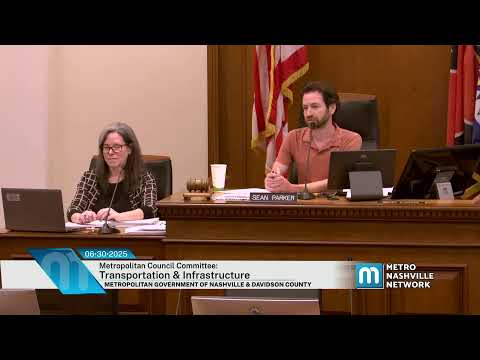
The Transportation & Infrastructure Committee on Thursday voted to defer for one meeting an ordinance (BL2025-897) that would amend sections of the Metropolitan Code governing residential infill, artificial turf, tree credits and stormwater-management requirements.
The Transportation & Infrastructure Committee on Thursday voted to defer for one meeting an ordinance (BL2025-897) that would amend sections of the Metropolitan Code governing residential infill, artificial turf, tree credits and stormwater-management requirements.
Lead sponsor Council member Druffel said the proposal "goes back three years" and is intended to respond to increased impervious surface from larger infill developments by improving a tree credit and adding stormwater requirements for multifamily structures. "We think this will help mitigate some of the water," Druffel said.
Council member Allen proposed an amendment to refine language on artificial turf and to clarify how the code defines "residential" (unit-count versus impervious square footage). Allen said the amendment was intended to ensure the code did not create an unintended gap where properties fall outside both the infill rule and the larger 10,000-square-foot disturbance threshold. "We are not finalizing any regulations with this. We are just asking the Metro stormwater folks to continue working on it," Allen said.
Steve Michoud of Metro Water Services told the committee that permitting practice typically allows either a licensed surveyor or a professional engineer (PE) to stamp smaller infill plans (Tier 1 and Tier 2), while larger projects require a PE. On the residential-definition threshold he said capping at four units would likely "cover 95% of all our permits," while six units would capture almost all cases and that using a square-footage standard was another option to consider.
Committee members raised several technical questions the sponsors and staff agreed required more time, including whether landscape architects should be allowed to stamp certain plans and whether the definition of residential should be unit-count or square-footage–based. The committee moved and approved a one-meeting deferral by a 9-0 vote to allow additional drafting and technical review.
What happened next: the ordinance will return at the committee's next meeting with revised language reflecting the technical clarifications requested by members and additional input from Metro Water Services and legal counsel.