Get Full Government Meeting Transcripts, Videos, & Alerts Forever!
Get email alerts on the Employee Discipline topic
No spam. Unsubscribe anytime.
Milwaukee commission finds cause in sanitation worker appeal, reduces discharge to 15-day suspension
Summary
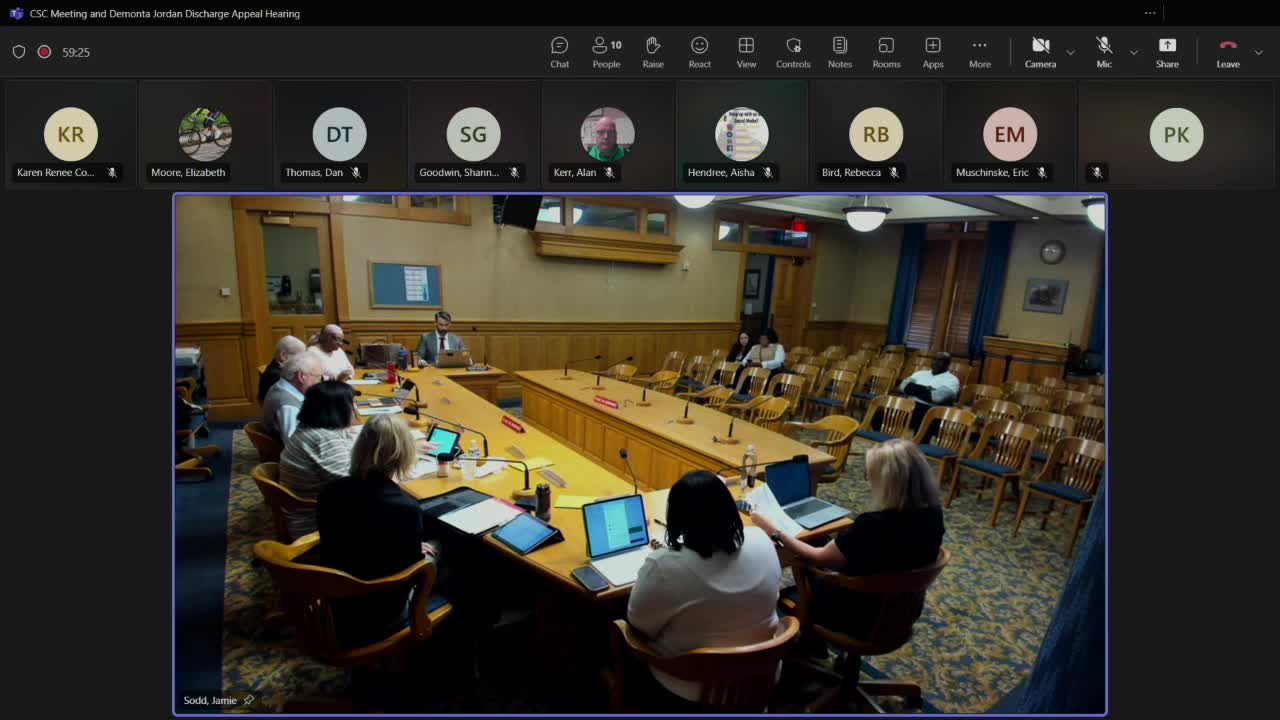
After a full evidentiary hearing into the Aug. 18 discharge of former Department of Public Works equipment operator Demontae Jordan, the Board of City Service Commissioners found the department had cause to discipline Jordan but voted to reduce the department’s discharge to a 15-day suspension.
The Board of City Service Commissioners on Nov. 4 found the Department of Public Works had cause to discipline former equipment operator Demontae Jordan, but the board voted to replace the department’s discharge with a 15-day suspension.
The commission heard multi-hour testimony and reviewed emails and other exhibits after the department appealed Jordan’s discharge for insubordination related to collection-route procedures. Department witnesses described repeated coaching sessions and directives in late July and early August 2025 that Jordan follow the route numbering and said he refused. Dan Thomas, administrative services director for DPW, testified that Jordan told managers “you’re gonna have to fire me because I’m not doing this,” and later declined a last-chance agreement and a 15-day suspension offered by the department.
Jordan and several co-workers told the commission that route practice on the South Area had long allowed on-the-ground adjustments and that parts of the route generate heavy wet refuse — described repeatedly in testimony as “garbage juice” — that leaks from trucks regardless of collection order. Jordan testified he was not notified, at the time he picked the route, that strict sequential collection was mandatory and said he believed he had completed required work each day.
Why it matters: The case pits DPW management’s claim of a clear, enforceable directive against an operator’s account that operational realities and past practice made strict numerical sequencing impractical. The commission’s ruling accepts the department had cause for discipline but concludes discharge was too severe in this case.
More details: The department presented testimony from South Area managers including district manager Natalie Smith and area manager Alan Kerr. Smith said supervisors coached Jordan on July 24 and again on July 28, and that an aldermanic office had passed along a constituent complaint about collection on the route; that chain of emails was admitted into evidence. Kerr explained that routes are numbered for safety, efficiency and to document progress during multi-crew operations or equipment breakdowns. Thomas described the predisciplinary/discharge meeting and said Jordan repeated the ultimatum and would not accept a last-chance agreement.
Jordan called four co-workers who described typical route conditions on parts of the South Area route, including frequent wet or heavy waste, and said crews routinely adapt collection order to conditions. Jordan told the commission he believed managers did not clearly place a written, preexisting requirement in front of him when he picked the route and that he had otherwise performed satisfactorily during multiple route cycles.
The commission first voted to find that, by a preponderance of the evidence, the department had cause to discipline Jordan. On a subsequent motion the commissioners voted to alter the discipline from discharge to a 15-day suspension. Commissioners present and recorded in the roll call for the votes were Commissioner Miller, Commissioner Smith, Commissioner Cleary and Commissioner Wicksboro; each voted in favor of the motions as announced in open session.
What happens next: The commission announced its decisions in open session immediately after closed-session deliberations. The suspension replaces the prior discharge. The commission did not announce further implementation steps or an effective date during the meeting; those details were not specified on the record.
Context and authorities: The department cited its DPW standard work rules and route-book materials governing conduct and route sequencing; Ms. Smith and Mr. Kerr testified that route books and standard operating procedures convey sequential collection expectations. Jordan disputed whether the sequencing expectation had been communicated to him at route selection or in training.