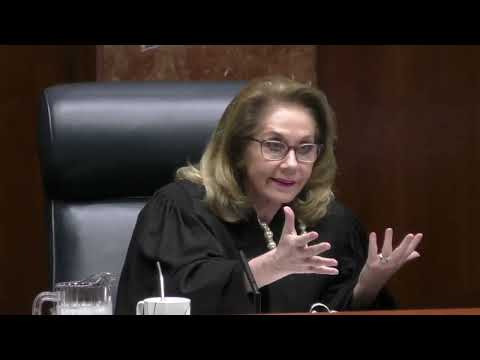
Texas Supreme Court presses counsel on lawyer-as-party ethics rule in oral argument session
Loading...
Summary
The Supreme Court of Texas heard three cases and focused sustained questioning on whether a disciplinary rule that limits communications with commission members applies when a lawyer represents themself.
The Supreme Court of Texas heard argument in three cases and spent substantial time probing whether a disciplinary rule bars communications with commission members when a lawyer is both a party and a representative.
Court Clerk opened the session and announced the court would hear three cases: No. 24063 (Ruth v. Division for Lawyer Discipline, from Gillespie County, fourth court of appeals), No. 240782 (Pusey v. South Texas ISD, thirteenth court of appeals), and No. 240864 (City of San Antonio v. Rayon Bank, Bexar County, fourth court of appeals). The court noted arguments were being live streamed and that counsel generally had 20 minutes.
Justices repeatedly questioned the premise that a lawyer who represents themself should be treated differently under the communications rule than a nonlawyer who represents themself. Justice 1 pressed whether, when a lawyer is a party and also functions as counsel, the lawyer should be considered an attorney for purposes of the rule and whether that status creates an unavoidable advantage. That line of questioning included concerns about fairness and whether the rule’s purpose — protecting represented parties and the integrity of proceedings — requires a special rule for lawyer-parties.
Bench discussion also flagged conflicting persuasive authorities. The court referenced prior guidance from a Texas professional ethics committee and noted that intermediate courts of appeals have reached differing conclusions about so-called hybrid representation in civil cases, with some courts finding a hybrid actor effectively acts in a representative capacity that puts opposing parties on notice.
The justices discussed practical consequences and remedies in disciplinary proceedings. The transcript records reference to an earlier proceeding that resulted in an 18-month active suspension and to subsequent filings by the disciplinary commission that added complaints after the initial case was resolved. The court questioned whether the existence of conflicting guidance outside the rule itself should affect whether misconduct proceedings are appropriate when the rule was not clearly established.
Throughout argument, the bench emphasized distinguishing the rule’s formal text from policy rationales (public protection and orderly process) and asked counsel whether those policy rationales justify treating a lawyer differently from nonlawyer professionals who appear before licensing or disciplinary bodies. The transcript shows a justice asking whether engineers or doctors who represent themselves would be similarly limited, highlighting the court’s concern about parity across professional regulation.
No decision or vote is recorded in the transcript excerpt provided. The arguments and questioning centered on statutory and disciplinary interpretation and on whether inconsistent guidance rendered sanctions inappropriate in some situations. The court’s line of inquiry indicates it is evaluating both the textual scope of the communications rule and the fairness of applying sanctions where persuasive authorities conflicted.
The court did not announce a ruling in the excerpted portion of the argument.