Get Full Government Meeting Transcripts, Videos, & Alerts Forever!
Get email alerts on the Land Use Tag Lakeside topic
No spam. Unsubscribe anytime.
Developer Withdraws High‑Density Tag Lakeside Proposals After Daylong Hearing; Residents, Conservation Groups Raised Flood, Traffic and Habitat Concerns
Summary
The applicant for a proposed 1,188‑unit Tag Lakeside development west of U.S. 17 withdrew its large‑scale comprehensive‑plan amendment and companion PD rezoning after a marathon Feb. 25 public hearing marked by intense resident opposition and persistent questions from commissioners over water, wastewater and habitat protection.
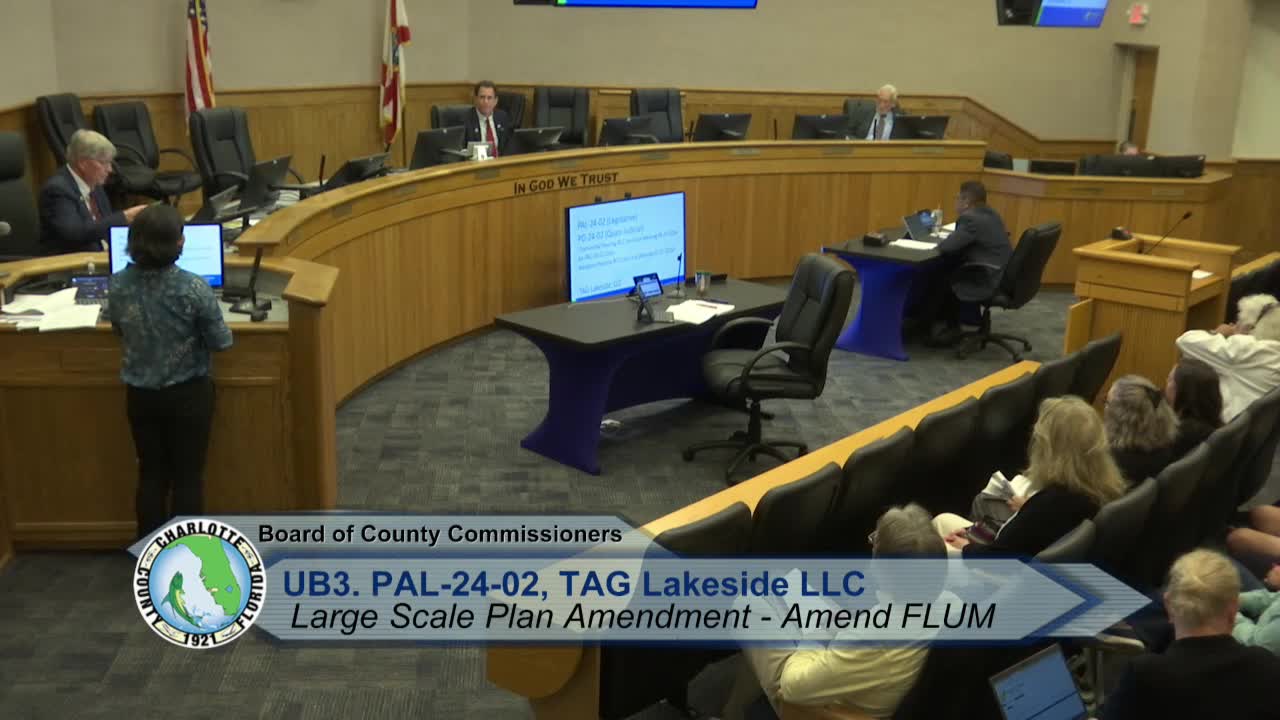
A proposed high‑density housing project west of U.S. 17 — the Tag Lakeside plan that would have converted about 139 acres to medium‑density residential and allowed up to 1,188 dwelling units — was withdrawn by the applicant after a lengthy public hearing at the Charlotte County Board of County Commissioners on Feb. 25.
The board convened a packed hearing and heard roughly three hours of staff and applicant presentation followed by more than three hours of public comment and technical reply. Residents, neighborhood groups, the Center for Biological Diversity and other speakers urged the board to reject or delay the land‑use change, saying the scale and timing were inappropriate. Key concerns were traffic and congestion on U.S. 17, storm surge and flood risk, the availability of central water and sewer, emergency response capacity, and impacts to listed and protected wildlife, including scrub‑jay habitat and gopher tortoise burrows.
Why it mattered: If approved, the amendment would have raised density on the parcel to about 8.5 units per acre overall but concentrated most buildings on the upland portion of the site. The applicant's general plan included nearly 50 percent of the site designated as habitat preservation, and the applicant's consultants presented storm‑surge and flood modeling that they said showed proposed building finished floors would sit above anticipated surge on the upland areas. Still, multiple county and state agencies and many residents said they needed firmer evidence of potable water and wastewater capacity before the county should grant an entitlement of this scale.
What the applicant told the board: Attorney Robert Bernsen and engineer Todd Reebel said the developer had prepared storm‑surge analysis and a habitat‑preservation plan and that state review under the coordinated review process had raised no formal objection to transmitting the amendment. The developer also said it had or was pursuing agreements that could provide wholesale potable water and long‑term wastewater options, and had proposed PD conditions that would prevent any multi‑phased development above a threshold until central utilities were available.
Public and expert testimony: More than 70 speakers addressed the petition. Concerns voiced to the board included:
- Traffic: multiple speakers said existing congestion on U.S. 17 and local intersections would be made worse by thousands of new daily vehicle trips. Several residents asked for a detailed operational traffic analysis including pass‑by capture and the cumulative effect of adjacent pending projects. - Utilities and concurrency: county officials and speakers said there was not yet a firm, lettered commitment showing available potable water and wastewater capacity to serve the full buildout proposed. Florida Department of Commerce and the water management district had noted the matter and requested clarity. Several commissioners said the lack of firm utility availability was a threshold issue for approval. - Flooding and storm surge: speakers described recent hurricane impacts and rising flood elevations in the Lee Branch/Hunter Creek system. The applicant's engineer presented modeled surge maps and explained expected finished‑floor elevation targets; residents and some commissioners said the modeling did not substitute for clear, conservative assurances about risk to future residents. - Wildlife and habitat: conservation groups and local residents cited Charlotte County's Habitat Conservation Plan (HCP) and state protected species. The county's HCP specialists told the board the PD conditions on the plan would require preservation, a management plan and conservation easements consistent with HCP rules; environmental advocates urged an even stronger on‑site preservation commitment and questioned whether mitigation and on‑site easements were adequate given the number of gopher tortoise burrows and scrub‑jay habitat.
Board response and outcome: Commissioners pressed the applicant for more robust evidence of utility availability and for a plan that better aligned density with the site's constraints. After several rounds of questions and more public comment, the applicant announced a voluntary withdrawal of both the large‑scale plan amendment and the companion PD rezoning. The withdrawals were recorded by staff.
What happens next: Because the applicant withdrew the petitions rather than receiving a denial or approval, the developer may refile in the future. Refiling would restart the review and notification process and the county would require new submittals and agency reviews. Commissioners and multiple public commentators urged the developer to conduct community outreach and to assemble firmer utility and habitat proposals before returning to the board.
Who spoke: The public record for the hearing includes technical testimony from engineer Todd Reebel, legal argument and presentations by attorney Robert Bernsen for Tag Lakeside, conservation testimony and legal comment from the Center for Biological Diversity, and more than 70 resident statements. Many residents requested stronger protections for creek and scrub habitat and asked the board to require firm utility commitments before approving a change of this scale.
Why residents opposed: Recurrent reasons given were (1) inadequate demonstration that central potable water and sewer capacity will be available for the proposal; (2) potential traffic and public‑safety impacts on U.S. 17 and local roads; (3) flood and storm‑surge risk to dense, multistory buildings sited near creeks and wetlands; and (4) habitat loss for listed and locally protected species.
Board note: Commissioners signaled openness to future, reduced or refocused proposals if the applicant returns with demonstrable utility commitments, an adjusted development program that responds to the neighborhood and habitat constraints, and better community outreach. For now, the petitions are withdrawn by the applicant and no entitlements were granted.