Get Full Government Meeting Transcripts, Videos, & Alerts Forever!
Get email alerts on the Electrification Policy topic
No spam. Unsubscribe anytime.
City staff present electrification options; attorney flags federal preemption risk from EPCA ruling
Summary
City staff presented electrification policy options and the city attorney warned that a Ninth Circuit decision interpreting the Energy Policy and Conservation Act (EPCA) creates legal uncertainty for local bans on natural‑gas infrastructure.
City staff and consultants briefed the advisory board on Jan. 9 about policy and program options to encourage electrification of buildings as part of Council climate goals. The Environment & Climate Committee had recommended that Council consider regulatory measures for new construction alongside incentive and education programs for existing buildings; staff asked the Board for input and identified legal uncertainty as a primary constraint.
"The city has goals that were adopted in 2016 to reduce greenhouse gas emissions by 40% by February 30 and 70 percent by 02/1950," Cassie Lacy, senior management analyst for the City Manager's Office and lead for climate and sustainability, said in the staff overview (transcript text as stated by the presenter).
Attorney overview and legal risk
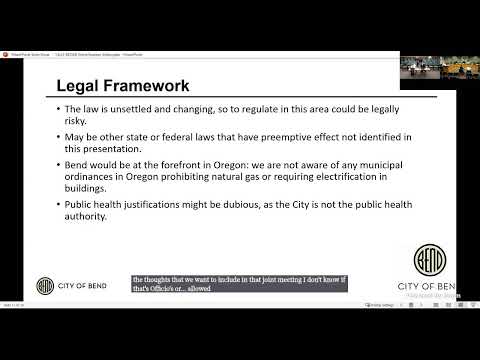
City Attorney Michael Seltzer summarized federal and state legal constraints and emphasized caution: courts and statutory text are changing quickly. He flagged the Ninth Circuit decision reviewing Berkeley's ordinance, and the Energy Policy and Conservation Act (EPCA) as central to the legal question. "The ninth circuit said that that halt that ordinance ... was preempted by EPCA and therefore was not lawful," he told the board, describing why some local prohibitions on natural‑gas piping or appliance choices have faced successful legal challenges.
Because the federal statute (EPCA) establishes appliance efficiency and related standards, local bans that have the same legal effect can be vulnerable to preemption claims, the attorney said; that creates uncertainty about steps a home rule city may lawfully take to ban fossil‑fuel infrastructure in new buildings. For that reason the attorney's office recommended a cautious approach and suggested a combination of (a) state advocacy for statewide code changes, (b) education and incentive programs, and (c) carefully targeted regulatory measures only after legal risk is assessed.
Policy options discussed
Staff presented a wide menu of possible actions grouped into: state advocacy (push for state building‑code or legislative authority), education and navigator programs, financial and nonfinancial incentives (permit prioritization, development bonuses, direct subsidies), local regulations (right‑of‑way restrictions on gas expansion; NOx appliance emissions limits; building energy performance standards), fees (permit surcharges tied to gas use), and a local building‑code amendment. For each option staff summarized likely administrative burden, potential greenhouse‑gas impact and legal risk.
Committee recommendation and next steps
The Environment & Climate Committee recommended that Council pursue a multi‑part approach that pairs strong incentives and outreach for existing buildings with a regulatory pathway for new construction—most commonly explored via right‑of‑way limitations on new gas service or appliance NOx standards—and that the city coordinate with the regional utilities and the public on transition steps. Council directed staff to solicit advisory‑body input; BDAB was invited to participate in a joint February meeting with ECC and AHAC to provide consolidated advisory input for Council.
Board reaction
Board members largely supported strong education and navigator programs while expressing concern about the legal and housing‑cost consequences of rapid regulatory steps. Several members said the city should prioritize measures that are least likely to increase housing costs or produce legal delays. City staff committed to return with a clear agenda and recommended representatives for a February joint meeting of ECC, BDAB and AHAC.
Ending
Staff will present a narrower set of high‑priority options for deeper analysis in Phase 2, with additional stakeholder outreach and legal review; BDAB members volunteered representatives to attend the planned February joint advisory meeting.