Get Full Government Meeting Transcripts, Videos, & Alerts Forever!
Get email alerts on the Committee Votes topic
No spam. Unsubscribe anytime.
Environment and Transportation Committee advances slate of bills on housing, safety and environment
Summary
The House Environment and Transportation Committee voted to advance a package of technical and policy bills in a short voting session, approving measures on tenant purchase paperwork, association privacy protections, condominium insurance deductibles, judicial ethics administration, seafood industry loans, boat‑dealer definitions, speed limits, sidewalk bicycle access and septic‑account funding priorities.
The House Environment and Transportation Committee voted to advance a package of bills in a short voting session that preceded bill hearings. Committee members approved measures addressing tenant purchase paperwork, privacy protections for common‑ownership communities, condominium insurance deductible responsibilities, judicial‑ethics administration, seafood industry loan rules, boat dealer definitions, speed limit authority, sidewalk bicycle access, and Bay Restoration Fund septic‑account priorities.
The measures were largely technical or narrowly targeted policy changes. Several bills passed with committee amendments that clarified scope or added specific protections, and a small number of members were recorded in opposition to one measure.
House Bill 872 (tenant right of first refusal). Sponsor summarized the bill as a technical correction that substitutes one term in the existing law related to a tenant’s right of first refusal to purchase a residential rental property. The committee had no committee amendments or fiscal note and moved the bill; members voiced “aye” and the measure passed in committee.
House Bill 755 (common‑ownership community access; sensitive information). The committee adopted a committee amendment that explicitly adds "medical records" to a list of sensitive information that condominium associations, cooperatives or homeowners associations cannot require from an owner, occupant, guest or child as a condition of access to recreational common areas such as a reading lounge, playground or swimming pool. The amendment was moved and seconded, explained on the record, and passed; the bill as amended passed.
House Bill 449 (condominium property insurance deductible). The bill raises the maximum unit owner responsibility for a council of unit owners’ property insurance deductible from $10,000 to $25,000 when damage originates in the owner’s unit. The committee accepted an amendment from the Realtors’ association to require existing notice language about the insurance requirement in contracts of sale; the amendment and the bill as amended passed. The chair noted that HOA United had proposed a more involved allocation process, which the committee did not adopt.
House Bill 166 (administration of judicial‑branch candidate ethics provisions). Presented as a departmental, technical bill, HB 166 directs that the body designated by the Maryland Supreme Court administer and implement conflict‑of‑interest and financial‑disclosure provisions for judicial‑branch candidates. There were no amendments; the committee moved and passed the bill.
House Bill 397 (Maryland oyster shucking house loan fund). The bill increases the maximum loan amount per projected seasonal full‑time job from $10,000 to $25,000 and shortens the experience requirement for licensed seafood dealers from five years to three years for program eligibility. Other program requirements were left unchanged. The committee passed the bill.
House Bill 425 (State Boat Act; auctioneer exclusion). The committee approved an amendment and passed a bill that excludes a licensed auctioneer from the definition of “dealer” under the State Boat Act when (1) the auctioneer acts on behalf of a seller, secured party or owner; (2) title does not pass to the auctioneer; and (3) the auction is not intended to avoid the State Boat Act provisions.
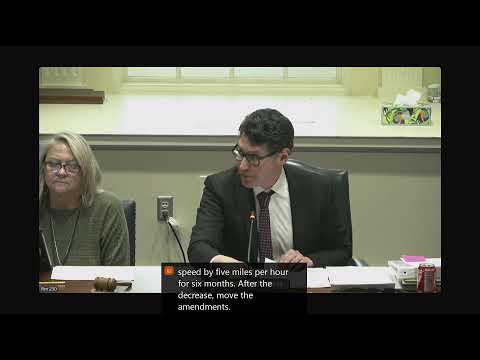
House Bill 780 (speed limits; State Highway Administration). As amended, HB 780 authorizes the Maryland State Highway Administration (SHA) to reduce the maximum speed limit on certain urban highways by up to 5 miles per hour without conducting a full engineering and traffic study. The committee added amendments requiring SHA to provide public notice on its website and in a local newspaper and prohibiting use of automated speed monitoring on a road reduced in speed under this provision for six months after the change. The amendments passed. The bill passed with recorded oppositions from Delegates Jacobs and Otto.
House Bill 375 (sidewalk bicycle access; “Jay’s Law”). The committee adopted an amendment and passed HB 375, which authorizes a person to ride a bicycle, tricycle or unicycle on a sidewalk or sidewalk area unless a local ordinance specifically prohibits that use; the amendment in committee designates the measure “Jay’s Law.” Several delegates were added as co‑sponsors.
House Bill 131 (Bay Restoration Fund; septics account). The committee passed HB 131 with amendments that modify prioritization and eligibility for projects funded from the Bay Restoration Fund septics account. The amendments removed proposed performance‑based funding levels for certain BAT septic systems, altered grant prioritization language and struck language that would have modified certain state procurement provisions.
Procedure and next steps. The chair recorded four bills withdrawn by request, then recessed the committee for a three‑minute break to reset the electronic voting system before beginning bill hearings.
Votes recorded in the transcript relate to committee passage and amendment approval; where individual votes were named during the roll call, those names were recorded in the committee transcript. The committee chair opened the session and presided over the voting sequence.